Pakistan’s Quiet Rebuild: Why India Should Pay Attention
Pakistan is often viewed through the lens of crisis. Economic strain, political instability, and institutional friction. That picture is not wrong, but it is incomplete. Beneath the noise, Islamabad is attempting a quieter course correction. Not dramatic, not transformative, but deliberate enough to matter.
What is taking shape is not leadership of the Islamic world in any formal sense. That space is too contested, too fractured. But Pakistan is trying to position itself as something else: a state that cannot be ignored in a region in flux.
Its nuclear capability remains central to this effort. Not because it changes the military balance overnight, but because it shapes perception. In parts of the Muslim world, that still carries weight. The phrase “Islamic bomb” may have faded from official vocabulary, yet the idea lingers. It gives Pakistan a certain standing, particularly in moments of tension, when symbolism tends to travel faster than facts.
Then there is Saudi Arabia. The relationship has always been more practical than ideological. Financial support in difficult times, security cooperation when required, and a broad political understanding that has held through ups and downs. For Pakistan, this is less about prestige and more about breathing room. It allows Islamabad to stay active externally even when things at home are far from stable.
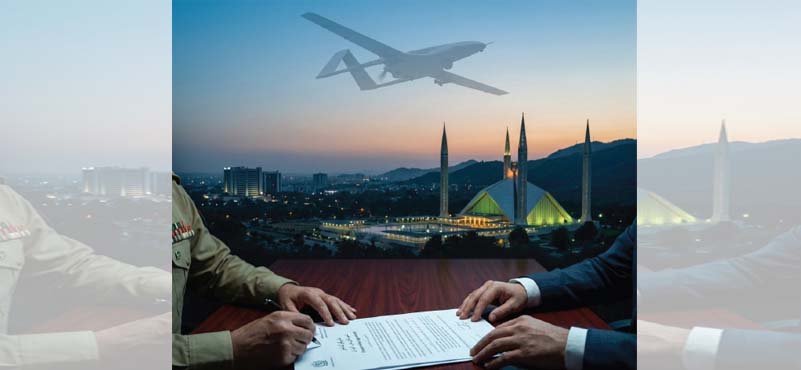
Turkey’s role is different, and perhaps more telling. The growing defence partnership is not about optics. It is about capability, slowly built. Drones, naval systems, and technical collaboration. None of this will dramatically alter the balance in the short run, but it adds up. Over time, it feeds into a more self-assured military posture, one that Pakistan is keen to showcase beyond South Asia.
The recent warming with the United States, limited as it may be, also matters. Washington does not deal in sentiment when it comes to Pakistan. Engagement returns when it serves a purpose. Even so, the optics of renewed contact help Islamabad reinsert itself into conversations where it had been peripheral. In a region unsettled by tensions involving Iran and the Gulf, that relevance has value.
Put together, these strands do not amount to a strategic breakthrough. Pakistan is not about to reshape the Islamic world. Its internal constraints are too serious for that. But this is not about dominance. It is about presence. About ensuring that when regional questions are discussed, Pakistan is somewhere in the frame.
That is where India needs to look more carefully. For years, the assumption has been that Pakistan’s internal weaknesses will limit its external reach. Broadly true, but not entirely. States do not need to be strong across the board to be effective in specific arenas. Sometimes, selective partnerships and careful signalling are enough to create leverage.
If Pakistan manages to hold together even a modest network of Saudi financial backing, Turkish defence cooperation, and functional ties with Washington, it gains room to manoeuvre, not against India in a direct sense, but in the wider narrative space. That is where perceptions begin to shift, often quietly.
None of this calls for alarmism. Pakistan’s structural problems are real and persistent. But it does suggest that complacency would be misplaced. The contest is no longer confined to borders or even to traditional diplomacy. It is playing out across regions where influence is fluid, and alignments are rarely fixed.
India’s response, therefore, cannot be narrowly framed. Military deterrence will remain the baseline, but it is not sufficient on its own. The larger requirement is sustained engagement across West Asia, deeper economic linkages, and a narrative that travels as effectively as Pakistan’s is beginning to.
Pakistan is not rising in the conventional sense. It is adjusting, recalibrating, finding spaces where it can still matter. That makes it less predictable, and in some ways, more relevant than a state in visible decline.
India’s Silent Siege: Demographic Erosion and the Battle for Identity
For India, demographic change is not a uniform national phenomenon. It is regionally concentrated, politically sensitive and strategically significant in select border states. The issue is not religion in itself, but how uneven population growth, migration, weak border systems and political hesitation combine in certain regions.
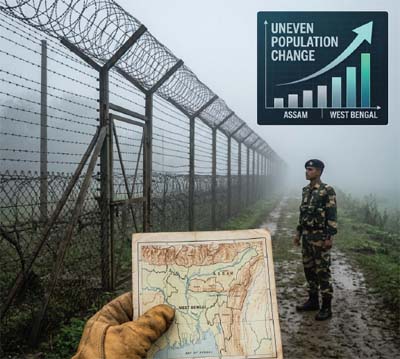 In border regions, these pressures begin locally but can gradually influence adjoining areas, often faster than institutions can respond. These forces can alter the demographic balance faster than a nation can adapt. The demographic change in the Muslim population of India between 2001 and 2011 was uneven across states, with some reporting significant increases in share and growth rates. The highest percentage increase in proportion was in Assam, where the Muslim proportion rose from 30.9 per cent in 2001 to 34.2 per cent in 2011. West Bengal saw its Muslim population share increase by 1.8 percentage points to reach 27 per cent in the same decade. Similar, though smaller, shifts are visible in states such as Uttarakhand, Kerala, Jammu and Kashmir, Maharashtra and Rajasthan.
Pew Research Centre estimates suggest India’s Muslim population could approach 18 per cent by mid-century, though the more relevant concern is the uneven pace of change across regions. Border districts with existing migration networks are more susceptible to acceleration.
The strategic question is not about a community’s size. It is about the pace of change in vulnerable geographies.
India confronts simultaneous external challenges from Pakistan and China. Border states cannot become arenas of internal demographic contestation while facing external pressure. If local political arithmetic begins to shape national security decisions, strategic coherence weakens.
In Assam, migration intersects with ethnic politics and resource scarcity. In West Bengal, debates over fencing and documentation are entangled with electoral competition. When administrative measures become partisan symbols, implementation slows.
The issue, therefore, is not reducible to identity. It arises from the convergence of demographic trends, migration patterns, environmental change and uneven development. When these factors coincide in the same geography, their cumulative effect becomes strategically significant.
- This is where policy clarity becomes critical. A credible policy response must be balanced and practical.
- Border management needs stronger technological support, as physical barriers alone cannot close gaps.
- Citizenship processes should be clear, legally sound and based on reliable identification to reduce ambiguity while safeguarding due process. Engagement with neighbouring countries, such as Bangladesh and Myanmar, remains essential for managing migration in a coordinated manner.
- At the same time, districts under demographic pressure require stronger investment in education, employment and access to credit.
- Preventing radicalisation will depend not only on intelligence but also on sustained cooperation with local communities and civil society institutions.
- The proposed Demography Mission could offer a coherent response if designed with sufficient breadth. Its mandate should extend beyond immigration to include regional inequality, migration governance, ageing trends, and human capability development.
- Strengthening data systems, particularly in the absence of updated census data, is equally important.
India’s challenge is not one of demographic instability, but of managing uneven transitions. That distinction is critical. It requires vigilance without prejudice and firmness without fear.
Demography does not determine destiny. Governance does. If local political calculations begin to influence national security decisions, strategic coherence weakens.
Termites Within: Purging Subversion in Institutes
The recent subversion of institutions has exposed a grave threat lurking within India’s institutions: the Al-Falah University scandal linked to the 2025 Delhi Red Fort blast and the TCS Nashik “corporate jihad” controversy. At Al-Falah in Faridabad, investigators uncovered Jaish-e-Mohammed terror cells operating from campus rooms, with faculty members such as Dr Muzammil Shakeel coordinating the car bomb that killed 15 near the historic fort. Raids uncovered 2,900 kg of explosives, hawala trails to Lahore, and 10 missing suspects, prompting Haryana’s government takeover and the appointment of an IAS administrator. Meanwhile, TCS’s Nashik BPO unit faced allegations against six Muslim team leaders, including Asif Ansari and Shafi Sheikh, for grooming vulnerable Hindu women employees through harassment, financial coercion, and forced conversions since 2021. HR manager Nida Khan, now absconding, allegedly profiled recruits in distress; undercover police operations led to nine FIRs and seven arrests.
 These incidents reveal a disturbing pattern of institutionalised subversion. Radical networks have long burrowed into academia and corporate spaces, from the 2008 Batla House module in Delhi hostels to NIA busts of “halal” funding in southern colleges. Al-Falah’s unaccredited status masked ISI infiltration, while TCS’s diversity policies ignored prayer coercion, beef mandates, and overseas remittances.
The TCS Nashik case is not an isolated incident; it signals a more serious, organised threat that exploits vulnerable individuals within corporate spaces. Allegations of external links and ideological motives raise serious concerns. If such patterns persist, they demand urgent, decisive action and a far more vigilant, accountable response from authorities.
NCRB data shows a 40 per cent surge in tech-campus-linked “honour” crimes since 2023. Pakistan’s DG ISPR boasts of “sleeper victories” as China exploits these fissures amid LAC standoffs. Normalisation through “woke” DEI frameworks stifles scrutiny, branding probes as bigotry.
Waqf boards defend such outfits as charity; Tata Group’s privacy pleas delay audits. Meritocracy erodes, security frays, and the social fabric tears, inviting a death by a thousand cuts before open conflict.
The cost is existential. Subversion normalises jihadist footholds, diverting talent from innovation to ideology. It weakens two-front deterrence, emboldens adversaries, and fractures the cohesion of the Hindu majority, which is vital to Amritkaal’s goals. Political timidity, driven by fear of vote-bank backlash, lets termites feast unchecked.
Surakshit India demands a comprehensive mitigation blueprint.
- First, enact the National Subversion Monitoring Act (NSMA), requiring the NIA to vet annually all universities, hospitals, and firms with over 5,000 employees. AI-driven tools must scan hawala, foreign remittances, and demographic clustering, and auto-trigger shutdowns for red flags such as 20 per cent unexplained staff turnover or unverified overseas ties.
- Second, overhaul Waqf laws via a Bharat Endowments Act, placing all religious trusts under CAG oversight akin to public funds; no more opaque billions funding radical hubs.
- Third, mandate Corporate Integrity Protocols: loyalty oaths for executives, mandatory whistleblower bounties ($10,000 minimum), and quarterly audits revealing faith-based hiring patterns. Non-compliant giants like TCS face a 5 per cent turnover tax until they are cleansed.
- Fourth, a nation cannot rise on foundations threatened by radical violence and internal turmoil. The security of society rests on a National Citizens’ Security Culture and a National Integrated Security Grid to ensure social harmony, deradicalisation, and the closure of existing vulnerability gaps. Citizens must be the first responders to such threats.
- Fifth, infuse “Bharat Pledge” curricula across professional institutes, prioritising constitutional loyalty, cybersecurity basics, and case studies on subversion over rote multiculturalism. Pilot in ITIs and IITs, scaling nationwide by 2027.
- Sixth, establish a Surakshit Task Force under NSA Ajit Doval, fusing IB, CBI, and ED for proactive strikes. Annual “cleanse indices” will rank states, and federal grants will be tied to performance.
- Seventh, delink national security from petty politics and create an empowered Task Force under NIA for addressing radicalisation, demographic inversion, and subversion.
These measures strike surgically, preserving openness while purging threats. They weaponise data, community, and law without hysteria. India cannot afford complacency. Al-Falah and TCS are wake-up calls. Forge Surakshit Bharat now, or watch institutions crumble. The choice is stark: vigilance or vulnerability.
China’s Patient Shadow: Taiwan in Beijing’s Game Plan
In debates over the Taiwan Strait, urgency often eclipses accuracy. Policy circles in the West fixate on speculative deadlines, treating conflict as imminent and inevitable. Yet Beijing’s recent outreach to Taiwan’s opposition leadership suggests a different tempo. The Chinese approach is not defined by haste or opportunism but by a deliberate, long-term strategy that prioritises endurance over escalation.
 The messaging from Beijing has been consistent. Engagements with Taiwan’s Kuomintang figures emphasise cultural affinity, historical continuity, and gradual reconciliation. Official rhetoric leans on themes of shared identity and peaceful development, portraying reunification as a process rather than an event. Military exercises, though frequent and increasingly sophisticated, are framed as deterrents rather than immediate precursors to invasion. The underlying signal is calibrated: force remains available, but not preferred.
This posture reflects a deeper strategic conviction. Chinese leadership appears to believe that, in structural terms, time favours its position. Economic asymmetry continues to widen, with mainland growth and industrial capacity exerting a steady pull on Taiwan’s business ecosystem. Trade, investment, and supply chain linkages have created dense interdependencies that complicate any clean political separation. Even as political identities in Taiwan evolve, economic realities continue to bind the two sides in ways that are difficult to unwind.
Demography also factors into this long view, though not in a simplistic way. Younger Taiwanese voters increasingly identify with a distinct political identity, yet they are also integrated into regional economic networks shaped by China’s scale. Beijing’s strategy does not rely solely on ideological conversion. It leverages incentives, access, and opportunity to create conditions in which resistance becomes costly and accommodation more pragmatic.
On the military front, restraint goes hand in hand with preparation. Rather than prioritising a high-risk amphibious invasion, China has invested heavily in capabilities that complicate external intervention. Anti-access systems, missile forces, and naval expansion aim to raise the costs for any outside power contemplating involvement. This approach allows Beijing to shape the strategic environment without triggering the immediate consequences of open conflict. Economic tools complement this posture, with selective trade pressures and diplomatic isolation used to signal consequences without crossing thresholds that would provoke unified retaliation.
However, this strategy is not without vulnerabilities. Taiwan’s internal politics remain dynamic, and external support continues to strengthen its defensive posture. Moves towards formal independence, even incremental ones, could compress Beijing’s timeline and force a recalibration. Patience, while advantageous, is not infinite.
For India, the implications are significant yet often underappreciated. A prolonged, low-intensity contest in the Taiwan Strait reinforces a broader pattern of Chinese strategic behaviour: incrementalism backed by credible force. This has direct relevance along the Line of Actual Control, where similar tactics of pressure without full-scale escalation have been observed. India must prepare for a competitive environment defined less by decisive conflict and more by sustained, multidimensional contestation.
Economically, India faces both risk and opportunity. Any disruption to Taiwan’s semiconductor ecosystem would reverberate globally, affecting India’s manufacturing ambitions. At the same time, companies seeking to diversify away from concentrated supply chains may view India as an alternative. Strategic positioning in this context requires not only building domestic capabilities but also calibrated engagement with partners across the Indo-Pacific.
Diplomatically, India’s approach will likely remain measured. Open alignment on the Taiwan question carries risks, given India’s sensitivities with China. Yet silence is not a strategy. Quiet coordination with like-minded partners, investment in maritime security, and a consistent emphasis on stability and rules-based conduct can help shape outcomes without overt confrontation.
The central insight is clear. China is not rushing towards a resolution in the Taiwan Strait. It is shaping conditions over time, betting that persistence will yield results that force cannot secure quickly. For observers and stakeholders alike, the challenge is to adapt to this slower, more complex reality.
Nari Shakti: Decoupling Gender from Geography
The pledge to reserve a third of all seats in India’s legislative bodies for women has long been hailed as the most consequential step towards gender equity. However, as the dust settles after the latest political manoeuvres, it is increasingly evident that the road to empowerment is strewn with procedural landmines. The shifting of the goalposts by linking the Women’s Reservation Bill to the two anchors, namely a new census and a new delimitation exercise, has effectively put the process on hold.
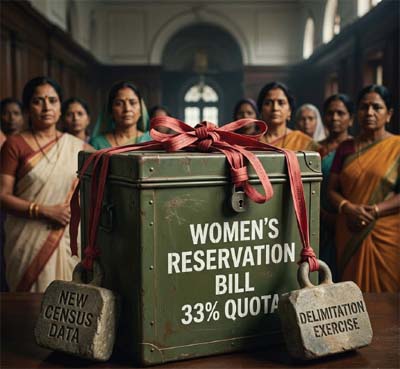 In practice, this approach allows the government to sidestep the quota without appearing to do so. The government’s messaging focuses on a historical move by Nari Shakti, but the fine print tells a different story. The association of gender representation with the redrawing of electoral maps is not mandatory; it is a political judgement. By linking the quota to the 2011 Census data and the controversial delimitation process, the first of the reserved seats will not be contested until at least 2029, and probably much later.
The reasoning is mathematical: it is impossible to book seats without knowing how many are available. Nevertheless, this argument overlooks the urgency of the crisis. India continues to rank low globally in women’s legislative representation. If the aim is to close the gender gap, the quota must be implemented immediately across the existing 543 Lok Sabha seats. Instead, the reservation has been turned into a carrot held over a population that has already waited decades to see this reform through.
More troubling is how it ties gender justice to regional anxieties. Southern states, which have successfully implemented population control measures, now fear that a delimitation-linked quota may act as a Trojan horse. They worry that while women gain seats on paper, their states will lose collective bargaining power to the more populous northern belt. By merging these two explosive issues, the Women’s Reservation Bill remains trapped in a cycle of litigation and federal friction.
Is it a masterstroke of political optics or a genuine logistical hurdle? The answer lies in the lack of a “sunset clause” for the delay. If the government can pass a bill in a special session with such fanfare, it surely possesses the legislative muscle to decouple gender from geography.
To truly empower women, the quota must be an unconditional right, not a conditional reward. As it stands, the policy remains a “post-dated cheque on a crashing bank.” Until the reservation is implemented in the next immediate election, the claim of progress remains just a claim. India’s women do not need more promises of a distant future; they need a seat at the table today, without the fine print of a census or the shadow of a map.
The Quiet Side of Power: China and the U.S.–Iran Conflict
The Iran conflict is often viewed through a narrow lens, overlooking the players behind the scenes. It is no longer just about Iran. The US and Israel face off. Other powers are playing an invisible role, influencing outcomes without taking centre stage. One of them is China.
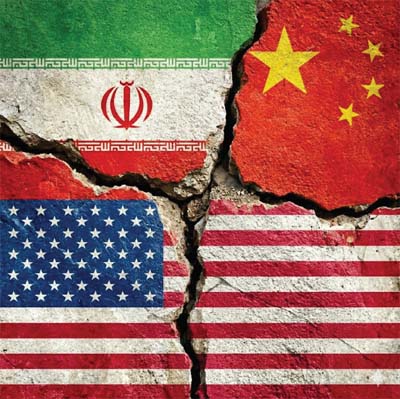 Beijing has stayed away from open military action—no troops, no direct threats, nothing dramatic. On the surface, it looks detached. But that distance is a bit misleading. Its influence shows up in decisions that don’t make headlines, especially in trade and long-term planning.
A simple example shows it clearly. China continues to buy Iranian oil despite sanctions. That choice alone changes the situation more than most official statements. Sanctions are meant to isolate, but they lose weight when a major economy keeps the door open. For Iran, this means steady income at a time when options are limited. For China, it means reliable access to energy. Simple, practical, and hard to replace.
There is no deep ideological bond holding this together. It is not about shared values. It is about need. China gets stability in supply. Iran gets breathing space. Relationships like this tend to last because they are built on something basic. Politics can shift. Necessity usually does not.
At the same time, China benefits less directly. The United States remains tied up in Middle Eastern tensions, and that takes focus. Managing Iran is not quick or easy. It demands attention, resources, and constant adjustment. That naturally pulls energy away from other regions. China does not need to interfere to gain from that. It just has to watch it unfold.
Still, there is an uncomfortable contrast. China often presents itself as a supporter of dialogue and restraint. It speaks against escalation. Yet its economic ties with Iran help sustain the current situation. Not by causing it, but by making sure it does not fade quickly. That difference between what is said and what is done is hard to miss.
That said, this position is not risk-free. The deeper China’s ties with Iran become, the harder it is to stay on the sidelines. If tensions rise further and supply routes are affected, China will feel it. Distance can shrink quickly in that kind of situation.
There is also the question of trust. China has shown interest in acting as a global mediator, especially among countries that are wary of Western influence. But mediation depends on credibility. If actions suggest one thing while official statements suggest another, people notice. Over time, that gap can matter.
From the U.S. side, this adds another layer to the problem. Iran is not operating alone. Its position is supported, at least in part, by external relationships. China’s role is a reminder that modern conflicts are rarely isolated. They sit inside a larger web of interests.
What is more concerning is how normal this kind of indirect involvement is becoming. Countries are learning that they can influence outcomes without crossing into open conflict. Trade continues. support continues. Responsibility stays unclear. That combination can keep tensions alive for longer than expected.
For India, China’s indirect approach matters more than the conflict itself. Beijing’s use of economic ties as quiet leverage shows how influence can grow without open confrontation. That raises concerns for India, especially in its neighbourhood, where similar methods could be used to expand influence without triggering direct resistance or conflict.
The message is that power does not always show itself directly. Sometimes it works in the background, shaping the situation, while others take centre stage.
ABOUT THE AUTHOR
 Lieutenant General A B Shivane, is the former Strike Corps Commander and Director General of Mechanised Forces. As a scholar warrior, he has authored over 200 publications on national security and matters defence, besides four books and is an internationally renowned keynote speaker. The General was a Consultant to the Ministry of Defence (Ordnance Factory Board) post-superannuation. He was the Distinguished Fellow and held COAS Chair of Excellence at the Centre for Land Warfare Studies 2021 2022. He is also the Senior Advisor Board Member to several organisations and Think Tanks.