A Statue in London’s Waterloo Place
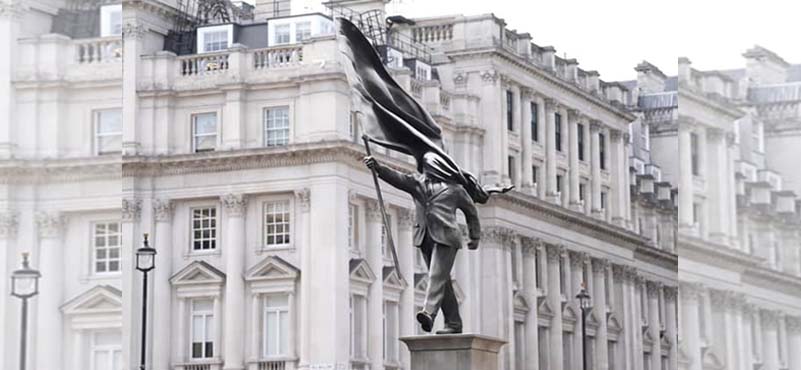
A large statue mysteriously appeared in the middle of the night of 29th April in central London. The artwork depicted a suited man, blinded by the wind-blown flag he was carrying and walking unknowingly off the ledge of a tall pedestal.
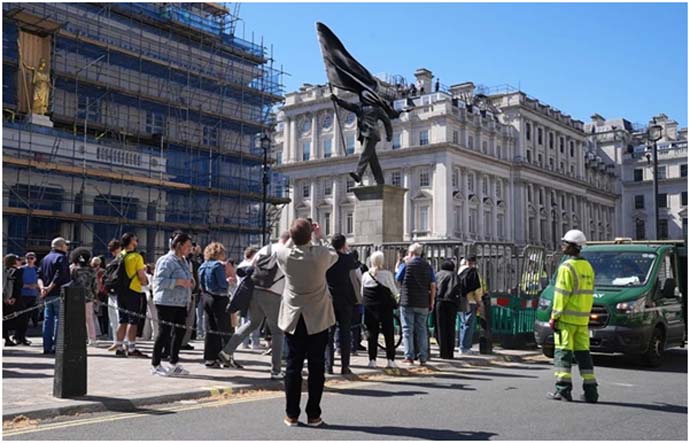
The seemingly satirical monument, which bore Banksy’s signature on its plinth, has been drawing crowds to London’s Waterloo Place since it appeared in the early hours of 29th April. The colouration of the statue and its plinth reflect the bronze and granite monuments nearby on the plaza-like road, including the Duke of York Column, the Guards Crimean War memorial, and statues of Florence Nightingale.
By 30th April, authorities in London had erected barriers around the statue. Westminster City Council, which oversees the area, stated to the BBC: “We’re excited to see Banksy’s latest sculpture in Westminster, making a striking addition to the city’s vibrant public art scene. We have taken initial steps to protect the statue; this time it will remain accessible for the public to view and enjoy.”
Telling Commentary on Blind Patriotism
The statue is an apparent commentary on the idea of blind patriotism. As someone on Instagram commented it is a “compelling statement on collective blindness – forward motion without vision, without preparation.”
“Really powerful,” the user added. “The flag carries no identity – no country, no allegiance – just a form, making the figure universal… and somehow still unmistakably directed.”
The statue, which Banksy claimed credit for on Thursday, is an apparent commentary on the notion of blind patriotism that is afflicting the world today and is visible in the ongoing conflicts.
Who Is Banksy
Banksy whose real name has never been officially confirmed, has become famous across the world for politically-charged murals. He keeps his identity a closely guarded secret and uses Instagram to confirm murals and sculptures are his work.
Reuters claimed that it had revealed Bansky’s identity following an investigation. Banksy, according to Reuters, is a bespectacled middle-aged man from Bristol named Robin Gunningham, though the artist did not confirm or deny his identity.
The apparent unmasking of Banksy, who has gone to great lengths to preserve his anonymity since his work began appearing around the UK in the 1990s, sparked controversy, with fans and collectors questioning how the revelation might affect the value and resonance of his work.
Banksy’s lawyer, Mark Stephens, told Reuters that the artist “does not accept that many of the details contained within your inquiry are correct” and said Banksy’s anonymity was critical as he had been “subjected to fixated, threatening and extremist behaviour”.
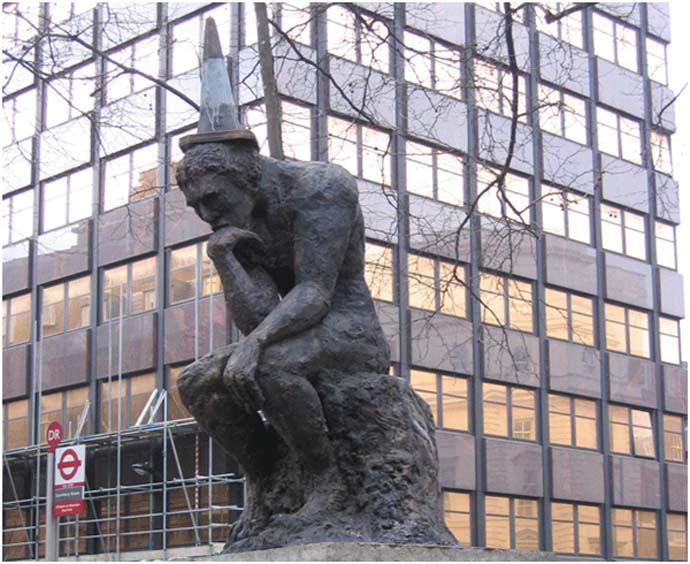
Banksy is best known for using stencils and spray paint to depict his political, satirical messages, though he has produced several statues and sculptures in his three-decade career. In 2004, he took credit for a sculpture depicting a pensive nude bronze figure wearing a traffic cone as a hat called “The Drinker” – a play on Auguste Rodin’s “The Thinker” – that appeared in London’s West End.
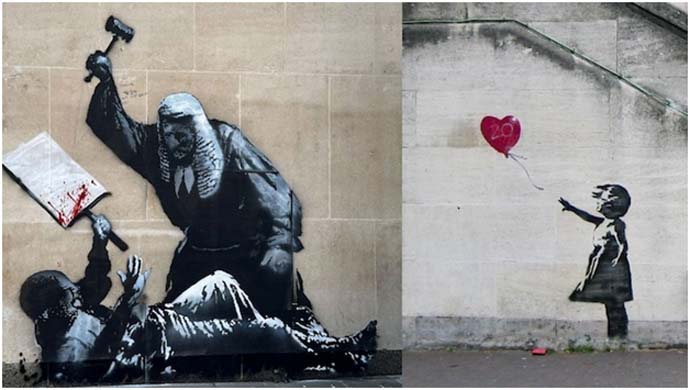
In September 2025, Banksy made headlines with a mural depicting a protester lying on the ground, holding a blood-spattered placard, while a judge, in a wig and gown, looms over him, wielding a gavel.
The painting appeared on an external wall in the Royal Courts of Justice complex, however it was swiftly covered up and guarded by security staff, before it was removed.
The art was interpreted by some as a comment on the arrest of hundreds of people for supporting Palestine Action by holding up placards at protests.
Most of Banksy’s works provide critical commentary on social, political, and cultural issues. Through his art, he addresses topics such as war, capitalism, freedom and identity. His ability to convey profound messages in a simple and often humorous way resonates with many people across the globe.
Conclusion
The suited figure which is indicative of a Western politician whose sight is obscured by the flag, has one foot poised over the edge of the plinth, indicating he is just about to step off. The work depicts “blind patriotism”, and now stands at the heart of London.
Sculpture has the ability to reduce universal, complex ideas into an image that can, at first glance, be understood in a matter of seconds. It conveys a sense of feeling by acting as a universal, non-verbal language.
While art has many forms but a statue like this is invaluable as it sparks dialogue, challenges institutional authority and forces public confrontation with topics like war. Banksy’s art is masterful and continues to challenge views, perceptions, and beliefs and has revolutionized the way that artists showcase their ideas. He is not only a master of his craft but also a master of communication.
ABOUT THE AUTHOR
 Maj Gen VK Singh, VSM was commissioned into The Scinde Horse in Dec 1983. The officer has commanded an Independent Recce Sqn in the desert sector, and has the distinction of being the first Armoured Corps Officer to command an Assam Rifles Battalion in Counter Insurgency Operations in Manipur and Nagaland, as well as the first General Cadre Officer to command a Strategic Forces Brigade. He then commanded 12 Infantry Division (RAPID) in Western Sector. The General is a fourth generation army officer.
 Major General Jagatbir Singh was commissioned into 18 Cavalry in December 1981. During his 38 years of service in the Army he has held various command, staff and instructional appointments and served in varied terrains in the country. He has served in a United Nations Peace Keeping Mission as a Military Observer in Iraq and Kuwait. He has been an instructor to Indian Military Academy and the Defence Services Staff College, Wellington. He is a prolific writer in defence & national security and adept at public speaking.