
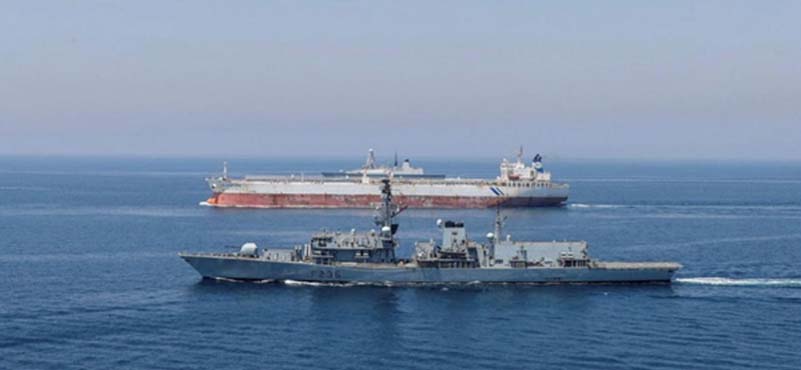
Amid the on-going tensions in the Strait of Hormuz, this article explores how a potential Taiwan crisis could draw the USA and China into a wider contest, turning the Strait of Malacca into a critical strategic chokepoint. It argues that in such a scenario, India – leveraging Campbell Bay – could emerge as a global pivotal power influencing maritime access, stability, and balance in the Indo-Pacific, with profound strategic implications.
The Hormuz Lesson: When Geography Becomes Power
The on-going tensions around the Strait of Hormuz remind the world of a timeless truth: geography, when contested, becomes power. A narrow stretch of water can dictate the fate of global energy flows, alter diplomatic equations, and recalibrate military postures overnight.
Hormuz is not just a maritime passage — it is leverage.
Nations do not merely transit through it; they negotiate around it, deter within it, and sometimes threaten through it. For India, Hormuz has always been a vulnerability — a corridor critical for energy imports yet beyond direct control. But the lesson is larger: control over chokepoints defines strategic autonomy. As one chokepoint dominates headlines in West Asia, another — quieter, but far more consequential in scale — lies to India’s East.
The Malacca Scenario: Blockade in a Taiwan Conflict
Taiwan is increasingly emerging as the most consequential flashpoint in the Indo-Pacific, where great power rivalry, economic interdependence, and questions of sovereignty converge. Taiwan may ignite the crisis, but it is Strait of Malacca that will determine its global consequences and could transform from a commercial artery into a strategic pressure point. The United States, with its overwhelming naval superiority and alliance network, possesses the capability to monitor, restrict or disrupt maritime traffic through this chokepoint.
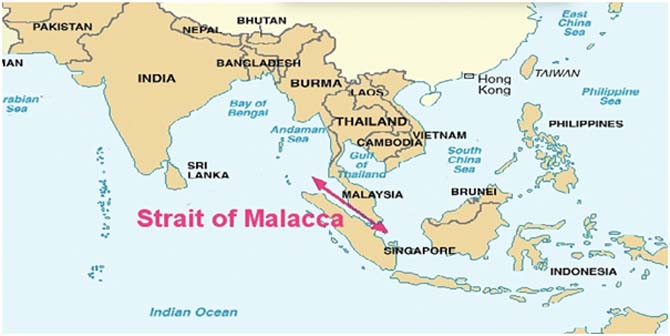
For China, this presents a structural vulnerability — often described as the “Malacca Dilemma.” A significant proportion of its energy imports and trade flows transit through this narrow passage. A controlled or contested Malacca would not necessarily require a formal blockade. Even selective interdiction, insurance disruptions, or naval signalling could impose severe economic and psychological pressure.
Such a scenario would not remain confined to China–US dynamics. It would reshape regional trade flows, escalate maritime militarisation, and compel neighbouring powers to reposition themselves.
India, located at the Western edge of this evolving theatre, cannot remain a passive observer.
India’s Geographic Advantage: The Great Nicobar Pivot
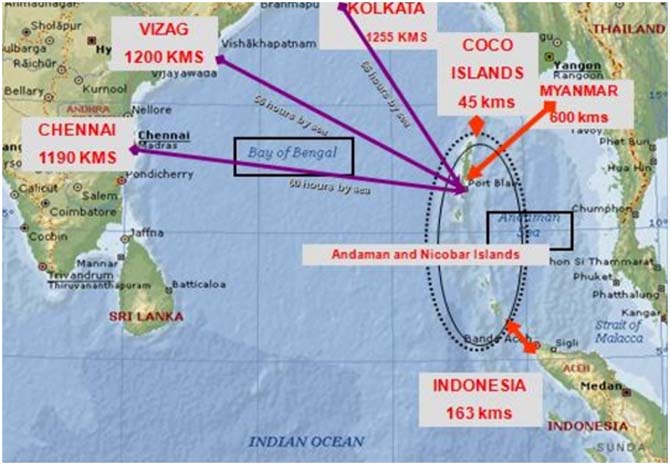
At the Southern edge of the Andaman & Nicobar archipelago lies Great Nicobar — India’s most consequential, yet historically under-leveraged, strategic asset. Just about 165 kms from the Malacca Strait, Campbell Bay and Galathea Bay sit astride the Six-Degree Channel — one of the primary approaches into the chokepoint.
This proximity offers India something rare: geographic adjacency to a global maritime hinge point. Unlike Hormuz, where India remains an external stakeholder, Great Nicobar provides India with a forward vantage — a position from which it can observe, influence, and potentially shape maritime outcomes.
The proposed trans-shipment port and strategic infrastructure at Campbell Bay are therefore not merely developmental initiatives. They represent the physical manifestation of India’s transition from a continental mind-set to a maritime strategic posture.
Campbell Bay as Strategic Lever: From Presence to Influence
Infrastructure, in isolation, does not create power. It creates presence. Power emerges only when presence is converted into influence. Campbell Bay and the proposed Galathea trans-shipment port represent precisely such a transition point. Located near one of the busiest maritime arteries in the world, the infrastructure has the potential to evolve from a commercial hub into a strategic lever.
In a stable environment, this lever expresses itself economically — capturing trans-shipment traffic, reducing India’s dependence on foreign ports, and integrating the Andaman & Nicobar Islands into global supply chains. But in a disrupted environment — such as a Malacca contingency — the same infrastructure acquires a different character. It becomes a node of control, coordination, and signalling.
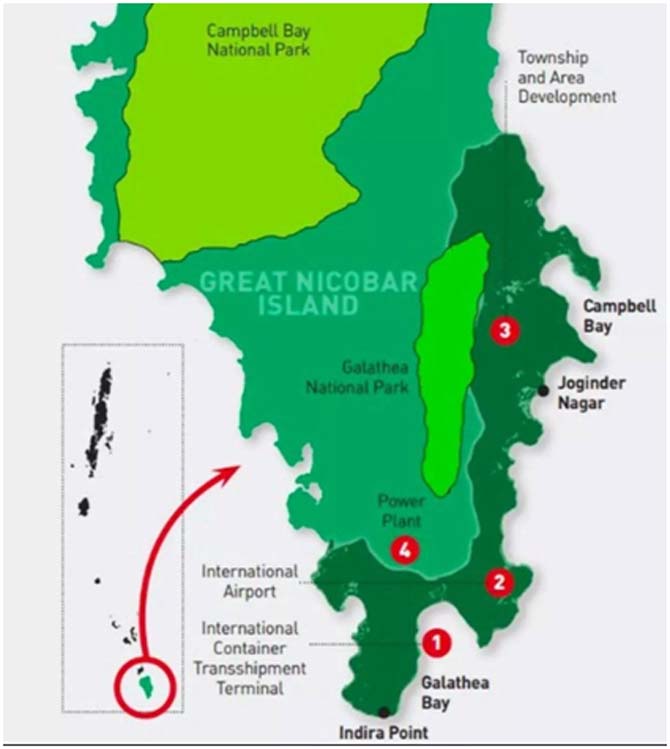
A deep-draft port allows sustained presence of large vessels. Logistics infrastructure enables replenishment. Communication systems enable monitoring and coordination. Together, they transform Campbell Bay into more than a waypoint — into a decision space.
The true value of Campbell Bay, therefore, lies not merely in what it handles, but in what it enables: the ability for India to shift from observing maritime dynamics to shaping them.
Malacca Equation: Sea Control to Sea Denial
In any Malacca contingency, maritime power will determine outcomes. Geography provides opportunity — but naval capability converts it into leverage. India’s naval doctrine traditionally balances sea control and sea denial. Campbell Bay strengthens both dimensions.
- From a Sea Control perspective, forward basing near Great Nicobar allows Indian naval assets to maintain persistent presence in the approaches to Malacca. Carrier battle groups, surface combatants and maritime patrol aircraft can operate with reduced transit time and greater endurance. This enhances India’s ability to ensure safe passage for friendly shipping and contribute to stabilisation efforts.
- From a Sea Denial perspective, the same geography enables India to complicate adversary movement. Subsurface surveillance, anti-submarine warfare operations, and coordinated surface-air patrols can create uncertainty for any naval force attempting to operate unchallenged in the region.
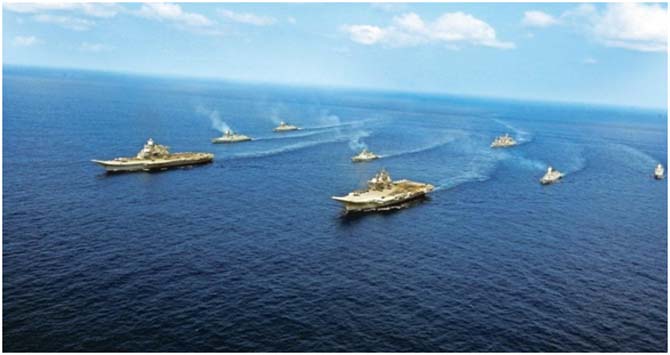
The distinction is critical:
- Sea Control enables access.
- Sea Denial imposes cost.
In a scenario where the Strait is contested or selectively restricted, India’s role could evolve into that of a balancing power — capable of assisting in reopening maritime flows, or, if necessary, contributing to controlled restriction.
Campbell Bay thus becomes the hinge between doctrine and geography — a place where India’s maritime strategy acquires operational depth.
Integrated Power for Maritime Dominance
Maritime dominance in a chokepoint environment is never the product of a single service. It is the outcome of integrated power across domains. At Campbell Bay, this integration is both necessary and achievable.
- The Indian Navy and Indian Coast Guard ensure continuous maritime surveillance and interdiction capabilities. Its presence ensures that the security grid remains active not only during conflict, but in everyday operations — creating a seamless transition from peace to crisis.
- The Indian Air Force, operating from an upgraded dual-use airfield, extends surveillance and strike reach across the Eastern Indian Ocean. Long-range maritime patrol aircraft, airborne early warning systems, and rapid airlift platforms enable persistent monitoring and swift response.
- The Indian Army provides the grounded backbone of security. Coastal defence systems, air defence units, and hardened infrastructure protection ensure that critical installations remain resilient against both conventional and asymmetric threats. In an island environment, denial of access to adversaries begins with control of land.
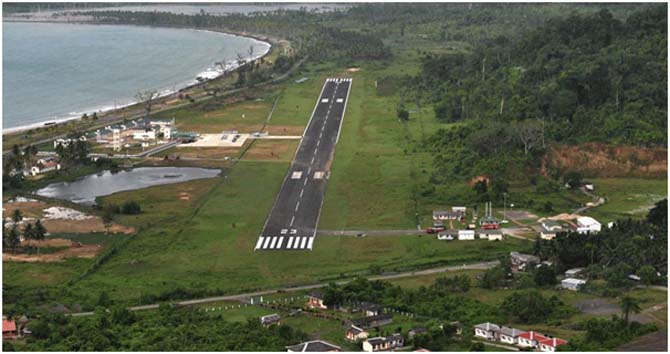
Together, these elements form a layered defence and influence structure:
- Naval power for control.
- Air power for reach.
- Land forces for stability.
- Coast Guard for continuity.
Campbell Bay, under such a framework, evolves into a fully integrated strategic node — capable of operating across the spectrum from peacetime monitoring to high-intensity maritime contingencies.
India as a Swing Power: Opening or Blocking Malacca
In a contested Indo-Pacific, power will not only be measured by strength, but by choice. A disruption in the Strait of Malacca — whether through conflict, coercion or controlled restriction — creates a vacuum that must be managed. It is in this vacuum that India’s role becomes decisive.
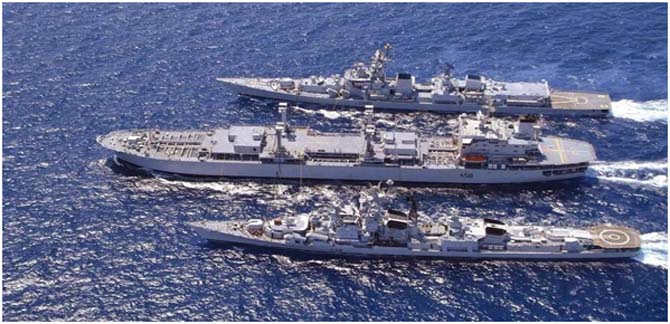
Positioned at Great Nicobar, India is uniquely placed to act as a swing power — neither geographically distant nor strategically peripheral. Its proximity allows it to influence maritime flows in ways that few nations can.
This influence operates along a spectrum.
- At one end lies the ability to assist in reopening and stabilising the Strait, ensuring the continuity of global trade and energy flows. This aligns with India’s long-standing commitment to freedom of navigation and a rules-based maritime order.
- At the other end lies the capability — if circumstances demand — to contribute to selective restriction or monitoring of maritime movement, thereby shaping the operational environment in alignment with broader strategic objectives.
The critical point is not that India will block or open Malacca.
The critical point is that India will have the capacity to matter.
Campbell Bay transforms India from a stakeholder into a potential arbiter of maritime access in one of the world’s most consequential chokepoints.
Risks, Restraint and Responsible Power
Strategic opportunity, however, is inseparable from responsibility.
The development of Campbell Bay and Great Nicobar carries inherent risks — ecological, social and geopolitical. The island is one of the most bio-diverse regions in India, home to fragile ecosystems and indigenous communities whose way of life remains closely tied to the land. Unchecked development risks undermining not only environmental sustainability but also the moral legitimacy of the project.
Equally, overt militarisation of the region could generate regional anxiety, particularly among Southeast Asian nations that are sensitive to shifts in maritime balance. Power, if perceived as coercive, can create resistance rather than influence.
There is also the question of escalation. In a Malacca contingency linked to a Taiwan conflict, the margin for miscalculation would be narrow. Any action taken in such an environment would carry global consequences.
India’s challenge, therefore, is not merely to build capability — but to exercise it with restraint, clarity and responsibility. A calibrated approach — combining strategic preparedness with ecological stewardship and diplomatic transparency — will ensure that Campbell Bay is seen not as a threat, but as a stabilising force in a volatile maritime theatre.
Conclusion: India’s Maritime Moment
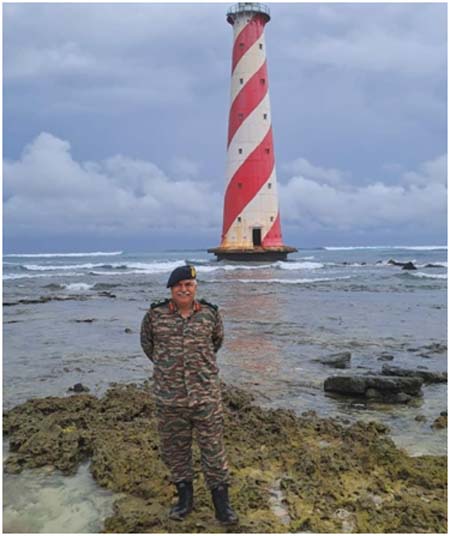
History occasionally offers moments when geography, capability and circumstance converge. For India, Campbell Bay represents such a moment.
From the tensions in the Strait of Hormuz to the emerging uncertainties around the Strait of Malacca, the global maritime order is entering a phase of flux. Chokepoints are no longer passive corridors of trade; they are becoming active instruments of strategy.
In this shifting landscape, India stands at a threshold.
Great Nicobar provides more than proximity — it provides possibility. The possibility to transition from a nation shaped by continental concerns to one that actively shapes maritime outcomes. The possibility to influence the balance between openness and control in the Indo-Pacific. The possibility to act not merely as a participant, but as a provider of stability.
Yet, this moment must be approached with discipline. Power must be anchored in responsibility. Strategy must be guided by restraint. Development must be balanced with sustainability.
Campbell Bay is not just a port. It is not just a military outpost. It is a strategic fulcrum — a place where India’s choices can influence the direction of maritime history in the Indo-Pacific.
And in that choice lies India’s true rise.
ABOUT THE AUTHOR

Lt Gen Rajeev Chaudhry (Retd) is a social observer and writes on contemporary national and international issues, strategic implications of infrastructure development towards national power, geo-moral dimension of international relations and leadership nuances in changing social construct.