

The Great Disappearing Act
Retirement is a curious institution. One day you are indispensable, the next day you are available. After forty years of service, I discovered that the world had not been waiting for my retirement with bated breath. It had, in fact, been preparing rather efficiently for my departure. The farewell was magnificent: speeches, bouquets, photographs, elaborate dinners and promises of lifelong contact. There were enough adjectives describing my contribution to make me wonder whether the organisation would survive Monday morning. It did. Quite comfortably, I might add.
The first few days were spent adjusting to the absence of an office, appointments and the familiar telephone calls beginning with “Good morning, Sir.” I kept checking my mobile, expecting some urgent matter requiring my immediate intervention. Eventually, it rang. It was a reminder that my mobile bill was due. The next call was from a courier asking whether I was home. I was. I had nowhere else to be.
The successor had taken over, the files had moved, the staff had adjusted and the institution was functioning without any visible symptoms of my absence. It was a humbling discovery. Apparently, the organisation had not been surviving on my oxygen supply after all. I had spent forty years making myself indispensable, only to discover that the institution had an excellent replacement policy.
From General to General Purpose
At work, I had spent a lifetime issuing instructions, allocating responsibilities and ensuring that things happened. At home, I discovered that I had been appointed to a much larger organisation, with no retirement benefits and an extremely demanding chairperson. My wife had apparently been studying the transition carefully and had prepared a comprehensive induction programme.
I was now responsible for vegetable procurement, grocery inspection, courier collection, bank visits, pharmacy runs, electrician coordination and the occasional rescue operation involving a stubborn kitchen appliance. My former responsibilities had included strategic roads, bridges, tunnels and airfields. My present engineering portfolio consisted of a leaking bathroom tap and a kitchen drawer that refused to close. The tap was proving considerably more resistant than some difficult terrain.
There was also an interesting change in the chain of command. Earlier, I would issue an instruction and expect compliance. Now I receive instructions, acknowledge them and occasionally seek clarification. “Please get coriander” is not a particularly complicated operational order, but the consequences of returning with parsley can be strategically significant. I have learnt that domestic logistics require greater precision than military logistics. After commanding thousands, I was finally reporting to one person who had absolutely no intention of entertaining my suggestions.
The Advice Department without Customers
Perhaps the greatest casualty of retirement is the advice department. For decades, people sought my opinion on matters ranging from professional decisions to operational problems. I had become accustomed to being consulted. Retirement has not diminished my wisdom; it has merely eliminated the demand for it.
I continue to offer suggestions with admirable enthusiasm. I advise the younger generation on discipline, time management, career choices, investments, health, leadership and the importance of planning ahead. They listen with extraordinary patience; nod thoughtfully and then proceed exactly as they had intended before asking me. My children have perfected the expression of deep intellectual engagement while simultaneously examining their mobile phones.
WhatsApp has provided a wonderful new platform for my advisory services. I forward useful articles, motivational messages, leadership lessons and occasionally a long piece on the importance of reading books. The responses are encouraging. A folded-hands emoji, a thumbs-up and, on particularly successful occasions, a heart. I have yet to establish whether these signify agreement, appreciation or a polite request to stop.
I sometimes wonder whether my advice has become like an old military map: historically valuable, beautifully detailed, but not necessarily required for the current operation. I have not stopped giving advice; the world has simply introduced an advanced system of receiving it without acting upon it.

The Fall of Telephone Diplomacy
There was a time when telephone conversations began with “Good morning, Sir” and ended with “Certainly, Sir.” Today, the opening salutation has undergone a democratic transformation. It is usually “Hello, Uncle!” or, more alarmingly, “Are you free for five minutes?” I have learnt that five minutes is a flexible unit of measurement, particularly when somebody requires a recommendation, an introduction or a favour.
Old colleagues promise to meet over lunch. “We must catch up soon,” they say, with the conviction of people announcing a national infrastructure project. Months pass. The meeting remains under consideration. Some friends have become experts in sending birthday greetings, while others appear to have outsourced the entire relationship to WhatsApp stickers.
The telephone also rings for increasingly diverse reasons. Somebody wants to know the name of a good plumber. Somebody else needs a reference for a nephew. A third wants to know whether I can speak to somebody in Delhi. Occasionally, an unknown number offers me an investment opportunity that promises to double my money before breakfast. I have begun to suspect that my retirement has made me a highly sought-after national resource, particularly among people who need something.
The most remarkable promotion in retirement is that you become everyone’s uncle, everyone’s consultant and nobody’s immediate priority.
The Battle for the Remote
I had imagined retirement as an opportunity to read newspapers peacefully, watch interesting programmes and enjoy an uninterrupted cup of tea. This was before I discovered the domestic constitution. The television remote is not a household accessory; it is an instrument of authority, and its custody is subject to strict constitutional provisions.
My preferred news channel is rarely the preferred channel of the household. My wife has serials; the children have their streaming platforms and the grandchildren have animated universes in which nobody appears to speak a recognisable language. I occasionally secure the remote, only to be informed that somebody was watching something. The fact that I was watching it at that precise moment appears to have no constitutional relevance.
Technology has added another dimension to my humiliation. Having dealt with sophisticated communication systems during my professional life, I am now regularly summoned to repair the Wi-Fi, reconnect the television, retrieve forgotten passwords and explain why the printer is not printing. The younger generation approaches me with the confidence of people who believe that all retired officers possess an inbuilt technical support department.
I have discovered that the remote has a mind of its own, the Wi-Fi has moods and the printer has developed a personal dislike for me. I once commanded complex operations in difficult terrain; today, I cannot change a television channel without seeking coalition support.
The Busiest Man without a Job
The most extraordinary feature of retirement is the amount of work it generates. I had retired to escape meetings, deadlines, schedules and administrative responsibilities. Three years later, my calendar is full again. There are social engagements, family functions, medical appointments, bank visits, writing commitments, grocery expeditions and invitations to committees whose purpose I am still trying to establish.
There is also a curious competition among retired friends. Whenever we meet, the conversation invariably begins with “How are you keeping yourself occupied?” Nobody wants to admit that they have spent the morning doing nothing. Everyone is extraordinarily busy. One has taken up golf, another has joined a club, a third is travelling extensively and a fourth has discovered spirituality. I have begun to suspect that retirement is now a competitive sport in which the winner is the person with the fullest diary.
My own writing projects have ensured that I am not entirely unemployed. I write, edit, read and occasionally become involved in projects that consume more time than the appointments from which I retired. The difference is that nobody now pays me to be busy. I have become my own employer, employee, accountant and most demanding supervisor. There is no annual leave, no staff to delegate to and no grievance redressal mechanism.
I retired to escape the office, only to discover that I had unknowingly opened a one-man organisation with unlimited working hours and no pension revision.
Still At Ease, Sir!
Three years into retirement, I have begun to appreciate the arrangement. There is a certain freedom in not having to rush anywhere, justify an appointment or seek permission to spend an afternoon reading a book. One can travel without preparing a movement programme, enjoy a meal without discussing logistics and occasionally do absolutely nothing without submitting an explanation to anyone.
I have also learnt to accept that the world does not require my opinion on every subject. This is a significant personal achievement, although I cannot claim complete success. Occasionally, I still find myself explaining how something should have been done, only to realise halfway through the explanation that nobody has asked. I then withdraw gracefully, pretending that I was merely thinking aloud. It is a useful survival technique.
Perhaps the greatest gift of retirement is the ability to laugh at oneself. The uniform may have been packed away, the designation surrendered and the office chair occupied by somebody else, but curiosity, friendship, humour and the desire to contribute remain. I may no longer be in command, but I have certainly not surrendered my sense of humour. At home, I continue to maintain an excellent record of issuing instructions, most of which are ignored with admirable consistency.
After forty years of service and three years of retirement, I have reached a firm conclusion: I am finally at ease, although the rest of the household appears to be standing at attention whenever I enter the room.
And if anybody asks whether I miss my old job, the answer is simple: not at all. I have a much more demanding appointment now, with no transfer, no tenure and absolutely no possibility of appealing against the posting.
My wife calls it married life. I call it my permanent peace-time deployment.
ABOUT THE AUTHOR
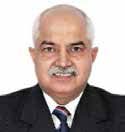
Lt Gen Rajeev Chaudhry (Retd) is a social observer and writes on contemporary national and international issues, strategic implications of infrastructure development towards national power, geo-moral dimension of international relations and leadership nuances in changing social construct.