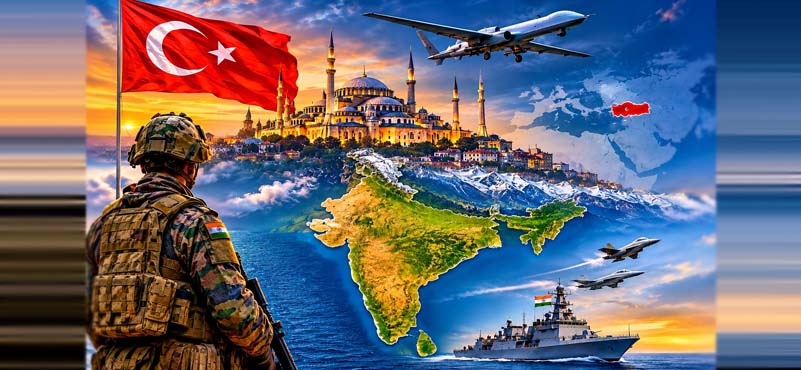
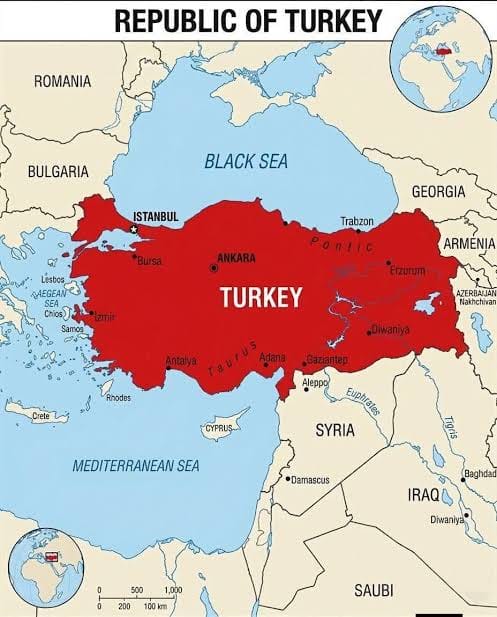
For much of the last century Turkey looked west. Today it looks everywhere, and the Muslim world is where its ambition shows most clearly. Ankara keeps security relationships with Qatar, Syria and Libya, a close partnership with Azerbaijan, and a defence industry whose drones have found buyers on several continents. It is also a NATO member with the alliance’s second-largest standing army, and it sits astride the Turkish Straits that link the Black Sea to the Mediterranean. That mix gives its voice in Muslim capitals a weight no other Muslim-majority state can match.
India has tended to read Turkey through one lens: its friendship with Pakistan. The lens is too narrow. A state that is turning into a hub for the Muslim world can affect India in more ways than a Pakistani ally ever could.
What Turkey is building
Three assets stand out. The first is hard power that sells. Turkish drones, naval platforms and training packages are priced for middle powers, and every buyer needs spares, software and instructors for years afterwards.
The second is presence. Under Erdogan, Ankara has sought leadership across the Middle East, the Caucasus and the Eastern Mediterranean, moving between economic soft power and a harder posture. Its footprint in post-Assad Syria is now hard to ignore.
 The third is convening power. Turkey hosts talks, offers mediation and carries Muslim causes into global forums. Erdogan used the UN General Assembly in September to raise Jammu and Kashmir again, as he has done before.
Soft power does quiet work too. Turkish aid agencies, religious foundations, television dramas and universities have built goodwill from the Balkans to South Asia, and that goodwill makes Ankara’s positions easier to accept.
Underneath sits an older ambition. Many in Ankara see Turkey as the natural centre of the Sunni world, reaching south to Arabia and north to Central Asia. Saudi Arabia, as custodian of the two holy mosques, sees things differently. The defence pact signed in Mecca in August, which binds Turkey, Saudi Arabia and Pakistan, is one instrument of this larger story. It is the most visible one, but not the foundation. Its early tests have been unconvincing. The Houthis struck a Saudi refinery within days of the signing, and Riyadh did not call on its partners, and Egypt has stayed outside. Turkey’s standing rests on a decade of patient work, not on one treaty.
The limits of the rise
India should not mistake momentum for dominance. Turkey competes with Saudi Arabia, Egypt and the UAE for influence, and its economy is under strain. Its NATO membership sits awkwardly beside its Muslim-world commitments. Its drones, which Pakistan used during Operation Sindoor in May 2025, were reportedly shot down in large numbers by Indian air defences. Turkey is a serious player. It is not an unstoppable one.
How it touches India
Kashmir comes first. Turkey is the loudest voice on the subject after Pakistan itself. As its standing in Muslim forums grows, its language travels further, and consensus wording on Kashmir is shaped in rooms where Ankara now matters. This costs India no territory. It does erode the claim that the issue is closed in capitals where India buys energy and employs millions of its people.
The second is Pakistan’s military supply line. Indian analysis of downed drones in May 2025 identified Turkish Songar and YIHA III types. Turkish training, naval cooperation and industrial partnerships continue. A reported deal for 100,000 Turkish-designed first-person-view drones, with assembly in Pakistan, has not been independently confirmed. If it proves true, Pakistan will have bought cheap mass at scale, and India must plan for a drone-saturated opening to the next crisis.
The third is the Gulf. India’s stakes there are large: energy, remittances, a diaspora of millions and the Hajj. A Turkey that competes with Riyadh for leadership of the Sunni world changes how Gulf capitals weigh their choices, and Pakistan will try to turn that to its advantage. No Gulf government wants to pick between Delhi and Islamabad. The risk to India is quiet drift, not open hostility.
The fourth runs the other way. India holds leverage over Turkey. It is a large market, and Erdogan has spoken of seeking full membership of the Shanghai Cooperation Organisation, where India already sits. Reports suggest Ankara would like to repair ties with Delhi. After Sindoor, Indian commercial and public pushback reportedly cost Turkish firms heavily. That experience is useful in any future negotiation.
What India should do
Engage Turkey as it is, not as a Pakistani extension. Keep a working channel open, including through multilateral forums, and say plainly that normal trade and tourism cannot coexist with drones for Pakistan and Kashmir speeches at the United Nations. A clear price works better than repeated protest.
Deepen Gulf partnerships on their own merits. Energy, technology, food security and defence cooperation with Riyadh, Abu Dhabi and Doha give those capitals reasons of their own to protect the relationship. India should not ask them to choose and should not let any of them assume India will not notice.
Build the Eastern Mediterranean ties carefully. India and Cyprus announced a strategic partnership in May 2026, and Greece has urged closer links. These relationships are legitimate and useful. Turkish commentators already call them a proxy war. Delhi gains nothing by proving them right, so the partnerships should be built for their own value.
Fix the military problem at home. Layered counter-drone defence, electronic warfare, indigenous loitering munitions and sharper intelligence on the Turkey-Pakistan supply chain will count for more than any statement. Cheap drones fail against good air defence, but only when that defence is deep, networked and constantly refreshed.
Finally, use an advantage that few others have. India is home to one of the largest Muslim populations in the world. Its scholars, business leaders, universities and diaspora can tell the Kashmir story, and the story of Indian pluralism, in the Muslim world far more credibly than any ministry briefing. That engagement should be sustained, not occasional.
Turkey’s rise will not be reversed by Indian objections. The task for Delhi is to make sure that, as Ankara’s weight grows, India’s own place in the Muslim world is built by choice and not left to Pakistan and Turkey to define.
ABOUT THE AUTHOR
 Lieutenant General A B Shivane, is the former Strike Corps Commander and Director General of Mechanised Forces. As a scholar warrior, he has authored over 200 publications on national security and matters defence, besides four books and is an internationally renowned keynote speaker. The General was a Consultant to the Ministry of Defence (Ordnance Factory Board) post-superannuation. He was the Distinguished Fellow and held COAS Chair of Excellence at the Centre for Land Warfare Studies 2021 2022. He is also the Senior Advisor Board Member to several organisations and Think Tanks.