
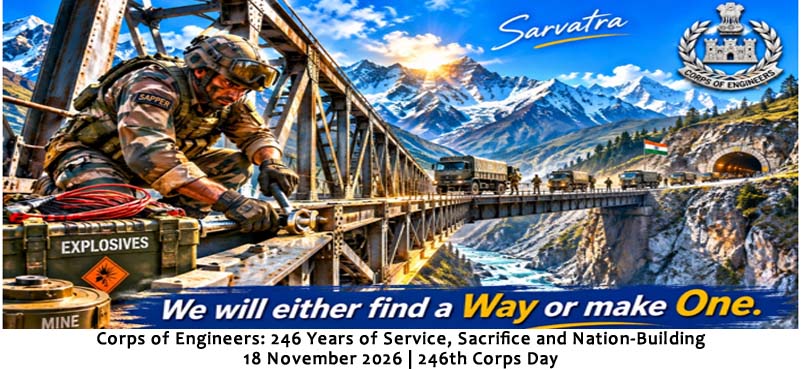
There is a particular breed of soldier who does not always wait for the battle to begin before entering the danger zone. He may be found clearing a minefield under enemy fire, constructing a bridge across a raging river, breaching an obstacle to enable an armoured advance or restoring a vital route when the mission cannot afford a delay. He is a warrior, an engineer and, above all, a Sapper. As the Indian Army’s Corps of Engineers celebrates its 246th Raising Day on 18 November 2026, India has an occasion to salute an institution whose contribution extends far beyond the battlefield. Its story is one of courage married to competence, ingenuity strengthened by discipline and an enduring commitment to national service.
A Legacy Forged in Time
The story of the Corps goes back to 1780, when the first regular engineer companies of the Madras Sappers were raised. The Bengal and Bombay Sappers followed, each developing its own proud traditions, battle honours and professional identity. These three distinguished groups were amalgamated on 18 November 1932 to form the present Corps of Engineers. The distinction is important: 1780 marks the recognised origin of the Corps, while 18 November commemorates the historic amalgamation. Over nearly two and a half centuries, generations of Sappers have served across continents, campaigns and changing political landscapes. Their legacy is not merely a record of engineering achievements; it is a chronicle of valour, adaptability and sacrifice. The traditions of the Madras, Bengal and Bombay Sappers remain living expressions of a common identity, bound together by professional excellence and the motto Sarvatra — Everywhere.
Four Pillars, One Purpose
The Corps of Engineers derives its remarkable breadth from four principal pillars: Combat Engineers, the Military Engineer Services, the Border Roads Organisation and Military Survey. Each has a distinct responsibility, yet all contribute to a common national purpose. Combat Engineers provide close engineering support to fighting formations. The Military Engineer Services plans, constructs and maintains the infrastructure required by the Armed Forces, from operational facilities and airfields to hospitals and complex installations. The Border Roads Organisation builds and maintains connectivity in some of the country’s most demanding geographical environments. Military Survey provides the mapping, geospatial intelligence and terrain information essential for planning and operations. Together, these capabilities create an engineering ecosystem that supports military preparedness in peace and war. Their collective contribution demonstrates that the Corps is not confined to one battlefield function. It is an institution whose professional reach extends from the tactical requirements of a combat unit to the strategic infrastructure of a nation.
Sapper: Warrior Behind the Engineer
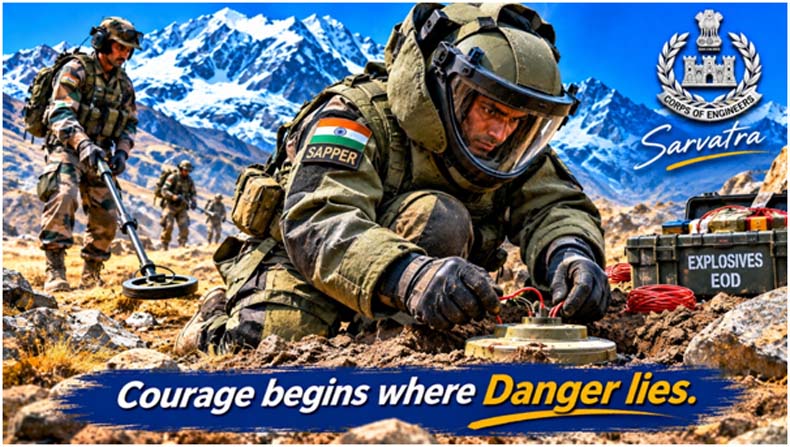
Combat engineering is not an academic exercise conducted at a safe distance from danger. It is an operational necessity, often performed at the very point where the enemy’s resistance is strongest. The Sapper enables mobility by constructing bridges, tracks and crossings; creates obstacles through minefields and demolitions; and enhances survivability through fortifications, protective works and field defences. In an offensive, he helps open the way. In defence, he helps deny it to the adversary. In difficult terrain, he makes movement possible where geography appears to have ruled it out. The combat engineer must combine technical knowledge with physical endurance, tactical awareness and the courage to act under fire. His decisions can determine the speed of an advance, the safety of a formation and sometimes the outcome of an operation.
BRO: Instrument of National Power
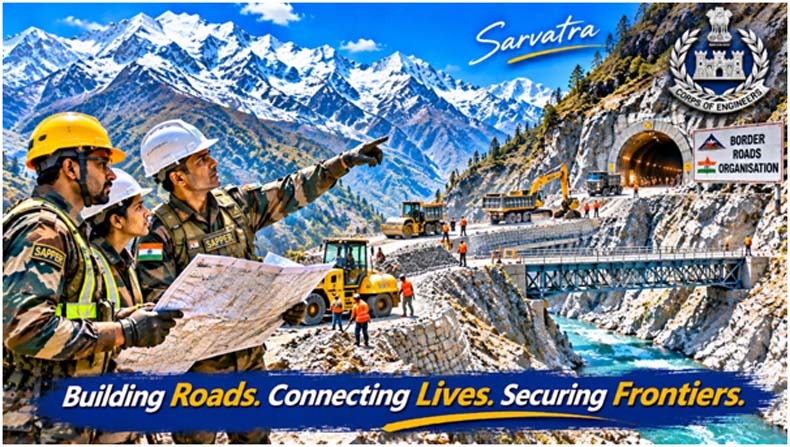
Border Roads Organisation (BRO) deserves particular recognition in this larger story. In a country with India’s geographical challenges and contested frontiers, engineering is inseparable from national security. Roads, bridges, tunnels and airfields are not merely construction achievements; they are instruments of operational reach, logistical resilience and deterrence. Working across mountains, deserts and remote border regions, BRO has transformed India’s strategic connectivity through projects such as the highest motorable road over Umlingla, highest twin tube tunnel at Sela, the highest multi-span bridge at Saser Brangsa, highest operational airfield at Nyoma, the highest tunnel in making at Shinkun La and the network of roads across the Himalayan frontier. Yet its contribution extends beyond defence. Every road reaching a remote settlement brings healthcare, education, markets and opportunity to communities long constrained by isolation. A connected frontier is not merely a secured frontier; it is a confident, empowered and integrated part of India.
MES: Building the Military Infrastructure
Military Engineer Services (MES) forms another vital pillar of the Corps’ contribution to national defence. It creates and sustains the infrastructure that enables the Armed Forces to remain operationally ready. From military stations, airfields, hangars and ammunition depots to hospitals, specialised installations and critical utilities, its engineering responsibilities span the entire spectrum of defence infrastructure. Its role is not confined to constructing buildings; it involves ensuring functionality, reliability, safety and sustainability of military assets, often under demanding geographical and operational conditions. By integrating engineering expertise, modern construction technologies and efficient asset management, MES strengthens the institutional foundations of military preparedness. If the Sapper enables the Army to move and fight, MES ensures that it has the infrastructure to remain ready.
The Sapper in the Service of Humanity
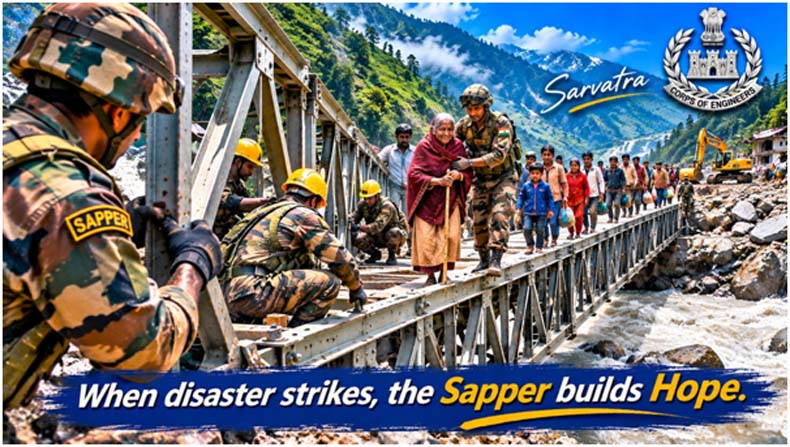
The character of the Corps is revealed not only in war or infrastructure development but also when calamity strikes. Floods, landslides, earthquakes and other disasters frequently demand immediate engineering intervention. Sappers have rescued stranded civilians, restored damaged bridges, cleared debris, opened blocked routes and helped establish essential facilities. Their technical skills become instruments of humanitarian relief. In these moments, the uniform carries a reassurance that transcends military responsibility. The Sapper arrives not to ask who needs help, but to determine what must be done. There is a profound human dimension to this service. The bridge restored after a flood may reconnect a village to a hospital; the road reopened after a landslide may deliver food and medicines; the temporary structure erected in an emergency may offer shelter to families who have lost everything. The Corps’ contribution to society is therefore as much about compassion as it is about competence.
Preparing for the Battles of Tomorrow
The nature of warfare is changing, and military engineering must change with it. Future battlefields will be shaped by artificial intelligence, autonomous systems, robotics, unmanned platforms, precision geospatial intelligence and rapidly deployable infrastructure. Mine detection and clearance will increasingly depend on remote technologies. Bridging and obstacle-breaching systems will need greater speed, protection and adaptability. Digital terrain modelling, real-time surveillance and data-driven planning will influence operational decisions. The challenge will be to integrate these technologies without diluting the human qualities that define the Sapper: initiative, courage, professional judgement and the ability to improvise under pressure. Indigenous research, closer collaboration with academia and industry, and continuous investment in specialised training must become central to the Corps’ future trajectory. The next generation of Sappers must be as comfortable with algorithms and autonomous machines as their predecessors were with explosives, bridging equipment and conventional engineering tools. Technological superiority, however, will matter only when it translates into operational advantage. The ultimate test will remain the same: can the Sapper deliver when the nation needs him most?
Sarvatra: The Spirit That Endures
Behind the achievements of the Corps lies an extraordinary human story. It belongs to the soldier who works through a freezing night at a high-altitude post, the engineer who calculates the strength of a bridge knowing that lives will depend on it, the team that clears a dangerous obstacle under fire and the veteran who carries the memories of comrades who never returned. Their achievements deserve recognition, but their sacrifices deserve remembrance. The fallen Sappers are an inseparable part of the Corps’ identity, and every Corps Day must begin with gratitude to those who gave their lives in the service of the nation. The motto Sarvatra is not merely a declaration of geographical presence; it is a statement of professional commitment and moral responsibility. It means being ready wherever duty calls, overcoming whatever stands in the way and finding a solution when circumstances appear impossible.
For 246 years, the Sapper has stood where the obstacle begins and the mission must continue. He builds when others cannot cross, clears the way when progress is threatened, protects when danger approaches and rebuilds when devastation strikes. His bridges may carry armies, his roads may connect distant communities, and his engineering may reshape the nation’s frontiers. Yet his greatest achievement is not measured in kilometres, structures or engineering records. It is reflected in the confidence he inspires and the possibilities he creates.
On 18 November, India salutes the men and women of the Corps of Engineers, past and present, serving and retired. Their legacy reminds us that courage is not always expressed through the weapon in a soldier’s hand; sometimes it is reflected in the bridge he builds under fire and the obstacle he refuses to surrender to.
The Army may march to victory, but the Sapper makes the way.
Happy 246th Corps Day. Jai Hind!
ABOUT THE AUTHOR

Lt Gen Rajeev Chaudhry (Retd) is a social observer and writes on contemporary national and international issues, strategic implications of infrastructure development towards national power, geo-moral dimension of international relations and leadership nuances in changing social construct.