China’s economic reach toward 2040, and what India should do about it
Beijing has published no document called a 2040 vision. Its stated milestones are 2035 and 2049. Yet strategists keep reaching for 2040 as shorthand, and the instinct is sound, because somewhere between those two dates the pieces of a long economic campaign are meant to click together. That campaign is not about tanks or bases. It is about making China so useful, so embedded and so hard to replace that confronting it becomes costly for most countries.
 Begin with infrastructure. The Belt and Road, launched in 2013, is not fading. Independent trackers put engagement in 2025 at about $213 billion, the busiest year on record, with energy drawing close to $94 billion of it and the cumulative total above $1.39 trillion. Ports, grids, railways and mines are assets that stay for decades. A country that runs its electricity on Chinese equipment and ships through a Chinese-operated terminal has not been conquered. It has acquired a long-term supplier it cannot easily fire. That permanence is the point. A loan can be refinanced, and a road can be rebuilt, but a grid, a port or a rail corridor tied to one supplier’s standards, spare parts and trained engineers shapes decisions for a generation. Influence of this kind seldom announces itself. It shows up later, in what a government finds awkward to say in a trade dispute or at the United Nations.
Critics call this debt-trap diplomacy, and Hambantota is their favourite exhibit. The record is less dramatic. The port was a Sri Lankan government project, and the 2017 lease of 99 years to China Merchants Port Holdings for $1.12 billion did not cancel a single Chinese loan. Sri Lanka was a stretched borrower that made poor choices, not the victim of a master plan. The leverage was real and the conspiracy thinner than the legend. That is worth knowing, because it points to the remedy. Weak governance invites dependence, while transparent contracts and credible alternatives reduce it.
 Technology is where dependence can harden fastest. When payments, telecom networks, and public services run on a foreign stack, switching becomes painful, and Chinese firms carry that stack across Africa, Southeast Asia, and Latin America. Manufacturing follows a similar logic. As wages rise at home, labour-intensive production drifts to Vietnam, Bangladesh and Ethiopia, while design, high-value components and the logistics that tie everything together stay in Chinese hands. Partner countries gain jobs and growth. China keeps the top of the pyramid. Neither shift needs a central plan, since firms chasing margins produce the same pattern on their own.
The financial leg is the weakest. Beijing has built alternatives, among them the Asian Infrastructure Investment Bank, the New Development Bank and a payments system designed to work outside SWIFT. They are useful, and they are small. The renminbi held 2.11 per cent of global reserves in the second quarter of 2026, according to the IMF, against 56.70 per cent for the dollar. A reserve currency needs deep, open markets that foreign holders trust to let them in and out freely. China has so far chosen control over openness. Talk of a yuan at 15 per cent of reserves by 2040 is a hope, not a trend.
The softest instrument is the model itself. A one-party state that lifted hundreds of millions out of poverty without a ballot box is an appealing story to governments tired of coalition politics and slow courts. It will not convert many democracies. It may make some leaders more comfortable with tighter control at home, and more willing to borrow Beijing’s tools for monitoring and censorship.
 The limits are real. Vietnam and the Philippines take Chinese money while deepening security ties with Washington. African publics push back on environmental damage and thin local hiring. European governments now screen Chinese technology and infrastructure deals far more closely. Even Sri Lanka’s new president, after the 2019 election, said he would revisit the Hambantota lease, then clarified that only port security was on the table. Dependence shapes choices. It does not erase them.
Three outcomes look plausible by 2040. In the first, interdependence ripens into deference across much of the Global South. In the second, the world splits into rival economic blocs, with middle powers such as India and Brazil bargaining between them. In the third, a tense coexistence emerges in which the major powers share control of critical systems. The evidence so far favours the second, though unevenly, and India’s weight makes its presence felt.
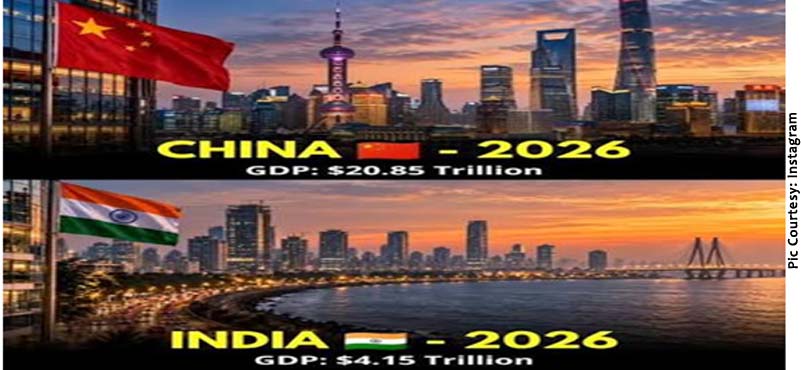
For India, the lesson is uncomfortable. It has stayed outside the Belt and Road since its launch, largely over the corridor running through Pakistan-occupied Kashmir, yet it sits deep inside Chinese interdependence all the same. In 2025-26, China overtook the United States as India’s largest trading partner. India bought $131.63 billion of Chinese goods, sold back $19.47 billion, and ran a record deficit of about $112 billion, up from $99.2 billion a year earlier. The spillover India should worry about is not on a distant continent. It is in its own factories, which lean on Chinese components, machinery and materials. Smartphone assembly has moved to India in recent years, yet much of what sits inside the box is still imported.
The answer is not a rival Belt and Road. It is plainer than that. Build depth in the inputs India now imports, since that deficit is where the leverage sits. Offer neighbours finance and project delivery they can trust on cost and schedule, so they have a credible second option. Keep trade open while diversifying, because cutting off $131 billion of imports overnight would hurt Indian manufacturers before it troubled Beijing. None of this is glamorous. All of it is measurable.
The question that matters is a narrow one. Can any country, India included, deliver what Chinese capital delivers at scale and on time, without imposing terms the borrower later resents? Slogans will not answer that; a delivery record will. Until one exists, Beijing’s long ledger will keep growing, plan or no plan.
ABOUT THE AUTHOR
 Lieutenant General A B Shivane, is the former Strike Corps Commander and Director General of Mechanised Forces. As a scholar warrior, he has authored over 200 publications on national security and matters defence, besides four books and is an internationally renowned keynote speaker. The General was a Consultant to the Ministry of Defence (Ordnance Factory Board) post-superannuation. He was the Distinguished Fellow and held COAS Chair of Excellence at the Centre for Land Warfare Studies 2021 2022. He is also the Senior Advisor Board Member to several organisations and Think Tanks.