
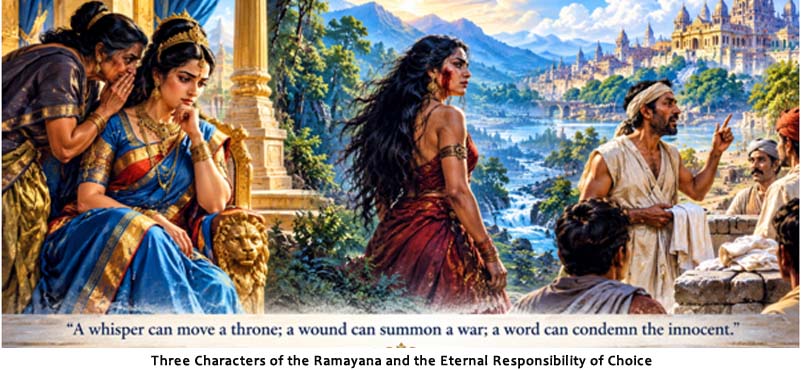
When Small Voices Move Great Destinies
The destiny of a kingdom may sometimes turn on a whisper, a war may begin with a wound, and the fate of an innocent person may be altered by a word spoken in an ordinary household. The Ramayana, an epic of kings, warriors, sages and divine purpose, reminds us that history does not always move at the command of those who occupy the highest seats of power. Sometimes, its direction changes through individuals whom society would scarcely consider important.
Manthara, Shurpanakha and the washerman occupy very different places in the epic’s narrative traditions, yet their actions or utterances become associated with consequences far exceeding their apparent standing. One influences a queen, another becomes entangled in a chain of personal and political retaliation, and the third represents public suspicion confronting royal responsibility. Their stories invite us to look beyond the familiar division between heroes and villains and examine the forces that govern human conduct.
The deeper question is not whether these three characters changed the course of events; it is how their influence acquired such power, and why those who possessed the authority to decide sometimes failed to rise above it. The distinction matters because influence is not authority, provocation is not justification, and public opinion is not necessarily truth. The Ramayana becomes particularly relevant when we recognise that its moral dilemmas are not confined to an ancient age. They reside within our homes, institutions, governments and, most uncomfortably, within ourselves.
Manthara: The Whisper That Changed a Kingdom
Manthara possessed neither a throne nor an army, yet she understood the vulnerabilities of the person who possessed the power to alter the succession. As Rama’s coronation approached, she influenced Kaikeyi to interpret an occasion of celebration as a threat to her own position and that of her son, Bharata. Fear gradually displaced affection, suspicion clouded judgment, and Kaikeyi invoked the two boons previously promised to her. Rama was sent into exile, while Bharata was to be installed as king. A private conversation thus became the beginning of a profound upheaval in Ayodhya.
Manthara’s significance lies not merely in her capacity to manipulate, but in her understanding that ambition becomes most dangerous when disguised as protection. She did not create every insecurity within Kaikeyi; she gave those insecurities a direction. Her words found entry because the listener was prepared, however briefly, to see love as a contest and succession as a threat. Persuasion becomes manipulation when it deliberately narrows another person’s vision until fear appears to be wisdom.
Yet responsibility cannot end with the adviser. Manthara could counsel, provoke and persuade, but Kaikeyi chose to act. The queen possessed the authority to question what she heard, examine the motives behind it and consider the consequences for her husband, Rama, Bharata and the kingdom. Instead, she surrendered discernment at the very moment when discernment was most necessary.
Every institution has its Mantharas: the adviser who feeds a leader’s suspicions, the subordinate who conceals inconvenient truths, and the flatterer who mistakes agreement for loyalty. Spiritual maturity demands more than recognising such influences in others. It requires the humility to ask whether our own fears make us receptive to them. A wise leader does not silence uncomfortable counsel; a wise leader tests counsel against truth, duty and consequence. The whisper may initiate the crisis, but the decision gives it power.
Shurpanakha: The Wound That Became a Conflict
Shurpanakha enters the forest as a figure of desire, but the episode becomes a study in rejection, humiliation and retaliation. Her advances towards Rama are refused; her encounter with Lakshmana ends in the mutilation of her nose and ears. She appeals to her powerful relatives, and events escalate until Ravana confronts Rama and abducts Sita.
It is tempting to reduce Shurpanakha to a jealous woman whose grievance unleashed catastrophe. Such a reading is too convenient. Her humiliation belongs to the story, but it does not absolve Ravana of responsibility for abducting Sita or for the choices that followed. Nor should the violence inflicted upon her be ignored simply because the larger narrative centres on other characters. The episode is morally complex because pain, conduct and consequence cannot be collapsed into one verdict.
Shurpanakha represents the danger of a wound becoming an identity. When humiliation becomes the defining truth of an encounter, the desire for redress can turn into revenge. Those who hold power may magnify personal injury into a collective cause, persuading themselves that retaliation restores honour. Yet honour that depends on making another suffer is often pride wearing the clothes of justice.
Families, institutions and nations know this progression. An insult is remembered, an apology rejected, and each response becomes evidence for the next grievance. The spiritual challenge is not to deny pain or tolerate injustice, but to prevent pain from becoming permission for cruelty. Anger may alert us to a wound; it cannot by itself prescribe the remedy.
The Washerman: The Word That Challenged a King
The washerman belongs especially to the Uttara Kanda narrative and later retellings of the Ramayana. In the familiar account, his reported remarks express suspicion about Sita’s return after her captivity in Lanka. His words become part of the pressure surrounding Rama’s decision to send Sita away, despite her ordeal and her vindication in the trial by fire described in the epic tradition. Here, the decisive force is neither private counsel nor personal retaliation, but social judgment.
The issue is not whether a subject may criticise a ruler or question a public figure. A society in which ordinary people cannot speak is vulnerable to tyranny. The question is what happens when suspicion is treated as proof, reputation outweighs evidence, and public judgment becomes harder to resist than justice.
Rama’s decision presents a painful conflict between the expectations attached to kingship and the duty owed to Sita as an individual. It should not be reduced to either unquestionable righteousness or easy condemnation. The episode asks whether a ruler can preserve public confidence by imposing a grave cost on someone who has already suffered, and whether the appearance of moral certainty can conceal a failure of compassion. The king remains responsible for his response.
The parallel with modern life is unmistakable. Rumour becomes verdict; a clipped statement eclipses a lifetime; a crowd punishes before facts are tested. Public opinion is essential to accountability, but it is not an infallible moral compass. Dharma requires discernment: to hear criticism without surrendering judgment, and to protect justice even when compassion is unpopular. A society reveals its character through the fairness with which it decides.

Beyond the Characters: Three Weaknesses Within Us
The three figures form a revealing sequence. Manthara shows how fear can be planted and amplified; Shurpanakha, how humiliation can harden into retaliation; the washerman, how suspicion can gain authority through public repetition. The whisper, the wound and the word become consequential when judgment fails to examine them. The epic’s mirror is not held up to three individuals alone, but to everyone who listens, reacts or judges.
We may condemn manipulation while enjoying the influence it gives us over others. We may speak of dignity while nursing grievances long after their cause has passed. We may demand truth from public figures while forwarding allegations we have never verified. Yet each story asks us to notice when an impulse begins governing conscience.
The responsibility of power is central. Kaikeyi could have questioned Manthara; Ravana could have refused abduction and war; Rama could have weighed public pressure against Sita’s dignity. Influence may explain why a decision became tempting; it cannot erase the agency of the person who made it.
Dharma is not a slogan that guarantees easy answers; it is the discipline of seeing clearly when desire, fear, pride and social pressure pull us in different directions. It asks for self-mastery before judgment of others, restraint before retaliation, and compassion without surrendering discernment. The first victory is not over an enemy outside us, but over the impulse within that would have us act without reflection.
Eternal Responsibility of Choice
The Ramayana’s vast canvas contains divine purpose and human frailty, noble sacrifice and grievous error. Manthara, Shurpanakha and the washerman remind us that influence may arise in unexpected places, but its presence does not settle responsibility. Words can awaken fear, wounds can provoke anger, and society can demand conformity; still, people must answer for the choices they make.
The lesson is neither to silence advisers, suppress wounded voices nor dismiss public criticism. It is to test counsel, transform hurt without making it an excuse for harm, and insist that judgment be guided by truth as well as compassion.
A whisper may awaken fear, a wound may provoke revenge, and a word may unleash judgment; but the final destiny still rests with the hand that chooses what to do next.
ABOUT THE AUTHOR

Lt Gen Rajeev Chaudhry (Retd) is a social observer and writes on contemporary national and international issues, strategic implications of infrastructure development towards national power, geo-moral dimension of international relations and leadership nuances in changing social construct.