

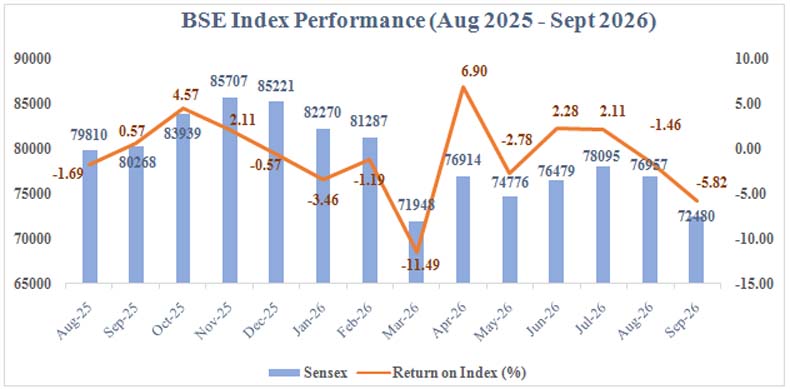
India’s economic outlook remains promising, but sustaining growth is becoming harder. The RBI has raised its FY2026–27 growth forecast to 7.1%, while the IMF projects 7% growth in both FY2026–27 and FY2027–28. Yet retail inflation climbed to 5.54% in September from 4.82% in August, prompting the RBI to raise the repo rate by 25 basis points to 5.50% on October 7.
 India faces not a growth crisis but an adroit balancing act different from the “knife-edge equilibrium” envisaged by Harrod and Domar. Expensive energy, deficient rainfall and tighter global financial conditions threaten purchasing power, corporate margins and fiscal flexibility. Policy must protect investment and employment without allowing supply shocks to entrench inflation.
Global Headwinds, New Opportunities
The IMF projects global growth of 3.1% in 2026 and 3.4% in 2027. Geopolitical tensions and commodity shocks are restraining activity, even as artificial intelligence drives investment. AI offers productivity gains, but these remain skewed.
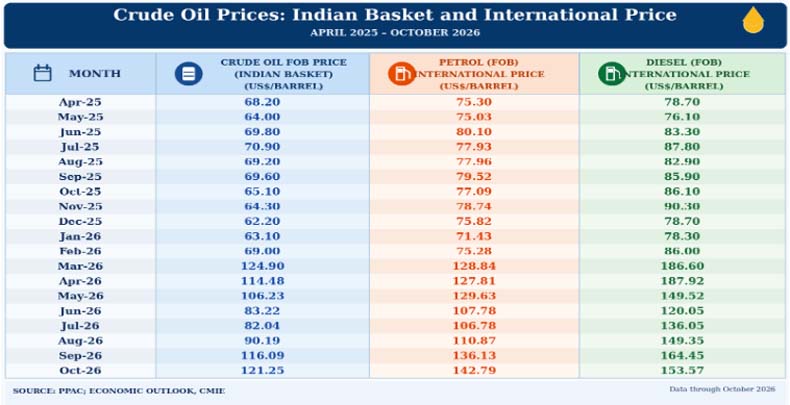
Energy is India’s immediate vulnerability. The Indian crude basket averaged $116.1 a barrel in September, consistently rising from $82 in July to $90.2 in August. Sustained high prices inflate import bills and production costs. Consumers, businesses or government must bear the burden through higher prices, lower margins, tax cuts or subsidies.
Higher advanced-economy bond yields, a stronger dollar and renewed West Asian tensions could also trigger capital outflows and raise borrowing costs. Strong growth provides resilience, not immunity. Meanwhile, AI creates opportunities in services, engineering and advanced manufacturing. Incentives must deliver domestic capabilities, skilled jobs and productivity.
Investment Leads, Consumption Remains Uneven
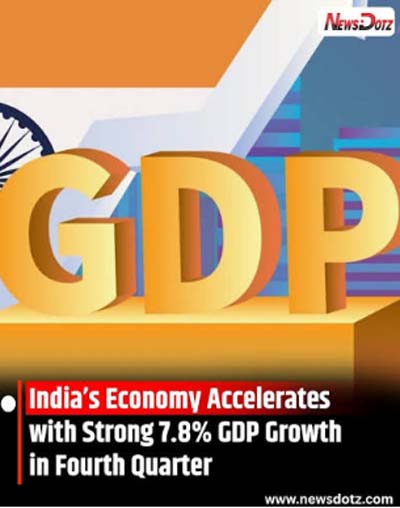
Real GDP grew 7.8% in April–June 2026, supported by consumption, investment and net exports. Capital-goods production rose 17.9% in July–August, capital-goods imports increased 24.5%, and cement output expanded 12.6%. These suggest healthy investment activity, but not necessarily an entrenched, broad-based private “crowding-in” of investment. Durability depends on capacity utilisation, financing costs and expected returns.
Manufacturing PMI rebounded to 55.1 in September from 52.8 in August, but its quarterly average slipped to 53.8 from 54.6, while services PMI fell to 54.2 from 58.7. Capacity utilisation nearly 80%, easing input costs and improving profit prospects could encourage fresh investment. Priorities should include diversifying export markets, strengthening supply chains and reducing vulnerability to external shocks for a more durable strengthening of India’s industrial base, rather than a temporary cyclical upswing.
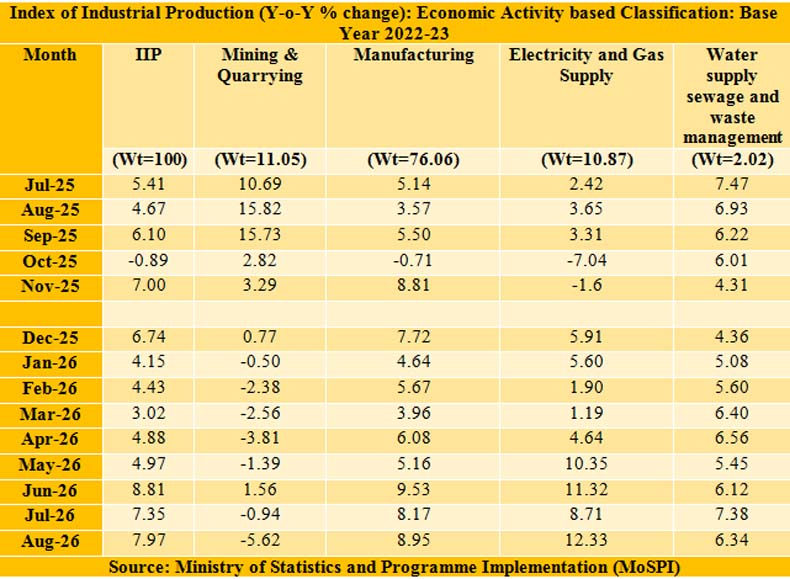
Consumption is more uneven. Consumer-durable production grew 11.5% in July–August, but non-durables rose just 0.6%; domestic air-passenger traffic fell 5.4%. Strong GDP, premium consumption and tax collections, however, do not establish improving purchasing power across households.
Agriculture adds uncertainty. The southwest monsoon ended approximately 13% below its long-period average. Kharif sowing was slightly above normal but marginally below last year, while deficient rainfall and El Niño threaten rabi prospects. Output depends on acreage, rainfall distribution, irrigation and yields. Weaker harvests could simultaneously raise food prices and depress rural demand.
Employment remains critical. September unemployment stood at 5%, but urban youth unemployment reached 19%, including 26.6% among young women. Participation, real wages and job quality must therefore accompany headline employment measures.
Calibrated Monetary Policy
The RBI raised its FY 27 inflation forecast to 5.2%, projecting 6% inflation in October–December and 5.7% in January–March. The October rate increase signals determination to contain persistent inflation. Yet the RBI identified limited evidence of demand-driven pressures or supply shocks becoming embedded in pricing behaviour. This is important because interest rates cannot produce oil, restore rainfall or remove distribution bottlenecks. Excessive tightening could weaken investment without resolving the initial shock. But prolonged inaction risks allowing repeated food and fuel increases to influence wages, expectations and business pricing.
Further decisions should therefore depend on inflation’s persistence and breadth, expectations, credit conditions and economic activity. Monetary vigilance needs complementary food-supply measures, transparent stock management and targeted household assistance.
Fiscal Policy: Spend Better
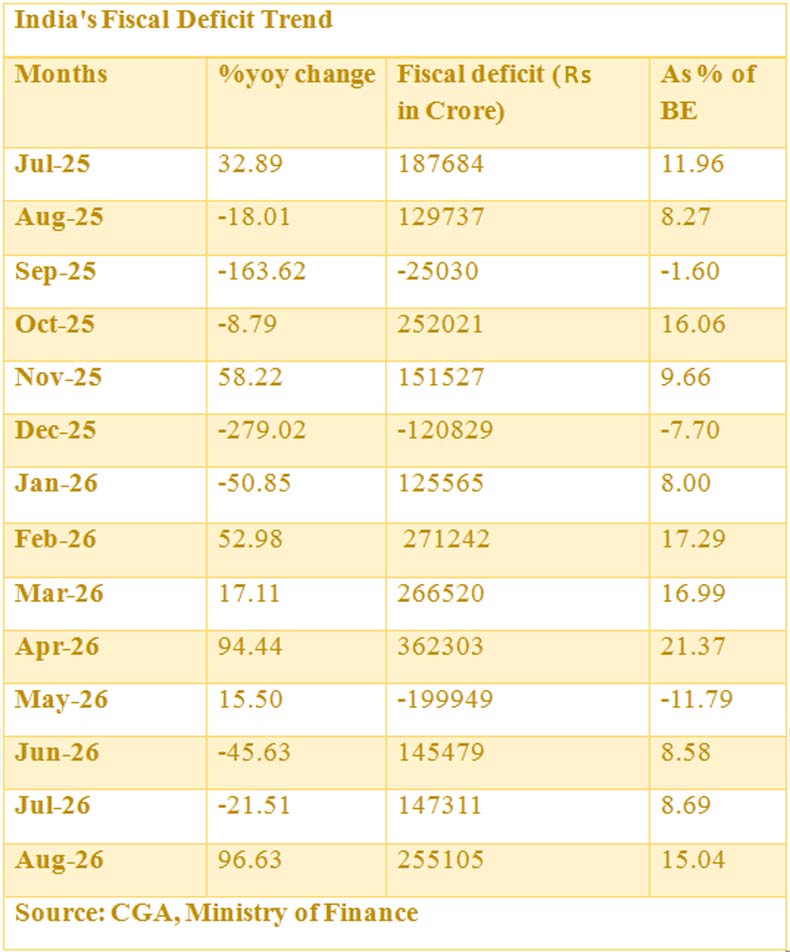
Government capital expenditure reached approximately ₹5.10 lakh crore through August against an annual allocation of ₹12.22 lakh crore. The fiscal deficit was approximately ₹7.10 lakh crore against the budgeted ₹16.96 lakh crore. Both stood near 42% of annual provisions; neither alone establishes slippage or exceptional consolidation because receipts and spending are uneven.
Payments of about ₹5.15 lakh crore absorbed nearly 40% of revenue receipts of ₹12.92 lakh crore, constraining productive expenditure and raising interest burden concerns.
September gross GST collections rose 14.7% to ₹2,03,521 crore. Encouraging revenue growth nevertheless reflects prices, import values, compliance, and activity; it is not a direct measure of real consumption. Asset sales likewise cannot substitute indefinitely for correcting recurring fiscal imbalances. Their value depends on proceeds, future income forgone and liabilities reduced. Completing viable projects, resolving land and regulatory delays, maintaining infrastructure, and disclosing overruns and utilisation require a sharper focus.
External Strength, Persistent Vulnerabilities
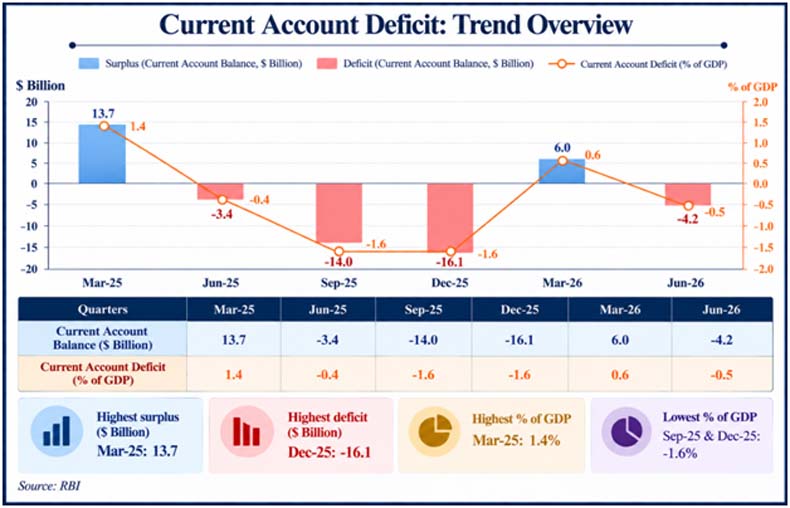
September merchandise exports rose to $44.40 billion from $36.08 billion a year earlier. Imports reached $74.61 billion, leaving a $30.21 billion deficit—narrower year on year but wider than August’s $26.86 billion. The half-year picture is less reassuring. Combined merchandise and services exports increased 13.84% to an estimated $476.20 billion, while imports rose 15.68% to $551.13 billion. The current-account deficit (CAD) widened to $74.93 billion from $58.10 billion, underscoring competitiveness and energy-security challenges. The April–June CAD was manageable at $4.2 billion, or 0.5% of GDP, but preceded September’s oil-price surge.
Capital flows were mixed. Net foreign direct investment (FDI) reached $13.8 billion in April–August, against $9.6 billion a year earlier. Portfolio investment, however, recorded $10.3 billion in net outflows through October 5.
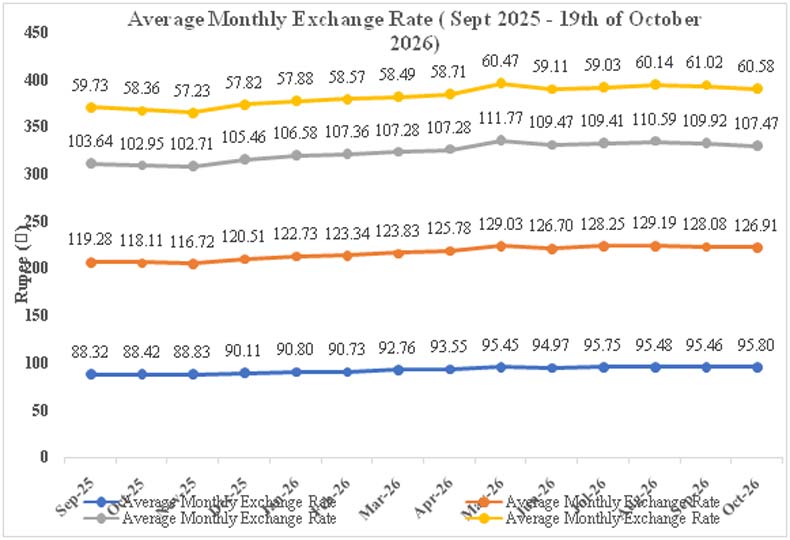
Reserves stood at $726.027 billion on October 9, down from $734.6 billion a week earlier. Valuation effects complicate interpretation. Policy should support orderly exchange-rate adjustment, not defend an arbitrary rupee level.
Durable Growth Priorities
Five priorities follow.
First, contain essential-cost pressures through better food distribution, timely supply interventions and targeted assistance. Open-ended subsidies would weaken fiscal discipline without eliminating the underlying energy shock.
Second, assess growth through household welfare. Real earnings, employment quality, participation and essential affordability deserve greater weight, particularly for rural households, young people and women.
Third, strengthen private investment through predictable taxes, reliable power, enforceable contracts and timely government payments. For MSMEs, settling receivables and improving working capital are important.
Fourth, reduce strategic import vulnerabilities through energy diversification, efficiency, storage and competitive domestic supply chains. Indiscriminate protection could instead raise input costs and damage downstream competitiveness.
Fifth, tie technology incentives to measurable productivity, domestic value addition, skilled employment, exports and commercial viability.
Immediate action should address food and energy pressures while protecting productive investment. Faster project execution, export-market access, receivables financing and transparent fiscal reporting should be prioritised. Longer-term resilience requires better water management, energy security, urban infrastructure, skills and female employment.
As I have repeatedly demonstrated, growth and stability must reinforce each other in a ‘virtuous cycle’. Monetary policy must remain proportionate, fiscal policy must improve the quality of expenditure, and external policy must strengthen competitiveness. The litmus test is not expansion, but the creation of productive jobs, stronger household incomes, and reduced vulnerability to shocks, to create meaning and value in the lives of the poor and the vulnerable sections of society – what Mahatma Gandhi called “the teeming millions of India”. Towards this end, Paul Alapat’s central call (The Times of India – “To Make India’s Demography A Dividend”, October 14, 2026) is that India must earn its demographic dividend through coordinated action with six action points:
- Improve education and employability: Upgrade government schools and expand vocational training and apprenticeships through government–industry–NGO partnerships.
- Make business easier: Cut approval delays, streamline overlapping regulators, and simplify tax, labour and other laws.
- Incentivise job-rich sectors: Strengthen support for labour-intensive manufacturing, especially MSMEs, alongside tourism and other employment-heavy services.
- Bring more women into work: Expand skills training and childcare support.
- Fix infrastructure bottlenecks: Ensure reliable non-fossil-fuel power, adequate water, better transport and stronger access to global supply chains.
- Remove barriers to services growth: Systematically dismantle labour, tax and regulatory constraints holding back the sector’s expansion.
Way to go. Amen!
ABOUT THE AUTHOR
 Dr. Manoranjan Sharma has been the Chief Economist for 25 years with Canara Bank and Infomerics Ratings.
Globally recognised as an expert in global economy, Indian economy, banking, finance, MSMEs, sustainable development and financial inclusion, he has chaired sessions at national and international conferences and is recognised as one of the 30 global experts by the UN Virtual University (UNVU) for SDGs.
He has been on over a dozen Advisory Councils in seven states, viz. Member, Rajasthan Governor’s Advisory Council; Governor’s Senate Nominee on Rajasthan University; Governor’s Senate Nominee on SNDT University, Mumbai; and Expert on selection panels for IIMs, Vijay Patil School of Management, SAIL, IDBI Bank, Canara Bank, Bank of India, Union Bank of India.
He has been published widely and quoted extensively in major Indian and international media and publications.