
India’s growth story remains impressive, but the next phase will be harder than the last. The National Statistical Office’s first advance estimates put real GDP growth at 7.4% in FY2025–26, against 6.5% a year earlier, with real output estimated at ₹201.9 lakh crore and nominal growth at 8.0%. The RBI’s October 2026 Monetary Policy Statement projects growth of 7.1% in FY2026–27. These numbers point to considerable resilience in an unsettled global environment. They do not, by themselves, settle the more important question: can India turn strong aggregate growth into sustained private investment, productive employment and rising incomes across a wider section of society?
Domestic demand, public capital expenditure, services exports and healthier bank balance sheets have supported the current expansion. Investment in roads, railways, ports, energy and digital infrastructure has improved productive capacity while sustaining demand. Services, particularly information technology, finance, communications and professional services, remain important sources of growth and foreign exchange. Production-linked incentives and efforts to strengthen domestic supply chains have also helped build manufacturing capacity.
The international outlook reinforces this broadly positive assessment, while underlining the risks. The IMF’s April 2026 World Economic Outlook projected Indian growth at 6.5% in both 2026 and 2027; its July update lowered the 2026 projection to 6.4%, citing the effect of higher energy prices on real incomes. The Asian Development Bank’s September Outlook projected growth of 7.0% in FY2026. While the differences reflect varying assumptions, the clear message is that India is well placed among the major economies. Oil prices, geopolitical tensions, protectionism and weather-related shocks could, however, throw a spanner in the works.
This brings to the fore the distinction between resilience and durability. An economic system stays resilient when it can absorb unexpected shocks. To achieve lasting growth, an economy needs a self-sustaining investment cycle, steady productivity gains, and broad-based employment that distributes wealth beyond just a few sectors and households.
From Public Capex to Private Investment
Public capital expenditure has been a reliable driver of India’s growth. Its contribution, however, should be judged not by the amount spent alone, but by its effectiveness in “crowding-in” private investment – a paradigm shift from “outlay” to “outcome”. The real test is whether public investment lowers business costs and makes private expansion commercially viable, creating the conditions for sustained growth.
Infrastructure translates to economic progress only when it unlocks tangible efficiencies—reducing freight costs, ensuring dependable port logistics, and rendering business expansion commercially viable through reliable power and urban planning. Public investment establishes the baseline, but private enterprise must power sustained growth.
The response remains uneven. Many large companies have repaired their balance sheets, reduced leverage and accumulated cash, putting them in a better position to invest. Smaller enterprises face a different set of constraints, even when infrastructure improves and bank balance sheets strengthen.
Aggregate figures easily obscure this distinction. A rise in total investment does not necessarily mean that investment opportunities are spreading across firms, regions and industries. India needs not only more capital formation, but a broader investment base in which MSMEs can expand capacity, adopt technology and move into higher-value activities. The policy priority should, therefore, shift from infrastructure creation alone to improving the ecosystem under which private investment becomes viable.
External Strength Must Translate into Export Competitiveness
India’s external position has become more resilient, helped by services exports and remittances. The current account deficit (CAD) was at 0.5% of GDP in the first quarter of FY2026–27. This provides a useful buffer against external shocks, but a decisive improvement in merchandise export competitiveness is yet to materialise.
Services have done much of the heavy lifting. Merchandise exporters continue to confront constraints involving logistics costs, economies of scale, supply-chain integration and access to overseas markets. A manageable CAD is positive, but a sustained boost in export capabilities would have a far greater long-term impact.

Manufacturing policy must address this gap. Incentives can encourage investment in selected industries, but they cannot permanently compensate for high transaction costs, unreliable infrastructure or unpredictable trade rules. Lower logistics costs, efficient customs procedures, dependable power, stable policy and stronger links with global value chains are essential if Indian firms are to compete on quality, cost and delivery.
The objective should not be to insulate domestic industry from competition. It should be to help Indian producers become competitive enough to win business in demanding markets. This is a tall order and requires, inter alia, synchronised measures focused not only on large manufacturers but also on the smaller suppliers whose productivity and reliability determine the strength of entire production networks.
Healthier Banks, Uneven Access to Credit
The banking system is in a stronger position than it was during the previous bad-loan cycle. Gross non-performing assets (GNPAs) have fallen to around 1.8%, while capital buffers and regulatory oversight have improved. This is a material gain. A banking system burdened by stressed assets cannot support a sustained investment cycle without repeatedly running into balance-sheet constraints.
Yet stronger banks do not automatically translate into affordable finance for every productive business. A large, well-rated company may borrow on favourable terms, while a small manufacturer with limited collateral and irregular cash flows may struggle to secure credit at a reasonable cost. The challenge is not merely to expand lending, but to improve the reach, pricing and timeliness of finance without compromising underwriting standards.
Cost of Inordinate Delay
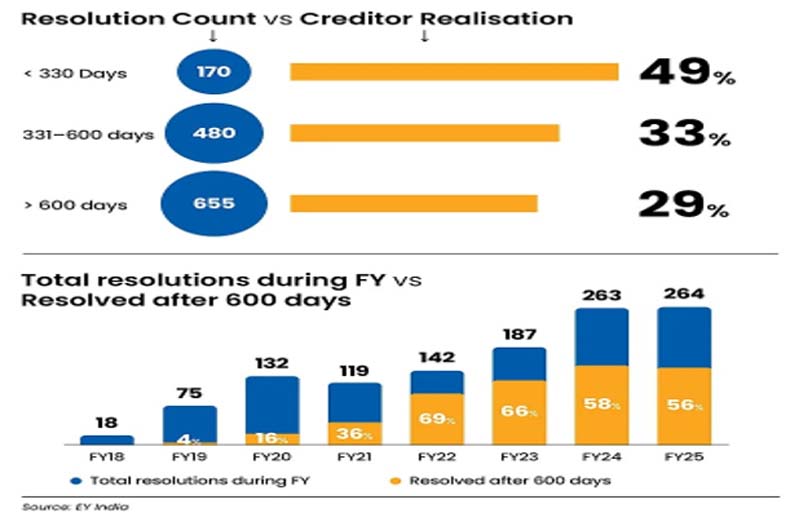
The Insolvency and Bankruptcy Code, 2016, reshaped India’s approach to stressed assets, but its performance must be evaluated by timely revival and value preservation, not merely approved plans. Average resolution time rose from 713 days in March 2025 to 744 days in March 2026, far exceeding the statutory 330-day benchmark. Yet cumulative recoveries through resolution plans reached ₹4.3 lakh crore, demonstrating the mechanism’s significance.
Individual cases expose different weaknesses. Subhash Chandra’s ₹6.5 crore repayment package against reported claims of approximately ₹22,006 crore raised questions about creditor protection. However, this concerned personal-guarantor insolvency, not corporate resolution; the package included ₹25 lakh in process costs, and recoveries from borrowing companies must be assessed separately.
Jaypee Infratech entered insolvency in August 2017, but Suraksha’s takeover followed appellate approval only in May 2024, illustrating the prolonged uncertainty confronting homebuyers. Bhushan Power and Steel’s ₹19,700 crore resolution secured Supreme Court approval in September 2025 after an earlier liquidation ruling, highlighting litigation risk even after acquisition.
Delay can weaken businesses, raise costs and depress bids. Nevertheless, haircuts alone cannot establish failure: evaluation must distinguish losses incurred before admission from value subsequently preserved. The priority is faster adjudication, credible valuations and enforceable implementation, rather than procedural closure alone.
Inflation, Oil and Policy Trade-Off
The growth outlook must also be read alongside inflation risks. The RBI projects average consumer inflation at 5.1% and warns that growth could moderate in the second half of FY27 as the initial stimulus from GST rationalisation and income-tax relief fades, sharpening the trade-off between growth and inflation control.
Persistently high oil prices would raise India’s import bill and put pressure on domestic costs. A weaker rupee could intensify imported inflation, while an adverse monsoon could push food prices higher. If these pressures become entrenched, monetary policy may need to remain tight—or tighten further—even when businesses would benefit from lower financing costs.
This is an uneasy trade-off. Premature easing could aggravate inflation expectations; excessive restraint could weaken investment and demand. The response must depend on the persistence and source of price pressures, rather than on any mechanical preference for either growth or inflation control. Fiscal and supply-side measures can help, particularly where food prices and logistics bottlenecks are concerned, but they cannot eliminate the consequences of a prolonged external energy shock.
Agriculture remains central to this macro balance. Although it accounts for about 16% of GDP, its influence extends well beyond that share. Farm incomes shape rural demand, while weather conditions affect food prices and household purchasing power. Headline GDP growth can therefore coexist with considerable stress in parts of the rural economy.
Employment Test
India’s demographic scale is an advantage, provided the economy can generate productive work on a sufficient scale. Growth of around 7% is valuable, but the quality of that growth is also important. An expansion concentrated in capital-intensive industries and high-productivity services may raise output without absorbing enough workers entering the labour market.
Manufacturing has a crucial role, especially in labour-intensive activities. Construction, tourism, logistics, food processing, healthcare and care services can also create employment across a range of skill levels. Modern business services can provide well-paid jobs, but they cannot carry the entire burden of employment generation.
The priority is to move workers from low-productivity activities to better-paid, more productive jobs. This necessitates market-relevant skills, closer industry–training linkages, greater female workforce participation and industrial policies aligned with labour absorption. Initiatives such as the National Manufacturing Policy (2011), Make in India (2014), PLI Scheme (2020), PM Gati Shakti (2021), National Logistics Policy (2022) and National Manufacturing Mission (2025) reflect this broader agenda. Ultimately, manufacturing success must be measured not merely by capacity created, but by productive employment generated to create meaning and value in the lives of what Mahatma Gandhi called “the teeming millions of India”.
MSMEs are central to India’s growth, but thin margins, weak bargaining power and delayed payments leave them vulnerable. Their expansion depends on timely, affordable finance, appropriate collateral requirements and credit assessments that reflect business realities. A viable enterprise can become distressed when receivables stall or borrowing costs rise. Technology adoption, skills, market access and reliable infrastructure matter, but these cannot compensate for chronic working-capital shortages. Policy must prioritise payment discipline, simpler compliance, predictable regulation, faster contract enforcement and dependable utilities. These are not merely administrative improvements; they determine whether small businesses can invest, raise productivity, create jobs and contribute more broadly to sustained economic growth across regions and diverse industries.
Rural Demand and Consumption Breadth
Urban consumption has provided an important source of momentum, supporting demand for housing, automobiles, travel, consumer durables and financial services. But a consumption-led expansion becomes more durable when purchasing power spreads beyond affluent urban households, necessitating more than transfers or short-term stimulus. Higher agricultural productivity, improved irrigation, stronger rural infrastructure and a wider range of non-farm jobs are essential. Food processing, storage, distribution and rural services can connect agriculture with local manufacturing and wider markets, reducing dependence on farm income alone.
The relationship between rural and urban growth should not be framed as a choice between the two. A stronger rural economy expands demand for manufactured goods; better connectivity enables rural producers to reach markets; and non-farm employment can support more stable household incomes. These links help turn growth into a broader domestic market rather than simply a larger one.
Fiscal Consolidation Without Sacrificing Growth
Fiscal consolidation remains necessary. Public debt and interest obligations constrain the room available to respond to future shocks, while excessive government borrowing can place pressure on financing conditions. But consolidation is not a mechanical exercise in cutting expenditure to meet a specified target; the composition and quality of spending are also important. Productive infrastructure, education, health and other investments that raise capacity can strengthen the future tax base. Weakly targeted expenditure and projects with limited economic returns deserve closer scrutiny. A credible medium-term fiscal framework can help reconcile debt sustainability with the need to build productive capacity.
Centre-state fiscal relations will become increasingly important as infrastructure, urbanisation and social-sector demands grow. The quality of public services and the efficiency of implementation often depend on state-level capacity. Fiscal policy should therefore support productive investment across levels of government while preserving transparency and discipline in conformity with the Fiscal Responsibility and Budget Management (FRBM) Act, 2003, to ensure financial discipline, reduce fiscal deficits, and achieve long-term macroeconomic stability.
Real Challenge Ahead
India enters its next economic phase on strong footing, backed by resilient domestic demand, sustained public investment, healthier bank balance sheets, and robust external buffers. As our macroeconomic policy series has consistently underscored, India has successfully transformed from a “Fragile Five” economy into a primary global growth engine. Today, the focus must shift to the quality of that growth. Public infrastructure should draw private capital, competitive manufacturing must generate jobs at scale, and MSMEs require access to growth finance. Crucially, rural incomes must keep pace with urban gains while productivity improvements move workers into higher-value employment. Sustainable, broad-based prosperity cannot rely on trickle-down assumptions alone; it requires conscious policy execution.
To be sure, sustaining 7% growth would be a substantial achievement. Sustaining it for a decade while creating productive jobs and widening economic opportunity would be more consequential. India’s strategic imperative has shifted from proving resilience to translating that stability into robust investment, higher productivity, and broadly shared economic growth.
ABOUT THE AUTHOR
 Suraj Pratap Malik, an alumnus of Modern School, Delhi, Amity University and Cardiff University, founded and nurtured Infomerics Ratings from inception. With extensive banking and financial services experience, he specialises in regulation, strategic partnerships, innovation, mergers and acquisitions, and international relations. Committed to educational opportunities for the underprivileged, he supports NGOs and CSR initiatives. An avid golfer, he encourages emerging talent and amateur golfers.