
What Survives After A Hundred Years?
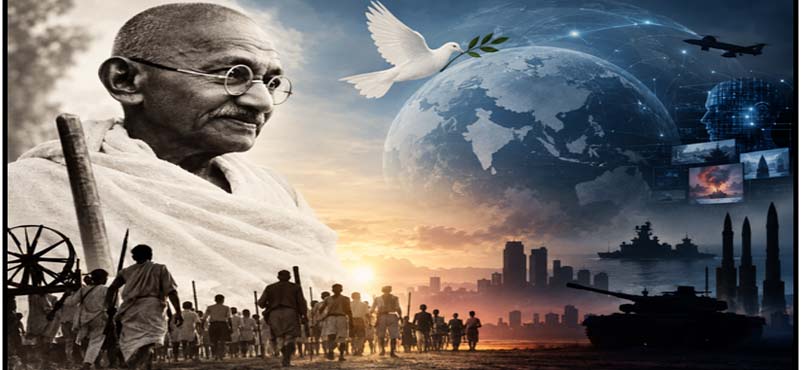
On 2 October 2026, it is difficult not to notice how different the world is from the one Mahatma Gandhi knew. Wars continue in Europe and West Asia. Military capabilities have expanded enormously. Nuclear weapons remain central to strategic calculations. Drones, cyber operations, artificial intelligence and long-range precision weapons have changed the way wars are fought.
Economic pressure, technology controls, critical minerals and supply chains have all become part of the larger geopolitical competition. The world has become far more powerful in material terms. It has not necessarily become better at settling its differences.
That makes Gandhi worth revisiting. Not as a solution to today’s geopolitical problems, and certainly not as someone whose every idea can simply be carried forward into 2026. A hundred years have changed the state, society, economics and the nature of war. Gandhi could not have imagined nuclear deterrence, cyber warfare or artificial intelligence. Some of his economic and social ideas belonged to the India of his time. The more useful question is, what remains of his revered legacy ?
Non-Violence Was Not Weakness
Gandhi’s ahimsa is often understood simply as opposition to violence. It was more than that. For Gandhi, non-violence required courage, discipline and a willingness to suffer rather than make others suffer. Satyagraha was not passive acceptance. It was resistance based on truth.
There is an important distinction here. Modern states cannot abandon military power. They have to protect their people, territory and interests. Deterrence remains a reality of international politics. Gandhi cannot therefore be offered as a prescription for modern defence. But he did show that power is not always measured by the ability to hurt or inflict violence. Public support, legitimacy, moral authority and the ability to withdraw cooperation can also exert political force.
“Do or Die”
The Quit India Movement of 1942 remains one of the clearest examples. On 8 August, after the Quit India resolution was adopted, Gandhi gave his famous “Do or Die” call. He and other Congress leaders were arrested the following day. Gandhi’s call was made within the framework of his continuing commitment to non-violence. “Do or Die” was not a call to take up arms. It expressed a determination that freedom could no longer be postponed. That is perhaps the more enduring point. The way a struggle is conducted can influence its political force. Gandhi understood this better than most.
An Idea That Travelled
Gandhi’s influence did not stop at India’s borders. Martin Luther King Jr. studied Gandhi and made non-violent resistance central to the American civil rights movement. He later visited India in 1959 to deepen his understanding of Gandhi’s methods. Nelson Mandela also acknowledged Gandhi’s influence, although the South African struggle eventually took a very different path and included armed resistance. The Dalai Lama has repeatedly spoken of Gandhi’s influence on his own commitment to non-violence.
None of these leaders simply copied Gandhi. Their circumstances were different and their methods evolved accordingly. What travelled was the idea that injustice could be opposed without hatred becoming the driving force.
Truth In The Age Of Information Warfare
If one Gandhian idea has acquired a new importance, it is satya—truth. Information is now part of conflict.
Artificial intelligence can produce convincing images, videos and voices. During wars, genuine battlefield material can sit alongside fabricated material, and the difference may not be obvious to the ordinary viewer. A false claim can travel around the world before it can be checked.
That has consequences beyond journalism. A fabricated statement can inflame public opinion. A manipulated image can put pressure on governments. A false account of an incident can make diplomacy harder. Gandhi’s insistence on truth therefore has a very contemporary relevance. When competing narratives spread globally, credibility matters.
The Digital Test
The problem is not limited to governments or armies. A disagreement that once remained within a small group can now involve millions within hours. Words travel across continents almost instantly. Anger, humiliation and misinformation can be amplified without much thought about the consequences. The answer is not to avoid disagreement. It is to conduct it differently.
Check before sharing. Disagree without abusing the other person. Listen before reacting. Do not forward something simply because it supports what we already believe. In a world where everyone can amplify a message, knowing when not to do so is also a form of strength.
India And Its Neighbourhood
For India, these are not abstract questions.
Operation Sindoor showed how quickly terrorism, military action, diplomacy and information can become part of the same crisis.
The confrontation with Pakistan in May 2025 also underlined the particular dangers of a conflict between two nuclear-armed neighbours. None of this reduces the importance of military preparedness. Quite the opposite.
A country facing terrorism and external threats has to retain the ability to respond. Restraint cannot mean the absence of action. Dialogue cannot mean concession. But military capability and dialogue are not mutually exclusive. In a nuclearised neighbourhood, keeping channels open while maintaining credible deterrence is a practical necessity. There is a limited Gandhian lesson here: strength and restraint can coexist.
Self-Reliance
Swadeshi is another idea that needs to be treated carefully. Gandhi’s thinking arose from colonial India. It cannot simply be translated into an argument for economic isolation in today’s interconnected world. Yet the concern behind it has not disappeared.
Dependence on critical technologies, energy, minerals, semiconductors and foreign supply chains can become a strategic vulnerability. For India, strategic autonomy therefore requires domestic capacity in areas that matter to national security and economic resilience. Self-reliance does not have to mean shutting the door to the world. It can mean having enough capability of our own to keep our choices open.
Dialogue When Confrontation Is Rising
Gandhi believed that an opponent should be resisted without being reduced to an object of hatred. Modern international politics is less accommodating. Terrorism, territorial aggression and threats to sovereignty cannot always be dealt through persuasion.
Governments have a responsibility to protect their citizens. Military preparedness remains indispensable. Yet dialogue still has a place.
The wars of the present have shown how difficult it is to find an exit once confrontation becomes entrenched. Military action, economic pressure, cyber operations, drones and information campaigns can feed into one another. Miscalculation becomes harder to contain. Gandhi’s lesson is therefore not that force should never be used. It is simpler: force should not become the only language available.
From India To The United Nations
Gandhi’s influence eventually reached the international system. In 2007, the United Nations General Assembly designated 2 October as the International Day of Non-Violence. India introduced the resolution with 140 co-sponsors. The resolution recognised the universal relevance of non-violence and called for a culture of peace, tolerance and understanding.
The UN’s message for 2026 is itself relevant to the world around us. It speaks of rising division, tension and conflict and calls for dialogue, diplomacy, empathy and shared humanity. An idea that grew out of India’s freedom struggle has travelled a long way.
What Einstein Saw
Albert Einstein wrote that future generations might scarcely believe that such a man had “in flesh and blood” walked upon the earth. The line has been quoted often, but it is worth reading again in the context of the present geo-political environment.
Einstein and Gandhi belonged to a world before today’s nuclear arsenals, artificial intelligence, autonomous systems, cyber warfare and instantaneous global communication.
Yet one question they both confronted, in very different ways, remains with us: What happens when human power grows faster than human restraint?
What Remains
It would be wrong to turn Gandhi into a universal answer for the challenges of the 21st century. His economic ideas cannot simply be imposed on a globalised economy. His methods of resistance cannot be mechanically transferred to every modern conflict. A military commander cannot defend a country through moral appeal alone. States require armed forces, intelligence, technology and credible deterrence.
What survives is more selective. Truth. Restraint. Dialogue. Courage in the face of injustice. The refusal to dehumanise an opponent. And the instinct to reduce critical dependence wherever it can threaten national freedom of action. These are not answers to every problem. They are useful principles against which some of our choices can be tested.
That may be Gandhi’s real relevance after a hundred years. He does not provide a geopolitical doctrine for 2026. He makes us think about the purpose of power and the manner in which it is used. The world does not need to become Gandhian. But a world with unprecedented power to destroy may need to rediscover the value of restraint. Einstein wondered whether future generations would believe that such a man had actually walked upon the earth. Perhaps our question should be different:
Having acquired unprecedented power to destroy, have we acquired an equal capacity to restrain ourselves?
ABOUT THE AUTHOR
 Lt Gen Tarun Chawla, was commissioned into the Regiment of Artillery in Jun 1984. He has served with the United Nations Mission in Liberia and has been an instructor at the College of Defence Management at Secunderabad. The officer has commanded an Artillery Brigade in the LC Sector in J&K, and an Artillery Division as part of Army’s Western Command. He was the Director General Financial Planning, prior to assuming the role of Director General of Artillery.