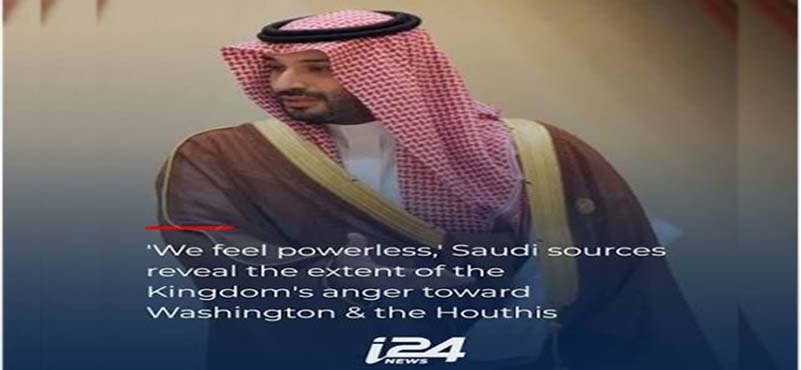
The Houthi campaign against Saudi Arabia, which began on July 13, 2026, and has not stopped since, is being read across the Gulf as a test of American reliability. Missiles have struck Riyadh. Tankers carrying Saudi crude have been targeted in the Red Sea. A refinery at Jazan has burned. A pipeline meant to bypass the Strait of Hormuz has been hit by an Iraqi militia acting, in effect, as an extension of the same campaign. None of this is new in kind. It is new in scale, duration, and what it reveals about the limits of a defence partnership that Washington itself upgraded barely a year earlier.
In November 2025, Crown Prince Mohammed bin Salman travelled to Washington and appeared to secure everything Riyadh had sought for a decade: designation as a major non-NATO ally, a green light for the F-35, and a new strategic defence agreement. Ten months later, with Saudi cities under fire, that upgraded relationship has yielded intelligence sharing and quiet diplomacy, not American aircraft. The kingdom wanted direct military engagement. It has not received it. The gap between the paper commitment and the operational response is the real story here, and it will shape Gulf security thinking for years.
This is not the first time Riyadh has felt this chill. In September 2019, drones struck the Abqaiq processing facility and the Khurais oil field. The attack was far more likely to have been carried out by Iran or its proxies than by the Houthis, who claimed responsibility. President Trump condemned the strike, said he was locked and loaded, and then did nothing beyond imposing additional sanctions. The stated reason was that American energy independence had reduced the strategic weight of Gulf oil for Washington. The unstated lesson for Saudi Arabia was that its primary security guarantor would tolerate direct attacks on its territory without a military response. That grievance did not fade. It hardened into a decade-long Saudi push for a formal defence treaty and, when that stalled, for the looser but still meaningful arrangement reached last November.
The current American reticence has several plausible sources, and they are not mutually exclusive. The Pentagon’s inspector general has flagged shortages of sophisticated interceptors after prolonged operations against the Houthis, and Fifth Fleet facilities in Bahrain sustained real damage earlier in the broader conflict with Iran. A force under strain is less inclined to open new commitments. There is also the May 2025 ceasefire with the Houthis, brokered with Omani mediation, which a fresh American strike would unwind. And there is the domestic political calendar. With midterm elections approaching, an American president who has spent months declaring the Iran war effectively over has a strong incentive to avoid any action that would reopen it in public view.
Whatever the mix of reasons, the effect on Riyadh is the same. A partner under attack by its principal adversary is watching its guarantor talk to that adversary rather than act against it. That is not abandonment in the formal sense. Decades of training relationships, arms sales, and integration into American regional planning are not being dismantled. But it is abandonment in the sense that matters most to a state under fire: the guarantor’s absence at the exact moment its presence was expected.
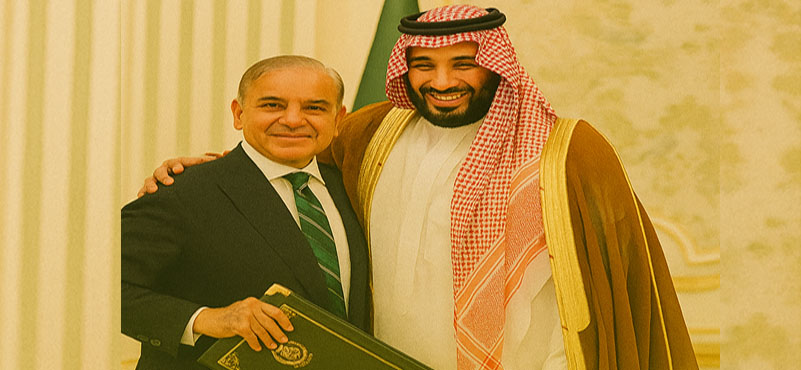
Saudi Arabia’s response will not be a dramatic rupture. It will be quieter yet more consequential. Expect Riyadh to press harder for clarity rather than sentiment: precise answers on what a major non-NATO ally designation actually obligates Washington to do, and on the role Saudi Arabia will have in American decisions that affect its security environment. Expect continued diversification of defence partnerships, with the recent Mecca Pact linking Saudi Arabia, Pakistan, and Turkey as an early marker, not a replacement for the American relationship but a hedge alongside it. And expect renewed, if unglamorous, investment in an indigenous defence industrial base under Vision 2030, particularly in cost-effective air defence, driven as much by strategic necessity now as by the original economic diversification goal.
There is also a domestic Saudi dimension worth noting. The kingdom’s leadership has spent a decade on an inward-looking transformation: economic diversification, social liberalisation, and the empowerment of Saudi women, none of which it wanted interrupted by war. Some of the more extravagant giga-projects, including The Line and the Trojena winter resort, have already been shelved or scaled back. This reprioritisation predates the current fighting and reflects a harder-headed Vision 2030, not a retreat from it. The social transformation, which costs little in fiscal terms relative to the giga-projects, is unlikely to be reversed by the current conflict. But the appetite for grand physical monuments will likely shrink further as the war continues.
For India and other states with deep economic and diaspora ties to the Gulf, the lesson is more narrowly focused but still important. Gulf security guarantees, however formally worded, are tested in practice, not on paper, and the outcome of that test shapes how regional states hedge afterwards. New Delhi has its own reasons to watch how Riyadh diversifies its defence partnerships and rebuilds its capacity, since a more self-reliant and multi-aligned Saudi Arabia will approach every future partner, India included, with the same demand for clarity it is now making of Washington.
The oil dimension sharpens this concern for India. Saudi Arabia has for years ranked among India’s top two or three sources of crude, and any sustained disruption to Saudi output, export terminals, or Red Sea shipping lanes feeds directly into India’s import bill and inflation, given that India imports roughly 85 percent of the crude it consumes. A blockade that keeps tankers away from Saudi ports, or repeated strikes on refining and pipeline infrastructure, tightens an already thin global spare capacity and pushes benchmark prices higher, regardless of which country is targeted. India has hedged this exposure over the past decade by diversifying toward Russian, American, and West African crude and by expanding its strategic petroleum reserves, but Saudi Arabia remains too large a supplier to route around entirely. A prolonged Houthi campaign therefore carries a direct cost for Indian refiners and consumers and gives New Delhi its own stake in seeing the conflict de-escalate quickly, independent of how the U.S.-Saudi security relationship is resolved.
The immediate path for Saudi Arabia remains unchanged: continue military operations against the Houthis as long as necessary, and eventually return to an imperfect diplomatic settlement that likely runs through Iran rather than around it. The larger, slower shift, from a relationship built on trust to one built on explicit guarantees and hedged alternatives, is already underway. That shift will outlast this particular round of Houthi attacks and will define the U.S.-Saudi relationship well beyond it.
ABOUT THE AUTHOR
 Lieutenant General A B Shivane, is the former Strike Corps Commander and Director General of Mechanised Forces. As a scholar warrior, he has authored over 200 publications on national security and matters defence, besides four books and is an internationally renowned keynote speaker. The General was a Consultant to the Ministry of Defence (Ordnance Factory Board) post-superannuation. He was the Distinguished Fellow and held COAS Chair of Excellence at the Centre for Land Warfare Studies 2021 2022. He is also the Senior Advisor Board Member to several organisations and Think Tanks.