
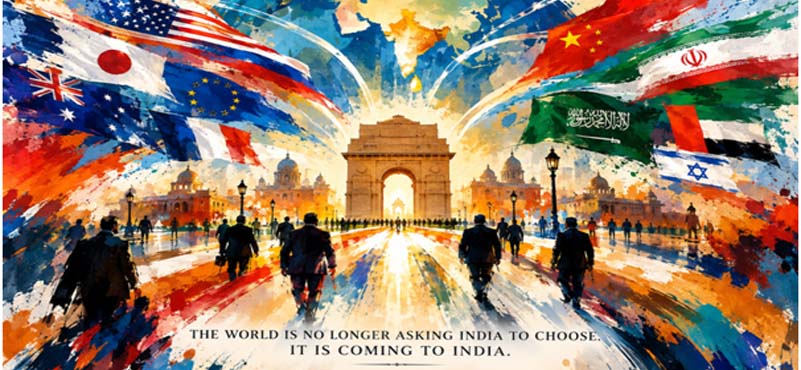
The Photograph that Should Make Us Think
There are photographs that record an event, and there are photographs that reveal a change in the world. The diplomatic congregation in New Delhi belongs to the second category. Look carefully at the gathering and the usual language of foreign policy begins to sound inadequate. Russia is in Delhi. Iran is in Delhi. China is engaging India at the highest level. The Gulf is represented. Beyond this gathering stands India’s continuing engagement with the United States, Japan and Australia through the Quad. Countries that disagree, compete and sometimes confront one another are nevertheless willing to enter the same Indian diplomatic space. The instinctive interpretation will be that India is cleverly balancing everyone. But that misses the more interesting story. The real question is not why India can accommodate so many powers. It is why so many competing powers find it worthwhile to come to India. The photograph is therefore not really about the guests. It is about the host.
World has Changed—And so has India’s Question
For much of the Cold War and its aftermath, India’s foreign policy was examined through the prism of alignment. Was New Delhi closer to Moscow or Washington? Was it leaning towards one bloc, resisting another, or attempting to remain non-aligned? The underlying assumption was that the great powers occupied the centre of the map and India had to explain where it stood in relation to them. That map no longer describes the world we inhabit. Power today is dispersed across overlapping networks of security, energy, technology, trade, finance and connectivity. A country can cooperate with Washington on the Indo-Pacific, retain a defence relationship with Moscow, acquire advanced platforms from France and Israel, pursue connectivity through Iran, deepen economic and energy links with the Gulf and remain engaged with China through multilateral forums, without believing that these relationships must become identical. India is not attempting to create a geopolitical family whose members love one another. It is building a network in which India’s own interests have room to breathe.
From Alignment to Optionality
The most useful word for this strategy may not be non-alignment or even multi-alignment. It is optionality. A powerful country does not merely accumulate friends; it accumulates choices. India’s relationships with different powers provide different forms of strategic, economic and technological space. Russian energy can serve one requirement; French aerospace another; Israeli defence technology another; American capital, technology and markets another; Gulf investment and energy another; Iranian geography and connectivity another. The point is not that every relationship is equally comfortable or equally permanent. The point is that no single relationship should become so indispensable that it dictates the limits of India’s sovereignty. Strategic autonomy, therefore, is not the freedom to stand outside every camp. It is the freedom to engage many camps without becoming subordinate to any one of them. India can cooperate where interests converge, compete where they collide and disagree where necessary, while keeping the larger relationship alive. That is harder than choosing an ally because it demands constant judgement rather than permanent loyalty.
Great Indian Contradiction
The remarkable feature of this diplomacy is that its contradictions are not a flaw to be hidden; they are the very reason the strategy matters. Russia and the West have a troubled relationship. Iran and several Gulf states have competing interests. India works with the United States and its Indo-Pacific partners while simultaneously engaging China in multilateral settings. India can deepen ties with Israel while maintaining its relationships across the Arab and Islamic world. None of these equations can be reduced to friendship or hostility. Yet India does not need to resolve every contradiction before conducting business. It can compartmentalise. It can separate energy from ideology, defence from diplomacy, commerce from political disagreement and connectivity from strategic rivalry. This is not hypocrisy, as critics may sometimes suggest. It is the normal grammar of a multipolar world. Countries are discovering that they can be partners in one arena, competitors in another and cautious interlocutors in a third. India’s strategic maturity lies in refusing to let one disagreement automatically destroy an entire relationship. Diplomacy, after all, is not always the art of making adversaries friends. Sometimes it is the art of ensuring that disagreement does not become permanent estrangement.
The New Currency of Power: Convening
This is where the Delhi congregation acquires a deeper significance. Power is usually counted in divisions, aircraft carriers, missiles, GDP, trade or technological capability. But there is another form of power that receives less attention: the power to convene. A country possesses convening power when competing actors find its platform too valuable to ignore. India is not necessarily mediating every rivalry represented in Delhi, nor does it need to. Its achievement is subtler. It is creating a diplomatic space in which different relationships can coexist. That space is valuable because today’s world is full of contradictions that cannot be permanently settled. A country that can bring together different interests without pretending that their differences have disappeared becomes useful to all of them. Delhi can increasingly function as a marketplace of strategic choices, a place where energy, defence, commerce, connectivity, technology and geopolitics intersect. A country becomes strategically important not only when others need what it possesses, but when others need access to the space it creates. The world may not agree with India on everything. It increasingly has to reckon with India on almost everything that matters.
The Delhi Test
Yet diplomatic freedom cannot be sustained by clever choreography alone. Strategic autonomy ultimately rests on domestic capability. The freedom to say no abroad begins with the capacity to stand on one’s own feet at home. India needs economic scale, military credibility, energy resilience, technological capability, manufacturing depth, secure supply chains and infrastructure that can support its ambitions. Every capability built domestically enlarges the diplomatic space available internationally. Every excessive dependence narrows it. This is why foreign policy and national development cannot be separated. A country that depends on one supplier for energy, one country for technology, one source for critical components or one partner for defence equipment will eventually discover that strategic autonomy has a ceiling. Diversification is therefore not merely an economic preference; it is a national-security doctrine. The more India can produce, innovate, finance, defend and connect by itself, the more confidently it can engage everyone else.
“India First” not as a Slogan but as a Responsibility
There is also a moral dimension to this argument. Governments do not conduct foreign policy for the satisfaction of geopolitical theorists. They do it for citizens. They must secure energy for homes and industry, technology for growth, weapons for soldiers, markets for businesses, investment for development, jobs for young people and stability for society. A foreign policy that ignores these responsibilities in pursuit of somebody else’s strategic preference is not principled; it is irresponsible. The relevant question cannot always be what Washington wants, what Moscow prefers, what Beijing expects or what another capital might approve. The first question has to be what India needs, what India can afford and what India must protect. This does not make India selfish. It makes India sovereign. Strategic autonomy is ultimately a citizens’ interest, not a diplomat’s luxury. The citizen who needs affordable energy, the soldier who needs dependable equipment and the entrepreneur who needs access to markets all have a stake in India’s ability to maintain choices.
The Final Reversal
It would be easy to describe the current moment as a clever Indian balancing act. But even that language gives India too little credit. A balancer stands between stronger forces and tries to prevent either from dominating. India is becoming something different: a consequential pole whose choices increasingly affect the calculations of others. Countries do not come to Delhi merely because India has managed to keep everybody reasonably happy. They come because India matters—to their markets, their energy calculations, their supply chains, their security architecture, their connectivity ambitions and their conception of the emerging world order. That is the real transition: from being courted by great powers to becoming a factor in the strategies of great powers.
The leaders will eventually leave Delhi. Aircraft will take off, motorcades will disappear and summit communiqués will become yesterday’s news. But the larger image will remain: a fragmented world gathering in a country that refuses to be neatly placed in one of its fragments. The old world asked India to choose a side. The emerging world is discovering something more consequential. India has chosen its interests, built the freedom to pursue them and created enough space for competing powers to remain engaged with it. That is not merely multi-alignment. This marks a profound shift in power.
And perhaps that is the real meaning of this congregation: the world is no longer asking only where India stands; increasingly, it is coming to Delhi to negotiate with the fact that India can stand on its own.
ABOUT THE AUTHOR
Lt Gen Rajeev Chaudhry (Retd) is a social observer and writes on contemporary national and international issues, strategic implications of infrastructure development towards national power, geo-moral dimension of international relations and leadership nuances in changing social construct.