
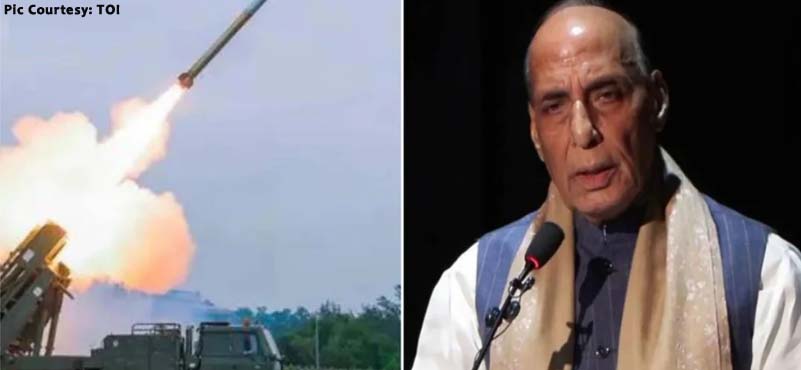
Defence Minister Rajnath Singh’s approval to transfer all DRDO-developed conventional missile technologies to private industry is, on paper, a modest administrative order. In practice, it is one of the more consequential shifts in India’s defence production architecture in years. For decades, the missile ecosystem has run on a nomination model, in which a single public sector unit was handed a programme with little competition and even less urgency. That model now formally ends for an entire category of weapons. Air defence missiles, anti-ship missiles, long-range strike systems, and the systems integration that binds them together will be subject to competitive bidding among qualified Indian private firms, with Bharat Dynamics Limited no longer the default choice by birthright.
The scope is deliberately bounded. Strategic systems such as the Agni series remain outside this order, as does the unique BrahMos arrangement. What is on the table is everything conventional: short-range air defence missiles, the Astra beyond-visual-range air-to-air missile, the Pralay quasi-ballistic missile, and the wider family of ground-attack and anti-ship weapons that any modern force needs in quantity rather than in small, cherished numbers. That distinction between strategic and conventional is the right one to draw. It protects the sanctity of the nuclear deterrent while opening the much larger and more urgent problem of conventional stockpiles to a wider industrial base.
The timing tells its own story. The West Asia war and the Russia-Ukraine conflict have both, in the bluntest possible terms, shown that modern conflict consumes precision munitions at a rate no peacetime production line can match. Closer home, Pakistan’s decision to stand up an Army Rocket Force Command, and its steady progression from Fatah I through Fatah II towards a reported thousand-kilometre-class Fatah V, is a clear signal that the subcontinent is entering a rocket and missile arms race of its own. India cannot outproduce that trend with a single DPSU working to its own institutional rhythm. Affordable mass, not exquisite scarcity, is now the operational requirement, and mass is something private industry, with its multiple production lines and commercial instincts, is structurally better suited to deliver.
There is also an industrial logic worth stating plainly. Firms such as Bharat Forge, Solar Industries, Adani Defence, Larsen and Toubro, and a growing tier of specialised MSMEs have spent the better part of a decade building propulsion, seeker, composite, and systems integration capabilities, often for export or for subsystems supplied into existing programmes. What they have lacked is not competence but access, the ability to bid for full technology transfer on a level playing field rather than wait for a DPSU to decide how much work to subcontract downward. Removing that gatekeeping function is likely to do more for depth in the missile industrial base than any single fresh order placed with an existing player.
None of this should be read as a guarantee of smooth execution. Three risks deserve attention.
First, the capacity for technology absorption is uneven. A handful of large private groups have genuine systems engineering depth, but transferring the same class of technology to a wider set of qualified vendors, as the policy intends, will test whether India has enough trained metallurgists, propulsion engineers and quality assurance personnel. A ToT handed to a firm that cannot sustain configuration control is a liability, not an asset.
Second, the test and evaluation infrastructure, including the ranges, telemetry, and certification pipelines that DRDO and the services currently operate, was designed for a smaller number of programmes. Competitive bidding will multiply the number of qualifying trials required, and unless that infrastructure is expanded in parallel, the policy risks becoming a paper reform that private firms win on contract but cannot clear on trial.
Third, there is a quiet danger of substituting one form of concentration for another. If the competitive process consistently favours the two or three largest conglomerates because only they can meet qualification thresholds, the stated goal of broadening MSME participation will not be met, even as the nomination system is formally abolished.
Recommendations: What Must Come Next
- The Ministry should publish a transparent, tiered qualification framework now, before the first bidding round, so that MSMEs know precisely which capability thresholds unlock participation in tiers two and three as subsystem suppliers, rather than learning after the fact that only prime integrators were eligible.
- Test range capacity, particularly at Chandipur and the naval ranges used for anti-ship trials, needs a funded expansion plan explicitly tied to this policy, rather than being treated as a separate budget line that competes with it.
- DRDO’s role should shift decisively from production shepherd to design authority and quality auditor, with clear service-level commitments on how quickly it certifies a private firm’s production standard, since delay at that stage would quietly recreate the very inefficiency the reform is meant to remove.
- The most ambiguous aspects of deep indigenous content, by technology and critical parts, must be ruthlessly institutionalised, including supply chains, both fore-end and back-end.
- Startup handholding by DRDO must be an integral part of an integrated defence ecosystem. Unfortunately, within the first five years, a large number of promising start-ups end up in the proverbial valley of death, and talent is buried for lack of an encouraging environment.
- Finally, the armed forces should be included in the qualification criteria from day one, specifying life-cycle support, obsolescence management and surge production commitments as bid parameters, not as afterthoughts negotiated after a winner is chosen.
The decision itself is sound and, frankly, overdue. Bharat Dynamics Limited and the DPSU network will remain important, but they should now compete rather than inherit. What will determine whether this becomes a genuine transformation or another well-intentioned order that stalls in implementation is the unglamorous work of the next eighteen months: qualification standards, range capacity, and the discipline to let private industry actually build, not merely bid. The bottom line remains: India needs an Integrated Indigenous Defence Industrial Base – Technology, mass production and resilient supply chains matter.
ABOUT THE AUTHOR
 Lieutenant General A B Shivane, is the former Strike Corps Commander and Director General of Mechanised Forces. As a scholar warrior, he has authored over 200 publications on national security and matters defence, besides four books and is an internationally renowned keynote speaker. The General was a Consultant to the Ministry of Defence (Ordnance Factory Board) post-superannuation. He was the Distinguished Fellow and held COAS Chair of Excellence at the Centre for Land Warfare Studies 2021 2022. He is also the Senior Advisor Board Member to several organisations and Think Tanks.