
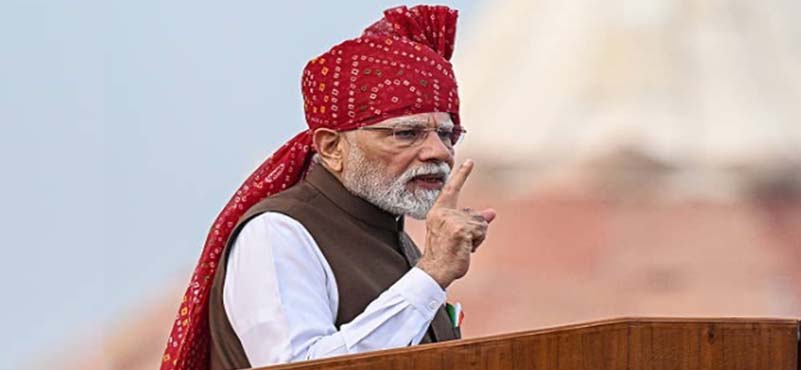
PM Modi’s 15 August 2026 Independence Day address offers an expansive and confident account of India’s path towards Viksit Bharat 2047. Its central contribution is the “Sapta Dhara” framework—manufacturing, agriculture and food processing, technology and innovation, Gati Shakti-led connectivity, defence production, the green and blue economy, and soft power—which seeks to connect economic modernisation with strategic autonomy. Yet, the speech is more compelling as a statement of national direction than as a sufficiently specified programme for employment-intensive, equitable and fiscally sustainable transformation.
A Critical Examination
The Prime Minister’s address from the ramparts of the Red Fort placed India’s development challenge within a long-term political and civilisational frame: the transition from an aspiring economy to a developed, self-confident and strategically autonomous nation by 2047. The underlying proposition of a steady move to Viksit Bharat is that India must move beyond dependence on imported technologies, foreign capital, energy, defence equipment and global supply chains and build domestic productive capabilities. In this connection, we would do well to do what our ancient scriptures stressed,
“प्रारभ्यते न खलु विघ्नभयेन नीचैः प्रारभ्य विघ्नविहिता विरमन्ति मध्याः ।
विघ्नैः पुनः पुनरपि प्रतिहन्यमानाः प्रारभ्य चोत्तमजनाः न परित्यजन्ति ।। “
नीतिशतकम्
English translation: The common ones won’t start a venture;
They fear a hard and tough adventure.
The mediocre start but see a sign of trouble, stop and flee.
The best are those who start and then,
When hardship strikes, and strikes again,
And a thousand hurts and hurdles hit,
Will never waver, never quit.
Bhartṛhari’s Nītiśatakam
The “Sapta Dhara” framework operationalises this proposition by identifying seven streams of national strength: manufacturing; farming and food processing; technology and innovation; logistics and infrastructure through PM Gati Shakti; defence capability; the green and blue economy; and soft power. This is an appropriate framework in broad developmental terms. India’s aspiration to become a developed economy cannot be met merely through consumption-led GDP expansion or the continued growth of high-productivity services concentrated in a limited number of cities. It requires a structural transformation in which labour and capital move into more productive sectors, domestic firms improve technological capability, supply chains deepen, exports become more sophisticated, and the gains from growth reach households across regions and social groups. The speech recognises, at least rhetorically, that India’s challenge is not simply to grow faster, but to create the productive capacity needed to sustain growth for two decades.
The speech’s optimism stems from real GDP growth at 7.7% in FY2025–26, while real gross value added—arguably a more useful measure of underlying production because it excludes the effects of indirect taxes and subsidies—grew even faster at 7.9%. Nominal GDP grew by 8.9%. All these impressive figures confirm that India has remained among the world’s fastest-growing major economies despite geopolitical instability, elevated energy prices and uncertain global trade conditions.
 Fiscal policy also provides a partial foundation for the government’s confidence. The Union fiscal deficit was contained at 4.4% of GDP in FY 26, while the Budget for 2026–27 targets a further reduction to 4.3% of GDP. Growth impulse is provided by budgeting of effective capital expenditure at ₹17.15 lakh crore, equivalent to 4.4% of GDP. This combination—incremental fiscal consolidation alongside high public investment—has been a defining feature of the present growth strategy. Public expenditure on roads, railways, logistics, digital infrastructure, energy systems and urban connectivity can reduce transaction costs, crowd in private investment and improve the competitiveness of Indian firms. However, the speech tends to treat infrastructure construction as a near-automatic route to broad-based prosperity.
Public capital expenditure is necessary, but it is not sufficient. A highway, freight corridor or industrial park produces durable developmental gains only when it is matched by viable firms, skilled workers, reliable electricity, affordable finance, efficient local regulation, market access and functioning urban institutions. Without these complements, capital-intensive infrastructure can raise aggregate investment while generating fewer jobs than India’s demographic profile requires. Given the magnitude of the travails of transition, it needs no clairvoyance to perceive that the core policy question is not the volume of capital expenditure alone, but its employment multiplier, regional distribution, maintenance quality and ability to lower costs for small and medium producers. It’s a tall order, but with meticulous planning, effective implementation and synchronised action by all stakeholders, it is by no means undoable.
Manufacturing and Employment
In the evolving macro setting, the emphasis on manufacturing, as I have repeatedly argued down through the decades, is especially important. India cannot rely indefinitely on services, public construction and informal self-employment to absorb a large and young workforce. Manufacturing has the potential to generate jobs across skill levels, support export earnings, deepen supplier networks and raise labour productivity. The government’s focus on quality, semiconductor capacity, electronics, defence production and domestic supply chains therefore reflects a legitimate concern: in an era of geopolitical fragmentation, technological self-reliance has become an economic as well as strategic objective.
India’s manufacturing base has become more technologically ambitious. Medium- and high-technology industries account for 46.3% of manufacturing value added, indicating a gradual movement towards more sophisticated production. The proposed operationalisation of several semiconductor plants over the next one to two years could, if accompanied by a credible ecosystem for design, materials, equipment, testing, packaging, research and skilled labour, help India establish a meaningful position in the global electronics value chain.
Yet, self-reliance is not autarky – no way! Semiconductor fabrication, advanced electronics, renewable-energy equipment and defence systems are embedded in global production networks. India’s policy objective should be strategic integration: reducing critical vulnerabilities while remaining competitive in international markets. Subsidy-led investment announcements do not by themselves establish technological sovereignty. The relevant test is whether domestic firms and workers acquire capabilities, whether Indian value addition rises, whether local supply chains become commercially viable, and whether firms can export without prolonged tariff protection.
The chasm between industrial ambition and trade outcomes remains visible. India’s merchandise trade deficit widened to $31.98 billion in July 2026, from $30.43 billion in June and $27.88 billion a year earlier. Merchandise exports rose 19.6% year-on-year to $44.24 billion but imports also increased 17.5% to $76.22 billion. Higher energy and electronics imports partly explain the deficit, but they also reveal the limitations of a simplistic self-reliance narrative. Domestic assembly may expand rapidly while dependence persists in components, machinery, energy, critical minerals and advanced capital goods.
A more rigorous manufacturing strategy would therefore focus on domestic value addition rather than headline output, on export competitiveness rather than import substitution alone, and on productivity rather than incentives alone. It must include lower logistics and power costs, predictable tariff policy, easier access to imported inputs where necessary, stronger standards and testing infrastructure, improved contract enforcement, research-and-development support, and stable rules for exporters. India should also avoid the danger of protecting inefficient domestic producers indefinitely in the name of national capability.
Employment is the more consequential issue. Aggregate unemployment figures may appear manageable, but they do not settle the question of whether India is generating enough secure, productive and adequately paid work. The overall unemployment rate for people aged 15 years and above was 5.5% in June 2026, unchanged from the previous month and almost identical to a year earlier. However, youth unemployment remains much more serious. For the 15–29 age group, the annual usual-status unemployment rate was 9.9% in 2025, including 13.6% in urban areas. More recent quarterly evidence suggests renewed pressure: youth unemployment reportedly reached 15.9% in April–June 2026.
This distinction is important because a country with a large working-age population cannot be judged solely by whether people are technically employed. It must ask whether jobs provide stable earnings, social security, opportunities for skill development and upward mobility. A significant share of employment remains informal, low-productivity or precarious. The speech’s strong emphasis on youth, AI training and entrepreneurship will be meaningful, provided skilling is linked with actual labour demand—not merely certificates, coaching or digital access.
Dushyant Kumar is exceptionally relevant to the contemporary development discourse. His famous lines express the frustration between promises and reality: “कहाँ तो तय था चराग़ाँ हर एक घर के लिए, कहाँ चराग़ मयस्सर नहीं शहर के लिए।” Few couplets capture the development paradox more sharply: promises of universal prosperity, but inadequate access to necessities. Development is not merely the expansion of GDP, infrastructure, technology or physical capital. Its ultimate test lies in whether it expands human capabilities, reduces vulnerability, creates dignified employment, protects the environment and ensures that the fruits of progress reach the last person. That would make the poetry the philosophical lens through which the economics of development is examined.
MSMEs, Agriculture and Inclusion
The PM rightly held, “When I speak of taking the country forward at a rapid pace, who is the greatest beneficiary of all these efforts? Who is the greatest force driving these efforts? If there is one, it is the youth of my country”. MSMEs are indispensable to a job-rich growth strategy. They account for around 31.1% of GDP, 35.4% of manufacturing output and 48.58% of exports. Official sources also place the number of MSME enterprises at more than 7.47 crore, employing over 32.82 crore persons. These figures explain why the Prime Minister’s emphasis on small businesses and export expansion is economically sound.
However, my research based on primary and secondary sources of data and cross-country international experiences revealed in over three dozen papers, multiple book Chapters and doctoral dissertations, which reveal that the MSME sector is highly heterogeneous- one size doesn’t fit all! A small number of formal, export-oriented, and technologically capable firms coexist with a much larger number of survival-oriented micro-enterprises facing limited access to credit, delayed payments, poor managerial capacity, limited adoption of technology, and vulnerability to demand shocks. Policy must distinguish between these groups. “Champion MSMEs” capable of scaling into global suppliers need patient capital, technology partnerships, export finance, design and quality certification. Very small firms require simpler compliance, affordable working capital, faster payment enforcement and digital tools that reduce—not increase—administrative burdens.
 Agriculture presents a similar contradiction. It remains fundamental to livelihoods and food security, yet its productivity and income potential remain constrained. The Economic Survey notes that agriculture recorded strong decadal growth of 4.5% between 2015–16 and 2024–25, with livestock and fisheries outperforming crop cultivation. But it also acknowledges that crop yields remain low and productivity is restricted by input and structural constraints. Agriculture continues to involve a disproportionately large share of the workforce relative to its contribution to national income; one estimate puts its employment share at 46.1%.
The speech’s inclusion of agriculture and food processing within Sapta Dhara is thus appropriate, but food processing cannot be treated as a rhetorical substitute for deeper agrarian reform. Raising farm incomes requires better irrigation and water management, climate-resilient seeds, extension services, storage, cold chains, crop diversification, farmer-producer organisations, transparent market access, risk insurance and more effective price-risk management. The green and blue economy agenda should similarly be judged through the prism of livelihoods, ecological sustainability and local institutional capacity—not only through large renewable-energy or port-led projects.
 Macroeconomic Constraints
The speech presents growth as evidence that India has decisively escaped earlier economic constraints. That conclusion would be premature. The IMF has revised its FY2026–27 growth forecast down to 6.4%, citing risks associated with higher energy prices and the wider Middle East conflict. The World Bank’s forecast is slightly higher at 6.6%, but it too identifies energy-price and supply-chain disruptions as important headwinds. A deceleration from 7.7% to the mid-6% range would still leave India among the fastest-growing large economies; nevertheless, it demonstrates that growth remains exposed to imported oil, global trade conditions, climate variability and external financial shocks.
Debt is another reason for caution. Central government debt is lower than the combined burden of the Centre and states. On a broader general-government basis, public debt was estimated at roughly 84% of GDP in FY2025–26. This does not imply an immediate fiscal crisis, given India’s domestic debt base and nominal-growth potential, but it limits policy space.
Future expenditure demands are substantial: defence modernisation, climate adaptation, public health, education, urbanisation, social protection and infrastructure all require sustained resources. Fiscal consolidation should therefore rely not only on expenditure restraint but on better-quality spending, stronger tax administration, a broader tax base and more transparent management of contingent liabilities.
From Swaraj to Su-raj
The speech is strongest when it frames development as national capacity-building rather than as a narrow contest over quarterly GDP growth. India needs industrial depth, digital and scientific capability, energy security, stronger logistics, resilient agriculture and a greater role in global markets. The Sapta Dhara framework correctly identifies many of these requirements. But the speech could focus more on treatment of distribution, institutions and measurable accountability. A developed India cannot be defined solely by infrastructure, valuations, defence exports, semiconductor facilities or aggregate GDP. It must be defined by whether young people obtain productive employment; whether women’s rising labour-force participation converts into safe and remunerative work; whether farmers gain stable and rising incomes; whether MSMEs can scale; whether real wages rise; whether public services improve; and whether growth reaches lagging states, districts and communities.
Hard Choices
It is crucial to ensure that these aspirations do not remain pie-in-the-sky predictions but translate into tangible outcomes on a meaningful scale across sectors, geographies and income groups. Achieving this will require us to “smell the coffee” and confront difficult choices with realism, resolve and a willingness to act. In this context, the full refrain of the celebrated Hindi poet and lyricist Pradeep (Ramachandra Narayanji Dwivedi), written for the patriotic film Jagriti (1954), acquires resonance:
“हम लाए हैं तूफ़ान से कश्ती निकाल के,
इस देश को रखना मेरे बच्चों सम्भाल के।”
A poetic English rendering would be: “We have brought the nation’s boat safely through the storm; my children, now guard this precious country with care.” The lines are not merely a celebration of what has been achieved; they are also a solemn reminder that the responsibility for safeguarding, strengthening and advancing the nation rests with the generations that inherit its legacy.
 The central policy challenge is, therefore, to convert macroeconomic resilience into inclusive structural transformation. India should set transparent targets not only for GDP and investment, but also for manufacturing employment, female employment, learning outcomes, export sophistication, real wage growth, MSME productivity, agricultural yields, renewable-energy reliability and reductions in regional inequality. But apart from quantitative targets, qualitative aspects of the process and pattern of growth and a sharper focus on outcome, not just outlay, must also increasingly factor in the decision- making matrix. In this sense, the movement from Swaraj to Su-raj is not simply a slogan. It means shifting from the achievement of political self-rule to the harder task of capable, accountable and welfare-enhancing governance, as Ashwin Sanghi wrote in his book The Ayodhya Alliance (published in 2025 by Harper Collins) – “the solutions we seek in the present were first dreamed of in the past”.
The couplet: “हो गई है पीर पर्वत–सी पिघलनी चाहिए, इस हिमालय से कोई गंगा निकलनी चाहिए।” (“साये में धूप” -Saaye Mein Dhoop) written by Dushyant Kumar, the renowned Hindi poet and one of the most influential voices of modern Hindi ghazal poetry. The metaphor is powerful: accumulated pain and suffering have become like a mountain of ice that must melt, and from that Himalayan mass of suffering should emerge a Ganga of change, renewal and transformation.
Towards this end, PM Modi’s speech offers a powerful national ambition in overcoming the socio-economic and human challenges of development. Its eventual credibility, however, will depend less on the breadth of its vision than on the quality of implementation: job-rich manufacturing rather than capital-intensive enclaves; technological capability rather than assembly dependence; productive agriculture rather than persistent underemployment; competitive exports rather than protection-dependent production; and growth whose gains are visibly shared across India. As Robert Frost (1874-1963) wrote movingly in his poem “Stopping by Woods on A Snowy Evening”,
“The woods are lovely, dark and deep.
But I have promises to keep,
And miles to go before I sleep.
And miles to go before I sleep.”
ABOUT THE AUTHOR
 Dr. Manoranjan Sharma is Chief Economist, Infomerics, India. With a brilliant academic record, he has over 250 publications and six books. His views have been cited in the Associated Press, New York; Dow Jones, New York; International Herald Tribune, New York; Wall Street Journal, New York.