If We Cannot Die for Our Country, Let Us at Least Learn to Live for It
Three Indias, One Tricolour
There are moments in a nation’s life when history writes three stories at the same time.
One story unfolded on our streets. Angry crowds shouted slogans, barricades were pushed aside, public vehicles were set ablaze and policemen stood as the first line of defence between order and disorder. Democracy had every right to hear dissent. It had no obligation to surrender to destruction.
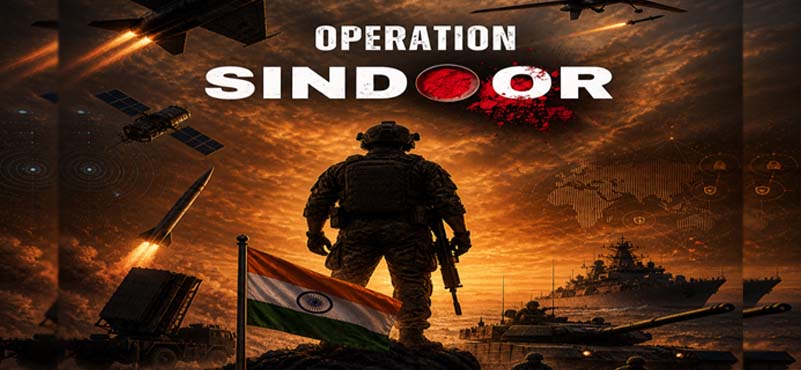
The second story unfolded thousands of kilometres away, where television cameras seldom linger. Along nearly 15,000 kilometres of land borders, from the icy heights of the Himalayas to dense jungles in the Northeast and the burning sands of the Western deserts, and across more than 11,000 kilometres of coastline, Indian soldiers stood their silent vigil. Their duty was not to ask who was protesting or who was governing. Their duty was simply to ensure that every Indian slept in peace.
A third story was unfolding beyond our shores. In stadiums and training arenas, Indian athletes pushed their bodies beyond exhaustion for a dream that only a sportsperson truly understands—the privilege of seeing the Tricolour rise above every other flag while the National Anthem echoes across the arena. Years of sacrifice are compressed into a few unforgettable minutes.
And then there was Drass.
As the nation prepared to observe Kargil Vijay Diwas, families, veterans and serving soldiers remembered the 527 brave Indians who never returned home because they chose to stand between the enemy and the Tricolour.
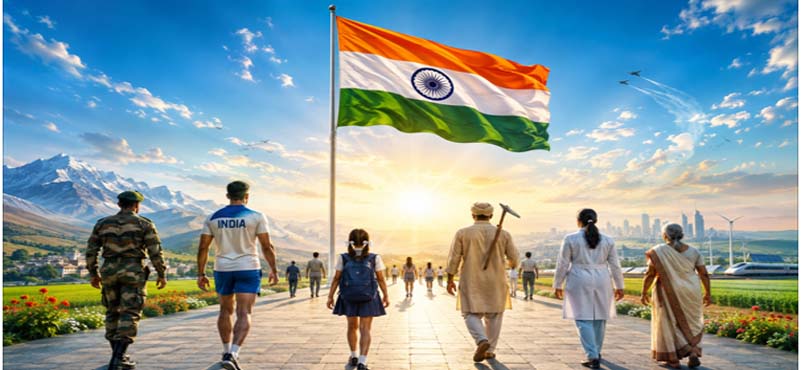
Three different landscapes. Three different Indians. One common flag.
The contrast is impossible to ignore. Some defend India with their lives. Some honour her through years of relentless discipline. Millions of others, including most of us, will never wear a uniform or stand on an international podium.
That raises a question which is far more important than any political debate.
What does India expect from ordinary citizens?
India: A Civilisational Continent
Perhaps no country has ever attempted what India attempts every single day.
Every sixth human being on Earth is an Indian. India’s population is roughly comparable to the combined population of Europe, North America and South America, yet it occupies only about 6.23% of the combined landmass of all these three continents. Within our borders live followers of every major religion, speakers of hundreds of languages and dialects, communities shaped by different histories, cuisines, customs and cultures. Our festivals change every few hundred kilometres. Our geography ranges from glaciers to tropical forests, deserts to islands. Few countries carry such diversity. None carries it at this scale.
India is therefore much more than a nation-state.
It is a Civilisational Continent.
For thousands of years, this land has welcomed ideas, absorbed differences and survived invasions without losing its civilisational soul. It taught the world Vasudhaiva Kutumbakam—the world is one family. It proclaimed Ekam Sat Vipra Bahudha Vadanti—truth is one, though sages describe it in many ways. It prayed not for the prosperity of one community but for the welfare of all—Sarve Bhavantu Sukhinah.
Our greatest inheritance is not merely the territory marked on a map. It is this extraordinary ability to remain one despite our many identities. That unity, however, cannot be taken for granted. It is renewed every morning—not by constitution alone, nor by government alone, but by the conduct of ordinary citizens.
A civilisation survives not because it has powerful rulers. It survives because it has responsible people.
The Republic Begins Within
We often imagine that the Republic lives in grand buildings.
In Parliament. In the Supreme Court. In Raj Bhavan. In South Block.
They are certainly the visible pillars of our democracy. But the Republic has a far deeper foundation. It lives in the conscience of its citizens. No Parliament can legislate honesty. No court can manufacture compassion. No police force can enforce integrity in every human heart. No army, however brave, can defend a nation whose citizens have stopped defending its values.
The Constitution gives us rights. Character gives those rights meaning.
Every honest tax paid, every traffic rule obeyed when no policeman is watching, every public park kept clean, every act of kindness towards a stranger, every refusal to spread hatred or misinformation, every disagreement expressed without violence—these invisible acts strengthen India far more than we often realise. Nations are not held together merely by laws. They are held together by habits.
The Republic is not something that exists outside us. It exists within us.
A Question Every Citizen Must Answer
We rightly salute our soldiers. We proudly celebrate our athletes. We admire those who dedicate their lives to public service.
Yet the overwhelming majority of Indians will never be called upon to display such extraordinary courage. History will never ask most of us to charge up Tiger Hill. Nor will it ask us to stand on an Olympic podium. Our test is quieter. It arrives every morning. In the office. On the road. Inside a classroom. At a polling booth. In the marketplace. On social media. Within our homes.
The future of India will not be decided only by those who make history. It will also be shaped by millions who never appear in history books. Perhaps, before asking what India has done for us, we should pause and ask a simpler, more personal question:
What have I done today that makes India a little stronger than she was yesterday?
For, in the end, patriotism may not be measured only by those who are willing to die for their country.
Its truest measure may lie in those who choose, every single day, to live for it.
The Citizen’s Dharma
If Raj Dharma is the sacred duty of rulers, Citizen Dharma is the sacred duty of the Republic’s true sovereign—the citizen.
For centuries, India has spoken of Raj Dharma. Great rulers were judged not merely by the power they exercised but by the restraint with which they exercised it. Today, however, sovereignty rests not with a king but with We, the People. If governments have a Raj Dharma, then surely citizens too have a Rashtra Dharma.
Perhaps the future of India depends less on finding perfect governments and more on creating responsible citizens. The Citizen’s Dharma rests upon eight simple vows.
- Truth Before Opinion. In the digital age, truth has become the first casualty of speed. Every rumour forwarded without verification, every fabricated image shared for momentary excitement and every deliberate falsehood weakens the trust that holds a society together. Patriotism begins with intellectual honesty. Before forwarding a message, we should ask not whether it supports our beliefs, but whether it supports the truth.
- Integrity Before Convenience. Corruption rarely begins with great scandals. It begins with small compromises—a bribe to avoid inconvenience, a false bill, an unpaid tax, a manipulated document. Every shortcut weakens the moral foundations of the Republic. Character is what we do when nobody is watching.
- Respect Before Victory. Democracy does not demand uniformity of opinion. It demands dignity in disagreement. We may oppose an idea without humiliating the person who holds it. Political opponents are not national enemies. Every Indian who believes in the Constitution belongs to the same national family.
- Stewardship Before Ownership. Every bridge, railway station, government school, public bus, hospital, park and monument belongs equally to every Indian. Public property is not government property—it is the inheritance of future generations. To protect it is patriotism. To destroy it is to diminish our own children’s future.
- Service Before Self. The measure of citizenship is not merely how much wealth we accumulate, but how much value we create for others. A few hours spent teaching a child, mentoring a young entrepreneur, helping an elderly neighbour, donating blood or cleaning a public space strengthens the nation far more than we imagine. Nations are built by volunteers as much as by visionaries.
- Excellence Before Excuses. Whatever our profession, our work is national service. The teacher shapes India’s future. The farmer feeds it. The doctor heals it. The engineer builds it. The entrepreneur employs it. The scientist advances it. The sanitation worker protects its dignity. Excellence is not personal ambition alone; it is national duty.
- Unity Before Identity. India’s diversity is not a weakness to be managed; it is a civilisational miracle to be cherished. We may speak different languages, worship differently and vote differently, but the Tricolour belongs equally to us all. Let our many identities enrich our Indian-ness, never replace it.
- Gratitude Before Entitlement. Every day, millions of Indians perform unseen acts of service. Soldiers guard lonely borders. Farmers prepare tomorrow’s harvest. Nurses work through the night. Railway workers, police personnel, power engineers and sanitation workers keep the Republic functioning while the rest of us sleep. Gratitude reminds us that no citizen succeeds alone.
The Constitution gives us rights. Duties make us worthy of those rights.
And perhaps the true measure of patriotism is not the slogans we shout, but the responsibilities we quietly shoulder.
Seven Ways to Live for India
Patriotism should not be reduced to an emotion that awakens only on national days.
It should become a habit practised every day. Perhaps the journey can begin with seven simple ideas.
- The Daily India Question. At dinner, every family asks one question: “What did I do today that made India a little better?” Not what the government did. Not what others failed to do. What I did.
- The Republic Starts With Me. A quiet national movement. No speeches. No politics. Every citizen takes responsibility for improving the one place he or she touches every day—home, office, street, school or workplace. Great nations grow from millions of small circles of responsibility.
- National Citizen’s Hour. One hour every month. Every Indian. One act of service. Teach. Plant. Clean. Mentor. Donate blood. Help a veteran. Visit an orphanage. The Republic grows stronger when citizens donate time, not merely money.
- Citizen’s Oath at Eighteen. When every young Indian receives the right to vote, let there also be a solemn pledge to uphold honesty, reject corruption, respect women, protect public property and place the nation above hatred. Rights and responsibilities should come of age together.
- Tricolour Week of Service. Instead of celebrating patriotism only through ceremonies, let one week every year be dedicated to service under the Tricolour. Every school. Every office. Every neighbourhood. One meaningful act for India. The flag deserves more than salutes. It deserves service.
- Adopt One National Treasure. Every family adopts one public institution or heritage asset—a government school, a library, a village pond, a memorial, a public park, a riverbank or a monument. What we emotionally adopt, we naturally protect. Ownership creates responsibility.
- National Gratitude Day. One day every year without politics or speeches. A day to thank the invisible pillars of the Republic—soldiers, teachers, farmers, doctors, scientists, sanitation workers, police personnel, fire-fighters and countless ordinary Indians who quietly keep India moving. Gratitude is patriotism expressed through humility.
Patriotism cannot be legislated. It cannot be manufactured. It can only be cultivated until love for India becomes not an annual celebration but a daily discipline.
The Last Salute
As I reflect upon those remarkable days of July, three images remain etched in my mind. A soldier standing silently before the Kargil War Memorial at Drass. An Indian athlete watching the Tricolour rise above an international arena after years of sacrifice. An ordinary citizen standing before a mirror, preparing for another day that history will never record.
The soldier serves India by risking life. The athlete serves India by pursuing excellence. The citizen serves India by living with character. None of these forms of service is insignificant. Each strengthens the Republic in its own way.
India does not ask all her children to become soldiers. She does not expect every citizen to become a champion. But she does ask something of each one of us. To be honest when dishonesty is easier. To be truthful when rumours are tempting. To be respectful when anger is fashionable. To protect what belongs to all. To leave our institutions stronger than we found them. To hand over to the next generation not merely a richer India, but a nobler one.
For governments may build roads. Armies may secure borders. Athletes may win medals. But only citizens build a civilisation.
And in the end, perhaps that is the true measure of patriotism.
If we cannot die for our country, let us at least learn to live for it.
ABOUT THE AUTHOR
Lt Gen Rajeev Chaudhry (Retd) is a social observer and writes on contemporary national and international issues, strategic implications of infrastructure development towards national power, geo-moral dimension of international relations and leadership nuances in changing social construct.