The global economy is undergoing its most significant transformation since the end of the Cold War. The era when globalization, trade liberalization and market efficiency largely shaped economic outcomes is giving way to a new geoeconomic order driven by geopolitical rivalries, technological competition, energy security and climate risks. Recent developments, including tensions in West Asia, disruptions in global supply chains, the rapid rise of artificial intelligence (AI) and the race for clean energy technologies, highlight that economic resilience is now as important as economic growth.
Despite this challenging global environment, India has demonstrated resilience. The RBI Bulletin July 2026 highlights robust domestic demand, resilient industrial and services activity, healthy credit growth and a stable external sector as key drivers of growth. However, it also cautions that delayed monsoon conditions, geopolitical tensions in West Asia, elevated energy prices and trade uncertainties continue to pose risks. While India’s macroeconomic fundamentals remain strong, sustaining high growth will require navigating an increasingly uncertain global landscape.
Economic resilience today extends beyond GDP growth, inflation and fiscal deficits. It depends on a country’s ability to withstand external shocks, strengthen supply chains, maintain financial stability, ensure energy security, build technological capabilities and adapt to climate change. India’s progress in these areas will shape both its growth trajectory and its journey towards Viksit Bharat @2047.
India’s Macroeconomic Fundamentals Continue to Inspire Confidence
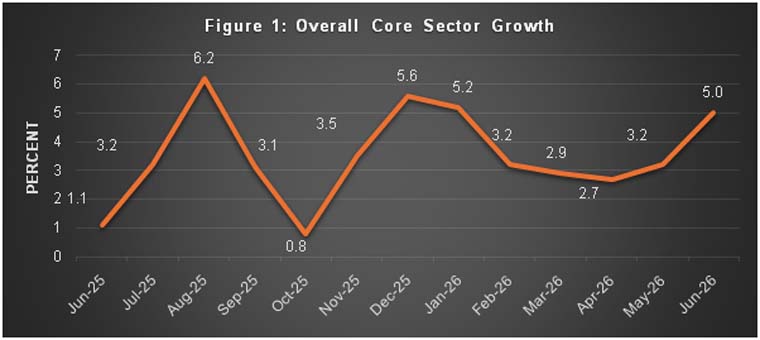
The resilience of the Indian economy is reflected not only in headline GDP projections but also in the broad-based improvement across several leading indicators. The Index of Eight Core Industries accelerated from 3.2 per cent in May to 5.0 per cent in June 2026 (Figure 1), recording its strongest expansion in five months. Particularly noteworthy was the 43.9 per cent increase in iron ore production, accompanied by higher output of electricity, cement and coal, signalling sustained momentum in infrastructure and industrial activity. Independent forecasts continue to place first-quarter GDP growth in the 6.4–6.6 per cent range, suggesting that domestic demand remains sufficiently robust to offset much of the weakness in the global economy.
Nevertheless, policymakers cannot afford complacency. Persistent geopolitical tensions continue to influence global commodity prices, particularly crude oil, while delayed monsoon progress has introduced fresh uncertainty regarding agricultural production and food inflation. In today’s interconnected world, domestic macroeconomic stability increasingly depends upon developments occurring well beyond national borders.
Trade Policy in a Fragmented Global Economy
Global trade is also entering a period of structural change. The rules-based multilateral trading system faces growing pressures from strategic industrial policies, economic nationalism and geopolitical realignments. Against this backdrop, the WTO’s latest Trade Policy Review of India recognises the country’s continuing efforts to improve the investment climate while also identifying areas where further reforms could strengthen competitiveness, including tariff rationalisation, customs facilitation and greater integration into global value chains.
For India, trade policy is no longer merely an instrument for expanding exports. It has become an important component of economic resilience. Diversified export markets, resilient supply chains and greater participation in global manufacturing networks reduce vulnerability to external shocks while enhancing employment and investment. Recent policy initiatives aimed at improving logistics, expanding production-linked incentive scheme and strengthening manufacturing competitiveness should therefore be viewed within this broader geoeconomic framework.
The global shift towards “friend-shoring” and supply chain diversification also presents India with significant opportunities. As multinational corporations seek to reduce concentration risks, India has the potential to emerge as a preferred destination for manufacturing, electronics, pharmaceuticals and advanced technology industries. Realising this opportunity, however, will require continued improvements in infrastructure, logistics efficiency, regulatory predictability and ease of doing business.
Banking and Financial Stability: An Anchor of Economic Resilience
The banking sector has emerged as a key pillar of India’s macroeconomic stability. Healthy credit growth, stronger balance sheets and improved capital adequacy have enhanced the financial system’s ability to absorb external shocks. Recent RBI initiatives, including proposed reforms to the Foreign Exchange Management framework and measures to mobilise FCNR(B) deposits, reflect a proactive approach to strengthening financial resilience.
The proposed FEMA reforms aim to simplify regulations governing cross border investments, overseas listings and foreign currency transactions, reducing compliance costs while improving transparency and supporting India’s integration with global capital markets. Likewise, the FCNR(B) initiative underscores the RBI’s willingness to reinforce external sector stability even as global interest rate differentials may limit deposit mobilisation.
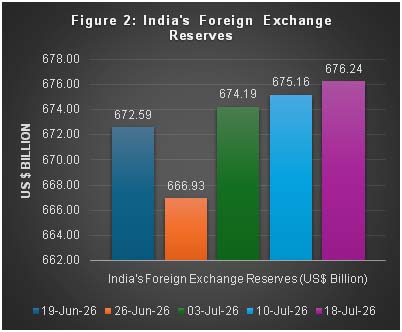
India’s external buffers have also strengthened, with foreign exchange reserves rising to US$676.24 billion as on 18 July 2026 (Figure 2), providing a vital cushion against exchange rate volatility and external financing shocks. Strong reserves enhance investor confidence and give the RBI greater policy flexibility amid growing global uncertainty.
Beyond these measures, banks are playing an increasingly important role in financing infrastructure, supporting digital transformation, promoting financial inclusion and facilitating India’s integration with global financial markets. As the economy becomes more technology driven and globally connected, a resilient banking system will remain central to sustaining long term growth.
Corporate India and the Technology Imperative
An equally important pillar of India’s resilience is the transformation of Corporate India. Despite geopolitical uncertainty, volatile commodity prices and slowing global demand, Indian companies continue to invest, innovate and expand. Corporate performance increasingly reflects structural improvements rather than a cyclical recovery.
Investment in infrastructure, manufacturing, semiconductors, engineering and digital infrastructure continues to strengthen India’s industrial ecosystem while complementing the Government’s infrastructure push. The next phase of transformation, however, will be driven as much by digital capabilities as by physical infrastructure. Artificial Intelligence (AI) is emerging as the most significant technological disruption since the internet, reshaping business models, productivity, healthcare, finance and manufacturing.
The global AI race increasingly resembles the strategic competition of earlier industrial revolutions. Companies such as Alphabet, Samsung, Tesla and Amazon are making substantial investments in AI despite short-term cost pressures, signalling that AI is becoming a strategic capability rather than simply another technological innovation.
For India, this presents immense opportunities as well as challenges. Its large digital talent pool, vibrant start-up ecosystem and globally competitive IT industry provide a strong foundation. However, sustaining technological leadership will require greater investment in semiconductor manufacturing, advanced computing, research and development, cybersecurity, digital skills and innovation. The competitiveness of Indian industry will increasingly depend on how effectively AI is integrated across production, logistics, finance and customer services.
Financial Markets Reflect Heightened Global Uncertainty
Financial markets have become the first responders to geopolitical developments. The correction witnessed in Indian equity markets during the week of 20–24 July 2026 reflected investor concerns regarding higher crude oil prices, foreign portfolio investor outflows, pressure on corporate profitability and uncertainty arising from the evolving situation in West Asia. These developments demonstrate how rapidly international geopolitical events now influence domestic financial conditions.
However, periodic market corrections should not necessarily be interpreted as indicators of underlying economic weakness. Rather, they underline the increasing interconnectedness of global financial markets and the importance of maintaining strong macroeconomic fundamentals. India’s relatively stable banking system, comfortable foreign exchange reserves and prudent monetary policy continue to provide important safeguards against excessive financial volatility.
Going forward, deepening domestic capital markets, encouraging long-term institutional investment and strengthening financial market regulation will remain essential for financing India’s ambitious infrastructure and industrial transformation.
Agriculture Remains Central to Inclusive Growth
The delayed progress of the southwest monsoon underscores that agriculture remains India’s most climate-sensitive economic sector. While sowing may recover with improved rainfall, increasing climatic variability calls for a shift from production-centric policies to a broader climate-smart approach. Strengthening irrigation, promoting climate-resilient crop varieties, improving weather forecasting and agricultural research, expanding digital advisory services and precision farming, and investing in post-harvest infrastructure, food processing, logistics and value chains will be critical to reducing post-harvest losses, protecting farm incomes and containing food inflation. In an era of climate uncertainty, agricultural resilience has become an essential pillar of India’s macroeconomic resilience.
The challenge before policymakers is to transform Indian agriculture from being weather-dependent to becoming knowledge-driven, technology-enabled and market-oriented. Such transformation is indispensable not only for food security but also for sustaining inclusive economic growth.
Energy Security and Climate Resilience Are Now Economic Imperatives
Climate policy is increasingly becoming economic policy. Rising temperatures, extreme weather events and disruptions to energy markets now directly influence inflation, insurance costs, agricultural productivity, electricity demand and industrial competitiveness. India’s rapid expansion of renewable energy, planned increase in nuclear capacity and continuing investments in energy infrastructure therefore represent not only environmental commitments but also strategic investments in long-term economic security.
India’s progress in expanding renewable energy capacity, improving energy statistics and strengthening evidence-based policymaking reflects the country’s commitment to balancing rapid economic growth with long-term sustainability. The planned expansion of nuclear power generation under the Nuclear Energy Mission further demonstrates recognition that achieving energy security will require a diversified energy portfolio combining renewables, nuclear energy and improved grid infrastructure.
At the same time, global developments—from devastating wildfires across southern Europe to growing international discussions on strengthening climate governance and adaptation—underscore that climate risks are becoming increasingly systemic. They affect agriculture, tourism, public health, insurance, infrastructure and financial stability simultaneously.
The emerging debate surrounding sustainable cooling, electricity demand and AI-driven energy consumption further illustrates that technological progress and environmental sustainability must advance together. Investments in resilient electricity networks, energy-efficient technologies and climate-resilient infrastructure are therefore becoming central components of long-term economic competitiveness rather than merely environmental objectives.
Building Resilience for Viksit Bharat @2047
The emerging global economy will increasingly reward countries that combine growth with resilience. India’s experience during recent geopolitical disruptions demonstrates that sound macroeconomic management, robust financial institutions and sustained infrastructure investment provide an important foundation. However, maintaining leadership over the coming decades will require strengthening seven mutually reinforcing pillars: macroeconomic stability, globally competitive manufacturing, resilient banking and financial markets, technological leadership, climate-smart agriculture, diversified energy systems and institutional excellence.
The transition from globalization to geoeconomics represents more than a change in the international economic environment; it represents a fundamental shift in the determinants of national competitiveness. Countries that successfully integrate economic efficiency with strategic resilience will define the next phase of global growth. With its strong domestic market, demographic dividend, digital transformation and continuing structural reforms, India is well positioned not merely to navigate this new landscape but to emerge as one of its principal architects. The challenge before policymakers is therefore no longer simply to accelerate economic growth; it is to build an economy that remains innovative, inclusive and resilient irrespective of the uncertainties of the global environment.
[This article is based on Weekend Macro by InsPIRE (Vol I, Issue 14, 25 July 2026), the weekly newsletter from the Institute for Pioneering Insightful Research Pvt. Ltd. (InsPIRE), Greater Noida. InsPIRE is a startup policy research and consulting firm specializing in economic development, international trade, financial sector, climate policy, sustainability, strategic advisory services, and executive education.]
ABOUT THE AUTHOR
 Dr Debesh Roy is the Founder-Chairman of the Institute for Pioneering Insightful Research Pvt. Ltd. (InsPIRE), Greater Noida, a startup research and consulting firm (website: https://inspire-solutions.in/). He has over three-and-a-half decades of professional experience, including 32 years at NABARD. Dr Roy holds a PhD in economics, and has extensive experience in macroeconomic policy, international trade, agricultural development, infrastructure financing, financial inclusion, climate policy and sustainability. (Email ID: debeshroy_chairman@inspire-solutions.in )