
A short viral clip of a dog theatrically carrying a newspaper from one family member to another generated a laugh and an apt observation: the once-common ritual of morning paper-reading is weakening. The image resonates because it condenses a larger behavioural shift across societies. Yet the clip’s humour also oversimplifies. The decline in print readership is real but uneven, shaped by generational change, economics, technology, and culture.
For many people, especially older readers, engaged professionals, and civically minded citizens, the printed paper remains an essential companion. I recently pared my subscriptions from eight titles to four, yet my mornings, despite a change of place from Lucknow, Chandigarh, Patna, Bangalore, Delhi, etc., remain incomplete without newspapers and tea; when the bundle doesn’t arrive on time, I feel as if an important ritual has been disrupted. That sense of loss is not mere nostalgia. For me, reading a printed newspaper is a paced, curated encounter with the world — one of life’s simple but enduring pleasures.
Scale and Drivers of Decline- The Form and the Substance
Over the past two decades, the global news ecosystem has been transformed. Print advertising revenues and circulation fell in many markets while digital ad spending and digital audience attention rose. The Reuters Institute’s 2025 Digital News Report shows that online platforms have become the primary route to news for younger cohorts globally, while legacy print still retains higher usage among older groups. In India, the pattern is more nuanced. The Audit Bureau of Circulations (ABC) and the Indian Readership Survey (IRS) indicate that overall newspaper reach (including print and digital) remains substantial; vernacular print newspapers retain strong penetration outside metro centres even as English broadsheet circulation declines in some urban markets (IRS 2023–24; ABC 2024).
Four clear drivers explain this shift:
- Mobile ubiquity and cheap data. India’s data revolution — cheaper smartphones, falling data costs, and 4G/5G rollout — democratized access to news, pushing many users toward screens.
- Social media and aggregators. Platforms such as X (formerly Twitter), Facebook, Instagram, and WhatsApp, together with news aggregators and video apps, deliver instant updates in bite-sized formats and enable rapid sharing.
- Video-first and short-form content. Apps that prioritise short video and audio formats have changed attention economies, particularly among younger users.
- Economic pressures on publishers. Advertising revenues have reallocated to digital platforms, squeezing print publishers’ revenues and prompting newsroom restructuring that affects long-form reporting capacity.

Why the Decline Matters: Cognitive and Civic Costs
Getting news quickly and easily is a clear benefit. Breaking news can reach millions within minutes; mobile alerts and live video democratise eye-witnessed events. But these gains come with trade-offs that matter for public discourse and democratic functioning. Amartya Sen’s powerful observation can substantiate this thesis: “It is not likely that India can have a famine even in years of great food problems. The government cannot afford to fail to take prompt action when large-scale starvation threatens. Newspapers play an important part in this, in making the facts known and forcing the challenge to be faced”.
Depth and Context
A newspaper is not only an information conduit; it is an editorial ecosystem that arranges reportage, background analysis, columns, and features into a coherent daily package. This structure helps readers connect disparate events across beats and time. Research in media studies suggests that exposure to long-form journalism and curated editorial content supports better contextual understanding than brief, decontextualised headlines (Pew Research Center, 2019). Seeing the full context of a debate in one place encourages careful reflection over knee-jerk reactions.
Editorial Standards and Reliability
Professional editing, layered sourcing, and newsroom gatekeeping impact accuracy. While errors can and do occur in print, longstanding editorial processes verification, copy-editing, corrections typically lower the prevalence of misinformation relative to unmoderated social feeds. UNESCO’s Journalism, Fake News & Disinformation handbook, which documents how the erosion of professional gatekeeping and the rise of platform-distributed content increase the prevalence of misinformation and unverified claims.
Cognitive Benefits and Habits of Attention
Sustained reading of long-form material builds vocabulary, comprehension, and reasoning skills. Educational research links regular, deliberate reading with improved critical thinking and better capacity to synthesise complex material — capabilities essential for policy analysis and informed citizenship. The consequences extend beyond individual gains: a populace habituated to sustained reading is better equipped to evaluate policy trade-offs, weigh evidence, and participate meaningfully in democratic processes.
Serendipity and Breadth
Newspapers expose readers to topics beyond their immediate interests. The physical layout of a broadsheet — front pages, business sections, op-eds, obituaries, culture pages — nudges readers toward serendipitous encounters. In contrast, algorithmic feeds tend to reinforce preferences, narrowing exposure and fostering “filter bubbles” unless platforms deliberately diversify recommendations.
The Digital Dilemma: Speed, Personalisation, and Fragmentation
Digital media has changed how we get information, making it harder for the public to think critically and have meaningful debates.
Attention-optimised formats
The attention economy incentivises short, sensational, or emotionally charged content that maximises clicks and shares. Snackable news fragments, headlines engineered for virality, and truncation of complex narratives reduce incentive for investigative depth.
Algorithmic personalisation and echo chambers
Personalisation algorithms aim to increase engagement by serving users content aligned with their interests and past behaviour. While efficient, this approach magnifies confirmation bias, frequently exposing users to homogeneous viewpoints. Computational social science research on platforms such as Facebook (Bakshy, Eytan, Solomon Messing, and Lada A. Adamic. 2015. “Exposure to Ideologically Diverse News and Opinion on Facebook.” Science 348(6239)) shows that algorithmic curation modestly reduces exposure to ideologically crosscutting political content, but that users’ own choices and homophilous networks play an even stronger role in constricting informational diversity.
Source Fragmentation and Verification Burden
The proliferation of channels, viz., independent blogs, influencer commentary, citizen journalism, and platform-native media, scatters reliable sources amid noise — a case of spreading resources thinly. The cognitive burden of verifying credibility shifts to readers, who may lack time or training to distinguish credible reporting from speculation or disinformation.
Generational change, adaptability, and hybrid consumption
It would be wrong to idealise print or assume younger audiences are inherently less informed. Many younger readers are highly information fluent: they use a mix of social platforms, podcasts, newsletters, and specialist outlets to stay informed. Their habits differ: they prioritise speed, multimedia, and community discussion.
Hybrid consumption patterns are emerging:
- Many readers use curated news apps for breaking alerts and rely on newsletters, long-form magazine features, or podcasts for deeper dives.
- Subscription newsletters, podcasts, and investigative digital outlets are creating oblique paths to the kind of depth newspapers historically supplied.
- Some readers maintain a ritualistic attachment to print for reflection, while screens handle immediacy.
The mixed ecosystem suggests opportunity: combining immediacy with depth, and algorithmic reach with editorial curation, can produce healthier public information diets.
Policy and Market Prescriptions- Breaching the inviolable “Lakshman Rekha” (the line of control)
The future of quality journalism depends not on resisting digital disruption but on ensuring that technological progress strengthens, rather than weakens, the enduring virtues of newspapers—editorial depth, rigorous verification, contextual reporting, diversity of coverage, and the habit of sustained reading. This is an era where information is abundant, but attention is fragmented. The journalism ecosystem is not a silo; it’s a microcosm, a miniature model of the broader macro-economy. The case for development and structural transformation of the journalism ecosystem must be placed in a proper historical and comparative perspective.
These are challenging times, momentous times marking the emergence of a “new normal”. As T.S. Eliot (The Rock) (1934) wrote eloquently,
“Where is the wisdom we have lost in knowledge?
Where is the knowledge we have lost in information?”
Information does not automatically translate into knowledge or wisdom; it requires active guidance. Public policy, market innovation, publishers, technology platforms, educational institutions, and readers each bear a share of responsibility for preserving these democratic assets. The task ahead is to build a digital-first news ecosystem in which speed complements accuracy, algorithms reinforce credibility, and commercial incentives align with the public interest.
The future of quality journalism depends on building sustainable business models. As digital advertising increasingly flows to large technology platforms, traditional news organisations can no longer depend on advertising revenue alone. Publishers must diversify through subscriptions, memberships, paid newsletters, podcasts, events, and philanthropic support. Paywalls are most effective when they protect exclusive value—investigative reporting, expert analysis, and original journalism that cannot be obtained elsewhere. Long-term sustainability lies not merely in attracting online traffic but in cultivating loyal readers willing to support credible journalism.
Public-interest reporting also deserves institutional support. Investigative journalism, local governance, public health, education, science, environmental reporting, and civic accountability generate immense social benefits despite offering limited commercial returns. Governments, philanthropic foundations, universities, and independent trusts should therefore expand grants, endowments, and non-profit journalism initiatives while ensuring strong safeguards that preserve editorial independence from political or commercial influence.
Digital platforms also require a more balanced regulatory framework. Social media companies, search engines, and news aggregators have become powerful gatekeepers of information, yet the algorithms that determine content visibility remain largely opaque. Greater transparency without compromising proprietary technology would help users, researchers, and regulators better understand how news is ranked and distributed. Equally important, users should have greater control over their news feeds so that credible journalism and diverse viewpoints receive greater prominence than sensational, engagement-driven content.
The financial relationship between technology platforms and news publishers also needs recalibration. Platforms derive substantial value from professionally produced journalism through search, aggregation, and referrals, while publishers bear the costs of reporting, verification, and editorial oversight. Fair revenue-sharing arrangements can help correct this imbalance, encourage continued investment in quality reporting, and strengthen the digital news ecosystem.
Fighting misinformation is no longer optional; it is an urgent democratic imperative. Falsehoods, supercharged by AI, deepfakes, bots, and algorithmic amplification, are corroding public trust at alarming speed. Any credible response must tread carefully: curb the damage without strangling free expression. The answer lies in co-regulation—a partnership among governments, platforms, newsrooms, fact-checkers, and civil society—backed by rigorous editorial standards, transparent corrections, robust content authentication, and stricter source verification.
Media literacy has therefore become a fundamental civic skill. In an information environment where professional journalism coexists with user-generated, sponsored, and AI-generated content, citizens must be able to assess credibility, identify bias, verify sources, and critically interpret evidence. Integrating media literacy into school and university curricula can foster informed, evidence-based thinking from an early age.
Education alone, however, is insufficient. National awareness campaigns involving governments, educational institutions, technology platforms, libraries, and news organisations should encourage responsible news consumption across society. Citizens should be encouraged to verify facts, recognise manipulated images and videos, and avoid forwarding unverified information. As AI-generated content becomes increasingly sophisticated, the ability to distinguish truth from fabrication will become as important as access to information itself.
Special attention must also be devoted to preserving local journalism, one of democracy’s strongest safeguards. Local newspapers and community reporters cover municipal governance, courts, schools, hospitals, civic infrastructure, and grassroots issues that often escape national attention. They expose corruption, strengthen accountability, amplify community voices, and promote informed civic participation. Yet these organisations face severe financial pressures from declining circulation, shrinking advertising revenues, and digital competition. Carefully designed public-interest funds, innovation grants, tax incentives, training programmes, and support for digital transition can help sustain local journalism without compromising editorial independence.
While public policy can create enabling conditions, readers themselves ultimately determine the future of quality journalism. Digital platforms have normalised fragmented news consumption through endless scrolling, headlines, and short videos that often sacrifice context and reflection. Citizens should consciously balance the speed of digital updates with the depth offered by newspapers, investigative features, magazines, and long-form journalism. Even dedicating half an hour each day to sustained reading can significantly improve understanding, critical thinking, and informed decision-making.
Readers should also broaden their information diet. Relying exclusively on algorithmically curated feeds increases the risk of information bubbles and confirmation bias. Subscribing to credible publications representing diverse editorial perspectives, regions, languages, and areas of expertise enrich understanding and encourage independent judgment. Slow reading—reflecting on important stories, comparing viewpoints, discussing issues with others, and considering broader implications—strengthens comprehension and reinforces journalism’s educational value.
Publishers, meanwhile, must adapt without compromising professional standards. Long-form journalism remains indispensable but must become more accessible through compelling headlines, visual storytelling, podcasts, newsletters, short videos, interactive graphics, and social media previews that draw readers toward deeper reporting rather than replacing it. Digital formats should function as gateways to comprehensive journalism, not substitutes for it.
In the coming years, a newsroom’s true edge won’t be speed; it will be substance that algorithms cannot mimic. Investigative scoops, on-the-ground reporting, rigorous data analysis, and the nuance of expert human judgment are irreplaceable. To thrive, publishers must go beyond selling content and start cultivating communities through events, memberships, and direct reader engagement, thereby insulating their bottom line from the whims of digital ad markets.
For multilingual countries such as India, expanding high-quality journalism in regional languages offers enormous potential. Millions prefer consuming news in their mother tongue, yet vernacular journalism often remains underfunded despite its critical democratic role. Greater investment in regional newsrooms, digital innovation, newsroom capabilities, and sustainable business models can significantly expand access to reliable information and strengthen democratic participation across linguistic and geographic boundaries.
The smartest path forward isn’t choosing between print and digital; it’s harnessing the best of both. Publishers who merge the trust, rigour, and immersive depth of newspapers with the speed, reach, and personalisation of digital platforms will build the most durable business. This hybrid approach serves readers on their own terms, diversifies revenue, and builds a buffer against the next wave of technological upheaval.
Ultimately, the objective is not to preserve paper but to preserve journalism. The challenge is not to protect traditional formats from technological change but to safeguard the enduring values that define quality reporting—accuracy, verification, context, independence, and accountability. Whether news reaches citizens through print, smartphones, or future technologies is secondary. What matters is that people continue to have access to trustworthy information that enables informed choices, critical thinking, and democratic accountability. Technology will continue to reshape how news is delivered, but journalism’s public purpose must remain constant.
Economic Implications of Fake News
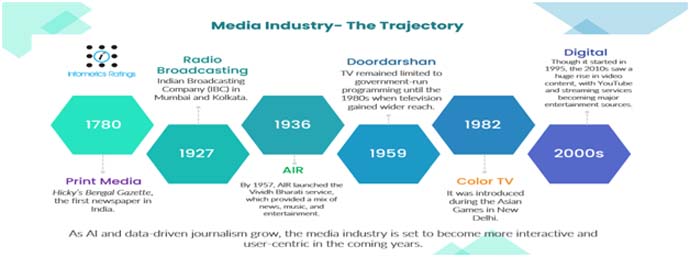
The digital revolution has fundamentally transformed the production, dissemination, and consumption of information. While digital platforms and social media have democratized access to knowledge, they have also enabled the unprecedented spread of fake news and misinformation. Low barriers to publication, algorithm-driven amplification, and the commercial incentives of the attention economy have created an ecosystem in which falsehoods often travel faster than verified information. Driven by political interests, ideological agendas, financial incentives, and the pursuit of influence, fake news has evolved from a communication challenge into a significant economic and governance risk. Some of these issues were closely and carefully examined in our widely acclaimed Industry Report on Media, Broadcasting, and Entertainment (May 30, 2025).
In economics, misinformation is a classic example of “information asymmetry”, where people make choices based on wrong or incomplete facts. Markets only work well when everyone has access to reliable, timely information. When fake news pollutes the system, it distorts public expectations, wastes resources, damages market confidence, and increases uncertainty. Because of this, fake news creates massive economic costs that go far beyond its social and political damage. Young people are particularly vulnerable because they constitute the largest consumers of digital content and social media. At an impressionable stage of life, exposure to misleading narratives can shape attitudes, beliefs, financial behaviour, career choices, political participation, and civic engagement. Behavioural economics shows that individuals frequently rely on cognitive shortcuts and confirmation bias, making them susceptible to emotionally appealing but factually incorrect information. Repeated exposure further reinforces misinformation through the “illusory truth effect”, whereby false statements acquire credibility simply through repetition – the “Goebbels effect” at play.
Emerging economic research reveals that misinformation is not merely a communication problem but measurably drags on economic activity. In their study From Buzz to Bust, economists Stefanie Huber, Tiziana Assenza, Fabrice Collard, and Patrick Fève examined US data spanning 2007 to 2022 and found that misinformation works like a conventional economic shock: it depresses business confidence, shortens working hours, curtails job creation, and prompts both households and firms to postpone major spending decisions. The risk is compounded by a broader deficit in public discernment — a related study found that only 38 % of respondents believed the average citizen could reliably distinguish real news from fake.
The economic consequences become particularly acute when misinformation targets core economic variables. False narratives about inflation, taxation, or employment can distort household saving and spending behaviour. Since markets are fundamentally expectations-driven, such narratives can become self-fulfilling, translating misplaced belief into genuine economic drag.
The Indian Experience
India’s experience demonstrates how debates over information quality increasingly shape both economic outcomes and democratic governance. A common example is the controversy surrounding official economic statistics. While differences often arise between government estimates and those of independent researchers, these usually reflect variations in methodology, sampling, data coverage, reference periods, and estimation techniques rather than deliberate manipulation. India’s statistical system continues to enjoy broad international credibility. Nevertheless, greater methodological transparency, clearer communication, regular peer review, and stronger engagement with economists, journalists, technologists, and civil society can further strengthen public confidence.
The rapid rise of artificial intelligence, algorithm-driven journalism, and personalised digital advertising has made the information ecosystem more complex. Digital platforms optimise engagement rather than accuracy, often promoting sensational or emotionally charged content because it attracts greater user attention. This “attention economy” allows misinformation to spread rapidly, while AI-generated content, deepfakes, and automated bot networks can create highly convincing but entirely fabricated narratives at unprecedented scale.
The economic consequences extend well beyond the media. False information about employment opportunities, government recruitment, skill development, entrepreneurship, or migration can distort career decisions and create unrealistic expectations, particularly among young people. During periods of economic uncertainty, misinformation amplifies public anxiety, weakens consumer confidence, and erodes trust in institutions. Similar effects have been observed in public health, where misleading claims about vaccines and medical treatments have adversely affected health outcomes and labour productivity.
Several structural factors accelerate the spread of fake news. These include unrestricted online publishing, algorithmic amplification, automated bot networks, weakening editorial gatekeeping, inadequate digital literacy, limited platform accountability, and the borderless nature of social media. Together, these forces enable misinformation to travel faster than corrections, making verification increasingly difficult.
Economic and educational inequalities further aggravate the problem. People with limited financial literacy, digital skills, or critical thinking abilities are less equipped to evaluate competing claims and are more likely to depend on informal or unreliable information sources. This widens existing inequalities, weakens informed economic decision-making, and diminishes civic participation. At the societal level, misinformation fuels polarisation, undermines institutional trust, and imposes long-term economic and social costs.
India’s rapidly expanding digital economy is particularly vulnerable. Influencer-led platforms, creator ecosystems, and algorithm-driven recommendation systems often reward engagement rather than credibility. Viral misinformation can quickly influence consumer behaviour, damage corporate reputations, affect investment decisions, trigger stock market volatility, and even disrupt tourism. Building a resilient digital economy therefore requires embedding trust, authenticity, and accountability into digital platforms rather than treating misinformation merely as a content moderation issue.
Addressing these challenges demands a coordinated policy response. Media and digital literacy should become an integral part of school and university curricula, enabling students to evaluate information critically, identify misinformation, and recognise cognitive biases. Technology companies should improve algorithmic transparency, collaborate with independent fact-checkers, clearly label manipulated or AI-generated content, and assume greater responsibility for information disseminated through their platforms. Independent fact-checking organisations and public-service broadcasters also require sustained institutional support to strengthen evidence-based public debate.
India currently relies on provisions under the Information Technology Act, the Disaster Management Act, and various criminal laws to combat fake news. However, the growing sophistication of digital misinformation calls for a coherent and balanced legal framework that deters the deliberate spread of false information while safeguarding freedom of expression and avoiding excessive censorship.
Economic research plays an equally important role in strengthening evidence-based policymaking and public discourse. High-quality statistical systems, transparent methodologies, independent empirical research, and effective communication of findings help reduce information asymmetry and improve public understanding of complex economic issues. Closer collaboration among researchers, policymakers, journalists, technology companies, and educational institutions can create a more resilient information ecosystem.
Financial literacy further strengthens society’s defences against economic misinformation. Citizens who understand inflation, taxation, banking, investment, public finance, and macroeconomic indicators are less susceptible to misleading narratives about economic policies or financial products. Artificial intelligence can also support automated fact-checking, misinformation detection, and content verification. Yet because AI itself can generate increasingly sophisticated false content, technological solutions must be complemented by human oversight, ethical standards, and appropriate regulatory safeguards.
Ultimately, preserving the integrity of the information ecosystem is both an economic and democratic imperative. Trust is an indispensable public good that underpins efficient markets, credible institutions, sound policymaking, and social cohesion. As India’s digital economy continues to expand, sustainable growth will depend not only on technological innovation but also on reliable journalism, transparent governance, robust statistical systems, informed citizens, and effective safeguards against misinformation. Combating fake news is therefore no longer merely a media challenge—it is a strategic economic priority essential for strengthening markets, protecting democracy, and ensuring inclusive and sustainable development.
Conclusion: Medium Matters Less Than the Habit of Reading
The decline in newspaper reading marks a techno-cultural shift. It needs no clairvoyance to perceive that while technology widened information availability, it also reshaped attention and incentives in ways that risk shallower public discourse. My personal attachment to printed newspapers is rooted in their curated depth, ritual value, and cognitive benefits. Yet the normative objective should not be to preserve paper per se, but to preserve the practices that matter: sustained reading, exposure to diverse viewpoints, and the habit of critical reflection. If those practices erode, the costs will be civic and cultural: poorer policy debates, weaker public accountability, and a citizenry less equipped to evaluate complex trade-offs. The task for readers, publishers, platforms, and policymakers is to adapt. By aligning funding models to support long-form journalism, regulating platform dynamics that favour speed over accuracy, and investing in media literacy, societies can retain the virtues of the printed page even as the medium evolves.
The ritual of morning tea and a broadsheet may become rarer, but its intellectual function to educate, to provoke reflection, to broaden horizons need not vanish. That function can be preserved in digital forms that prize depth as much as reach. The question remains whether market forces and public institutions will act in time to sustain that culture of serious reading. If they do, the ritual will survive; if they do not, our news diets risk becoming fast and wide but thin — a poor substitute for the sustained attention a healthy democracy requires. If the reading habit continues to decline, it will weaken the mind’s capacity for deep, structured, and disciplined thinking. We watch warily.
ABOUT THE AUTHOR
 Dr. Manoranjan Sharma is Chief Economist, Infomerics, India. With a brilliant academic record, he has over 250 publications and six books. His views have been cited in the Associated Press, New York; Dow Jones, New York; International Herald Tribune, New York; Wall Street Journal, New York.