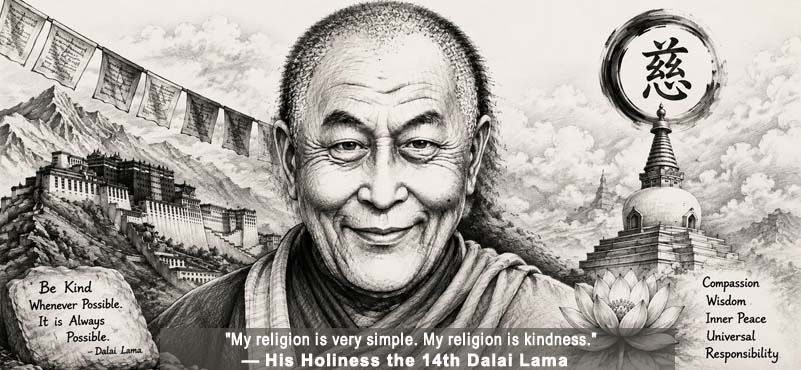
Why the World Still Needs the Dalai Lama at Ninety-One
The Smile That Survived History
Some smiles belong to happy people. Others belong to wise people.
And then there are smiles that belong to souls who have walked through unimaginable suffering and yet refused to surrender their faith in humanity.
The Dalai Lama’s smile belongs to the last category.
As His Holiness celebrates his ninety-first birthday, the world is not merely honouring the longevity of a remarkable life. It is celebrating something far rarer—the endurance of compassion in an age increasingly defined by anger.
We live in extraordinary times. Humanity has conquered diseases, split the atom, explored distant planets, and built machines capable of astonishing intelligence. Yet, amid all this progress, something deeply human appears to be slipping away. Our conversations have become louder, our opinions sharper, and our patience thinner. Nations compete for power, societies fracture over differences, and individuals struggle with loneliness despite unprecedented connectivity.
Against this turbulent backdrop stands a frail monk in maroon robes whose greatest weapon has always been a gentle smile. Perhaps the world needs him today more than ever.
A Boy Chosen by Destiny
Not every child is born to choose his destiny. Some are chosen by destiny itself.
In a small village in Northeastern Tibet, a little boy named Lhamo Thondup could never have imagined that his life would one day belong not only to Tibet but to the entire human family. Recognised as the reincarnation of the Thirteenth Dalai Lama when he was barely two years old, he entered a world of monastic discipline, spiritual learning, and immense responsibility.
History, however, had other plans.
Long before he had completed his education, he found himself carrying the burden of an ancient civilisation threatened by forces beyond his control. While most young men dreamt of careers and families, he was compelled to shoulder the hopes of millions.
Some lives are measured by success. His would be measured by service.
The Longest Journey Was Not Into Exile—But Into Compassion
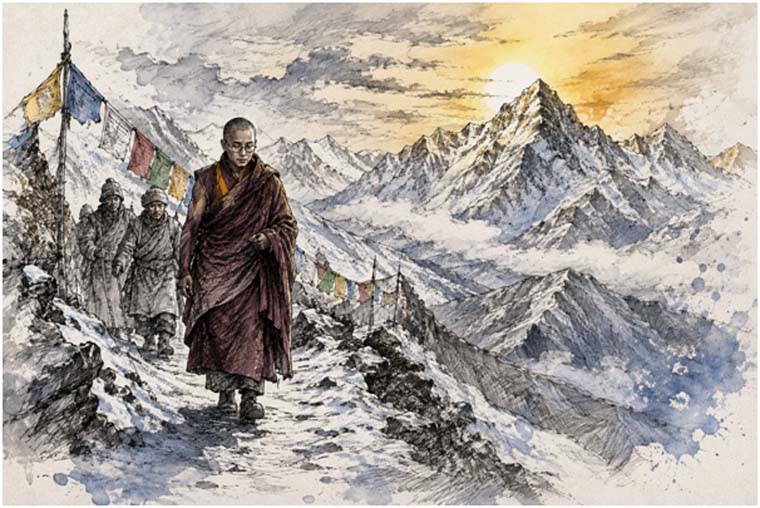
In 1959, as Tibet descended into turmoil, the young Dalai Lama embarked upon one of history’s most poignant journeys. Disguised as an ordinary soldier, he crossed the snowbound Himalayas under constant danger, eventually finding refuge in India.
He left behind his homeland. His monasteries. His childhood. His people. He even left behind the certainty that he would ever return. Yet remarkably, he did not carry bitterness. Many refugees lose their homes. Few refuse to lose their humanity.
For over six decades, Dharamshala has become his home, but never his prison. Exile became not an ending but a beginning. Instead of allowing suffering to harden his heart, he transformed it into compassion for all who suffer, irrespective of nationality, race, religion, or ideology.
He crossed the Himalayas carrying no luggage of hatred. That may be one of the greatest journeys any human being has ever undertaken.
The Monk Who Refused to Hate
History often celebrates those who conquered kingdoms. It seldom celebrates those who conquered themselves. The Dalai Lama belongs to this rare fraternity.
He has witnessed the loss of his nation, the destruction of sacred monasteries, and the displacement of his people. Yet nowhere in his speeches does one find calls for revenge or vengeance. Instead, one hears an unwavering appeal for dialogue, understanding, and reconciliation.
Forgiveness, in his philosophy, is not forgetfulness. It is freedom. Hatred imprisons the one who carries it far more than the one against whom it is directed. This simple truth has become the moral foundation of his life.
In a century marked by violent revolutions, his revolution has been astonishingly quiet. He has challenged oppression not with bullets but with conscience; not with slogans but with compassion.
It takes extraordinary courage to forgive. It takes even greater courage to continue loving after history has given you every reason not to.
When Science Met Spirituality
One of the most remarkable aspects of the Dalai Lama’s life is his refusal to imprison spirituality within dogma. Curiosity has always been one of his deepest virtues.
Over the decades, he has engaged with neuroscientists, psychologists, physicians, physicists, and philosophers in an extraordinary dialogue between ancient wisdom and modern science. Meditation, mindfulness, emotional resilience, and compassion have moved from monasteries into laboratories and universities across the world.
Perhaps his most extraordinary statement remains:
“If scientific analysis conclusively demonstrates certain claims in Buddhism to be false, then Buddhism must accept the findings of science.”
Such intellectual humility is rare. It reflects a mind that seeks truth rather than victory.
He has reminded both scientists and spiritual seekers that knowledge without compassion becomes dangerous, while compassion without wisdom becomes ineffective. Civilisation needs both.
In an Angry World, His Smile Became a Philosophy
Our century is becoming increasingly efficient at producing comfort but surprisingly inefficient at producing peace.
People own larger homes but experience smaller joys. They possess thousands of digital connections yet often feel profoundly alone. Information travels instantly. Understanding does not.
The Dalai Lama diagnosed this condition long before psychologists gave it names. He repeatedly reminded us that peace cannot be imported, purchased, legislated, or downloaded. It arises from the disciplined cultivation of the human heart.
His smile is not optimism. It is practice. It is not ignorance of suffering. It is mastery over suffering.
Perhaps that explains why millions who have never visited Tibet, never studied Buddhism, and never met him personally nevertheless feel comfort simply by looking into his face.
Some people speak about hope. He radiates it.
His Greatest Teaching Was Never Buddhism
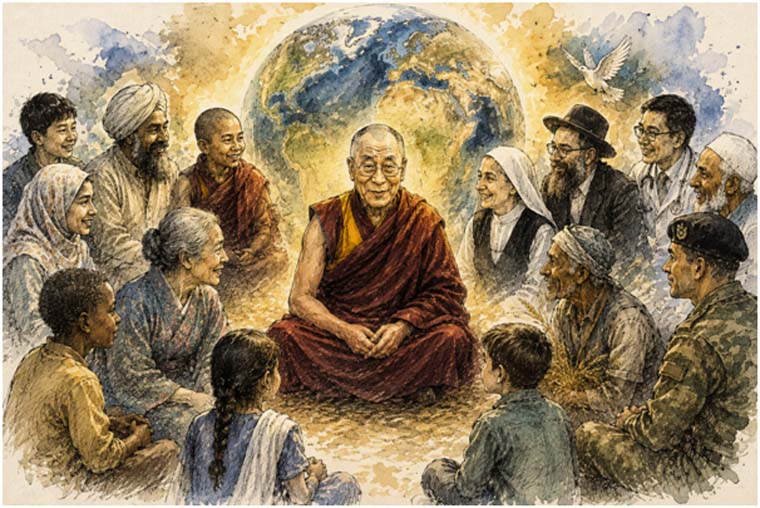
Although he is the spiritual leader of Tibetan Buddhism, the Dalai Lama’s greatest gift to humanity transcends every religion.
He rarely asks people to become Buddhists. Instead, he asks them to become kinder human beings.
“My religion is kindness.”
Few spiritual philosophies have ever been expressed with greater simplicity. He speaks not of converting faiths but of expanding hearts.
Compassion, empathy, forgiveness, humility, gratitude, and universal responsibility—these are values recognised by every civilisation and every great religious tradition.
In a world fragmented by identity, he gently reminds us of our common humanity. Before we are citizens of nations, followers of religions, or speakers of different languages, we are simply human beings sharing one fragile planet.
The future of civilisation may depend less upon ideological victories and more upon our ability to rediscover this elementary truth.
The Twenty-First Century Needs Moral Power
The twentieth century admired military strength.
The twenty-first century increasingly realises that moral strength is even more indispensable.
Military power can defend borders. Economic power can generate prosperity. Technological power can transform societies. But only moral power can preserve civilisation.
History ultimately remembers not those who accumulated the greatest wealth or commanded the largest armies, but those who expanded the moral imagination of humanity.
The Dalai Lama belongs naturally alongside Mahatma Gandhi, Nelson Mandela, Martin Luther King Jr., and Mother Teresa—not because they agreed on everything, but because each enlarged humanity’s capacity for compassion. Our age desperately requires such leadership.
Artificial Intelligence may become more intelligent. Only human beings can become more compassionate. That choice remains ours.
The Legacy of a Gentle Giant
One day, the prayer wheels of Dharamshala will continue to turn without the gentle hands that have spun them for nearly a lifetime. That is the destiny of every human life.
The real question is not whether history will remember the Dalai Lama. It undoubtedly will. The deeper question is whether we shall remember what he spent ninety-one years trying to teach us. That kindness is not weakness. That forgiveness is not surrender. That compassion is not sentimentality. That peace is not passivity. And that true happiness begins not by changing the world outside us but by transforming the world within.
Mountains are not remembered merely because they stand tall. They are remembered because rivers flow from them, nourishing countless lives far beyond their own boundaries. For more than nine decades, the Dalai Lama has been such a mountain. From the heights of suffering, he has released rivers of love. From the silence of meditation, he has offered words that have comforted millions. From the pain of exile, he has created a homeland within the human heart.
On his ninety-first birthday, the finest tribute we can offer is not another speech, another ceremony, or another commemorative message. It is a quiet resolve to become a little kinder than we were yesterday. A little slower to judge. A little quicker to forgive. A little more willing to listen.
If each of us carries even a small fragment of his compassion into our families, our workplaces, our communities, and our nations, his life’s work will continue long after his footsteps have faded into the snows of Tibet. For in the end, the Dalai Lama’s greatest miracle was not that he inspired millions. It was that he never stopped believing that every human heart—including yours and mine—possesses an infinite capacity to love.
The World has no shortage of powerful men. What it longs for are Gentle Giants. Happy 91st Birthday, Your Holiness.
(This essay is dedicated not to DALAI LAMA alone but to HUMANITY at large. To every human being who still believes that Kindness is Strength, Compassion is Courage, and Love is humanity’s greatest Wisdom.)
ABOUT THE AUTHOR

Lt Gen Rajeev Chaudhry (Retd) is a social observer and writes on contemporary national and international issues, strategic implications of infrastructure development towards national power, geo-moral dimension of international relations and leadership nuances in changing social construct.