
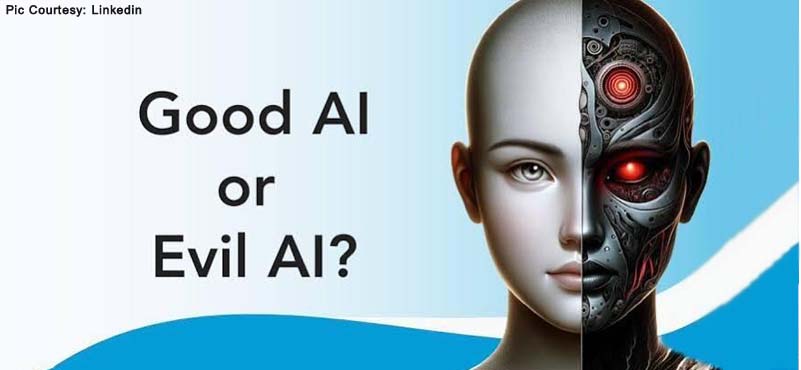
Artificial intelligence is often presented as a triumph of innovation, a tool destined to make life faster, easier, and more efficient. That description is true but incomplete. AI is not merely another advance in computation; it is a force quietly rewriting the terms of human life. It is changing how people work, relate, think, and assign value to one another. The deeper question is no longer what machines can do. It is what human beings risk losing when they lean too heavily on them.
The seduction of AI lies in its fluency. It answers quickly, speaks with confidence, and appears to understand. In a world already shaped by impatience, that is a powerful advantage. But confidence is not conscience, and fluency is not wisdom. AI can assemble information, predict patterns, and imitate judgment with growing sophistication. What it cannot do is care. It has no memory of loss, no moral burden, no stake in the consequences of error. It can approximate intelligence, but it cannot bear the full moral weight of being human. That distinction matters more now than ever.
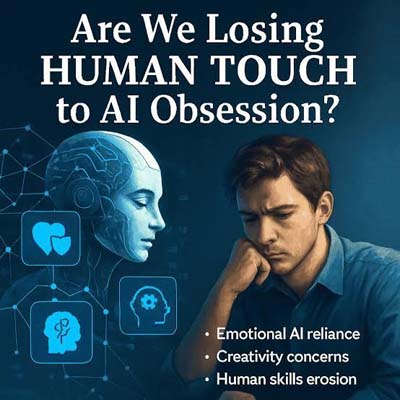
The danger is not that machines will become human. The danger is that humans will begin to adapt to machine logic. Already, digital life has trained people to value speed over depth, visibility over sincerity, and convenience over presence. AI intensifies this tendency. It rewards instant output, compresses reflection, and fosters the illusion that every problem can be optimised. But human life is not an optimisation exercise. It is an experience shaped by ambiguity, grief, loyalty, intuition, hesitation, and moral struggle. These are not defects in the human condition. They are its meaning.
This is especially evident in relationships. The digital age has already reshaped the nature of bonding. Friends, lovers, colleagues, and families now stay in touch more often, yet they often know less about one another. Screens have made communication more frequent but less embodied. They have created the appearance of intimacy without always delivering its substance. AI now enters this already fragile space with a new promise: it can listen without interruption, respond without fatigue, and simulate understanding on demand. For a lonely person, that can feel like relief. But companionship is not the same as responsiveness. Real human bonding is built on patience, friction, forgiveness, and shared vulnerability. It requires two conscious beings to meet in the same moral space. A machine can mirror concern, but it cannot share fate.
The costs extend to the body as well as the spirit. Screen-centered life is sedentary, fragmenting, and increasingly detached from physical reality. It shortens attention spans, disrupts sleep, weakens concentration, and fosters constant partial presence. People are everywhere connected and nowhere fully present. AI deepens this condition by surrounding users with systems that anticipate desire, shape choices, and keep them engaged. That may feel like empowerment, but it can also become a subtle form of dependency. When a person is constantly nudged, recommended to, and assisted by algorithms, the capacity for independent judgment begins to erode. Over time, the mind can lose the habit of resistance.
Yet the answer cannot be simple rejection. AI is not, in itself, a moral failure. It can aid medicine, improve access, support research, strengthen productivity, and open new possibilities in education and public service. The issue is not whether to use it, but whether human beings can use it without surrendering the habits that make civilisation humane. That requires discipline, not panic.
The first discipline is to preserve human judgment where it matters most. In education, healthcare, justice, leadership, and family life, AI may assist but should not displace responsibility. A machine can inform a decision, but it cannot bear the burden of conscience. The second discipline is to defend spaces of embodied life. Meals without phones, conversations without distraction, communities that gather in person, and friendships sustained beyond the screen are not sentimental luxuries. They are the infrastructure of human depth. Without them, values become abstract and relationships thin.
The third discipline is cultural rather than technical. A society that wants to remain human must actively resist the idea that everything important can be outsourced. Not every task should be automated. Not every silence should be filled. Not every problem should be solved by a system. There must still be room for memory, ritual, disagreement, mentorship, art, and unhurried conversation. These are the spaces where humanity is reproduced across generations. They are also where people learn that worth is not the same as productivity.
This is where the conversation about AI becomes a conversation about civilisation. Technology always changes society, but not all change is progress. The true measure of an advanced society is not how much it can automate, but how well it preserves human dignity amid automation. If AI brings greater convenience but weaker character, something essential has gone wrong. If it makes people more efficient but less compassionate, more connected but less bonded, more informed but less wise, it has failed the deepest test.
The task ahead is balance, but balance is not a passive middle ground. It is a choice. It means using technology as a tool without letting it become a template for life. It means keeping relationships rooted in presence, judgment in responsibility, and culture in practices that cannot be reduced to data. It means remembering that human beings are not merely information processors. They are creatures of affection, memory, conscience, and moral imagination.
AI will continue to grow. That is inevitable. Whether humanity grows with it is not the case. The future will belong to societies that know how to preserve the human within the technological. That will require restraint, wisdom, and the courage to say that some things should remain stubbornly, irreducibly human. The path is to be “Artificially Dumb and Naturally Intelligent”.
ABOUT THE AUTHOR
 Lieutenant General A B Shivane, is the former Strike Corps Commander and Director General of Mechanised Forces. As a scholar warrior, he has authored over 200 publications on national security and matters defence, besides four books and is an internationally renowned keynote speaker. The General was a Consultant to the Ministry of Defence (Ordnance Factory Board) post-superannuation. He was the Distinguished Fellow and held COAS Chair of Excellence at the Centre for Land Warfare Studies 2021 2022. He is also the Senior Advisor Board Member to several organisations and Think Tanks.