
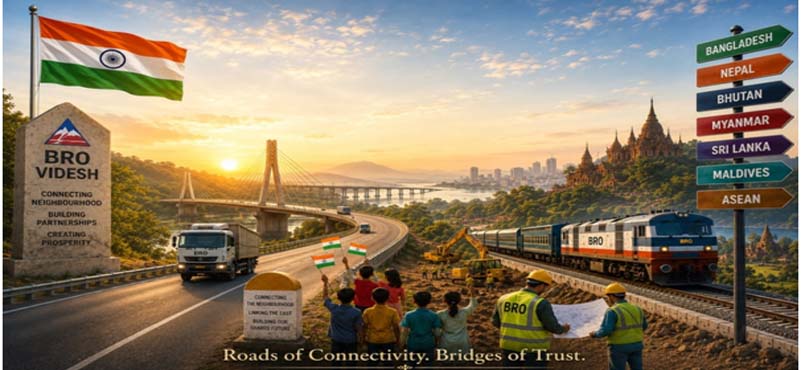
Connectivity is the New Currency of Power
For much of modern history, power was measured by the size of armies and the reach of navies. In the twenty-first century, however, influence increasingly travels along highways, railways, bridges, ports and economic corridors. Nations that build connectivity shape trade routes, investment flows, political relationships and strategic alignments. Infrastructure has become geopolitics by other means.
China understood this reality long before most countries did. Through roads, railways, ports and industrial corridors stretching across Asia, Africa and Europe, it transformed infrastructure into an instrument of national power. Its influence often arrived not through military deployments but through construction equipment, engineering firms and financing arrangements.
India, despite its growing economic and geopolitical weight, has yet to fully exploit infrastructure diplomacy as a strategic tool. The country has articulated ambitious visions through its Neighbourhood First Policy, Act East Policy and Indo-Pacific outreach. Yet the success of these initiatives ultimately depends not on declarations issued in New Delhi but on roads that connect markets, railways that move goods and bridges that link people.
The next phase of India’s regional strategy requires a new institutional instrument: a dedicated BRO Videsh Wing under the Border Roads Organisation (BRO), tasked with executing strategic infrastructure projects across friendly neighbouring countries and selected Southeast Asian partners.
Such an initiative would not merely build roads beyond India’s borders. It would build influence, trust, connectivity and strategic depth.
India’s Geography Problem and Opportunity
The logic begins with geography.
India’s geography presents both a challenge and an opportunity. The country’s most strategically sensitive region—the Northeast—remains connected to the mainland through the narrow Siliguri Corridor. Despite enormous economic potential and strategic significance, the region continues to suffer from logistical disadvantages that increase transportation costs, slow industrial growth and limit its integration with national and regional markets.
The roots of this challenge lie in history. Before Partition, railways, roads and river systems connected Eastern India seamlessly across what are today Bangladesh and Myanmar. The political boundaries that emerged after 1947 fractured these natural economic linkages. As a result, many routes that should be measured in hundreds of kilometres are today measured in thousands.
India has spent decades attempting to overcome these constraints by investing heavily within its own territory. These efforts are necessary and commendable. Yet infrastructure built exclusively within national borders can only achieve so much. The real strategic breakthrough lies in reconnecting the subcontinent and extending connectivity into Southeast Asia.
Geography has already connected India to its neighbourhood. Strategy must now catch up.
Why Infrastructure Has Become Geopolitics
Today’s strategic competition is increasingly shaped by connectivity networks. Roads determine trade flows. Railways influence industrial locations. Ports shape supply chains. Economic corridors create long-term dependencies and partnerships.
China’s Belt and Road Initiative demonstrated how infrastructure can be used to generate political influence, economic leverage and strategic presence. Whether in ports, highways or railways, connectivity projects have become instruments of national strategy.
For India, the challenge is not to replicate another country’s model but to develop its own approach—one based on partnership, transparency, local capacity-building and mutual benefit.
The most effective way to do so is by becoming a trusted builder of regional connectivity.
Why BRO is India’s Best Strategic Instrument
India does not need to create capability from scratch. It already possesses a proven institution.
For over six decades, the BRO has demonstrated extraordinary capabilities in some of the world’s most challenging environments. While constructing world’s highest motorable road at Umling La (19024 feet), world’s highest multispan bridge at Saser Brangsa (14,900 feet), world’s highest bi-lane tunnel at Sela (13,300 feet), world’s highest operational fighter base at Nyoma (13,700 feet) and many more engineering marvels across formidable Himalayan heights – all within past few years, BRO has repeatedly proven its ability to execute projects under conditions that would defeat many world famed construction agencies.
Its strengths are not merely technical. BRO combines engineering excellence, military discipline, operational flexibility and strategic awareness. It understands the security implications of infrastructure. It can operate in remote areas, difficult terrain and politically sensitive environments.
Few organisations globally possess such a combination of capabilities. This makes the case for a dedicated BRO Videsh Wing compelling.
A Connectivity Agenda for India’s Neighbourhood
1. Bangladesh: Bridge to Northeast
Among all India’s neighbours, Bangladesh occupies a uniquely important position. It is not merely a friendly neighbour; it is the geographical bridge between mainland India and the Northeast. Any serious conversation on regional connectivity must place Bangladesh at its centre.
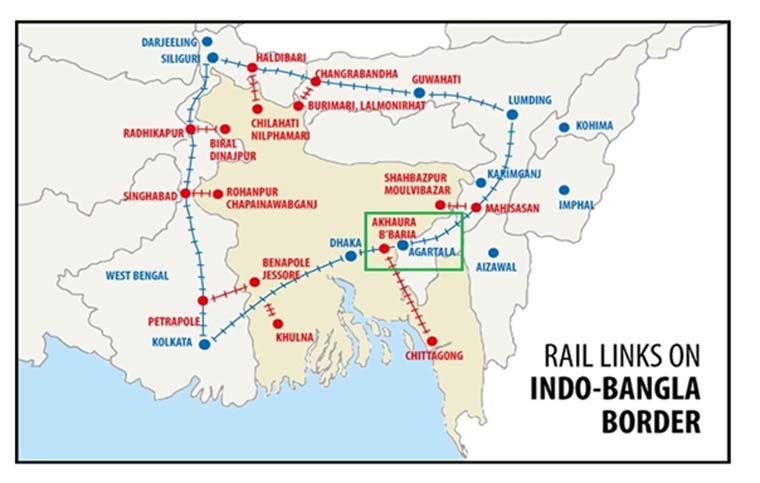
A future connectivity architecture should include a comprehensive rail and road network linking Kolkata, Dhaka, Akhaura, Agartala, Silchar and Guwahati.
Priority projects could include:
- Kolkata–Dhaka–Agartala rail corridor.
- Guwahati–Shillong–Sylhet rail connectivity.
- Revival of pre-Partition railway alignments.
- Dedicated freight rail corridor connecting Kolkata, Dhaka, Akhaura, Agartala and Guwahati.
- Integrated road corridors linking Northeast India with Bangladeshi ports.
- Expanded connectivity to Chattogram and Mongla ports.
- Development of multimodal logistics hubs.
- Enhanced inland waterway connectivity through the Brahmaputra-Meghna-Barak river systems.
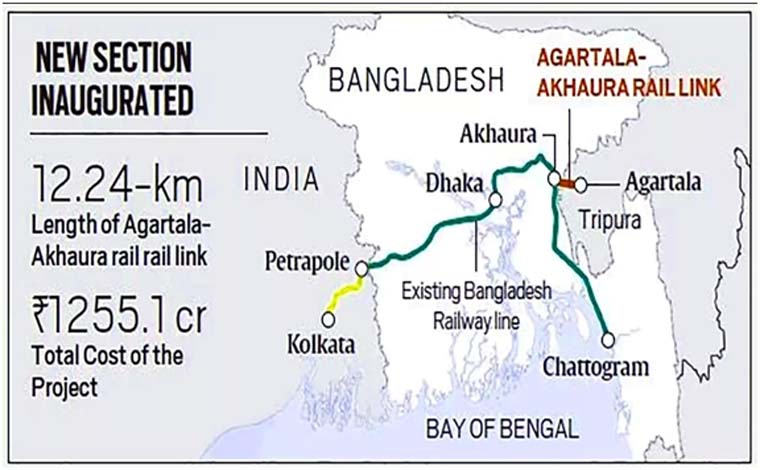
Bangladesh should not be viewed as a transit route. It should be seen as a strategic connectivity partner whose prosperity and connectivity directly strengthen India’s own economic and security interests.
2. Nepal: Himalayan Connectivity Partner
In Nepal, infrastructure cooperation can focus on:
- Kathmandu-Raxaul railway support.
- Strategic mountain highways.
- Cross-border logistics hubs.
- Bridges and tunnels.
- Disaster-resilient infrastructure.
BRO’s expertise in high-altitude engineering makes it a natural partner for Nepal’s development ambitions.
3. Bhutan: Deepening Trusted Connectivity
Bhutan offers opportunities for:
- All-weather roads.
- Mountain tunnels.
- Border trade infrastructure.
- Hydropower connectivity corridors.
- Digital infrastructure support.
Connectivity here would strengthen one of India’s most trusted partnerships.
4. Myanmar: Gateway to ASEAN
No meaningful Act East strategy is possible without Myanmar.
Priority projects should include:
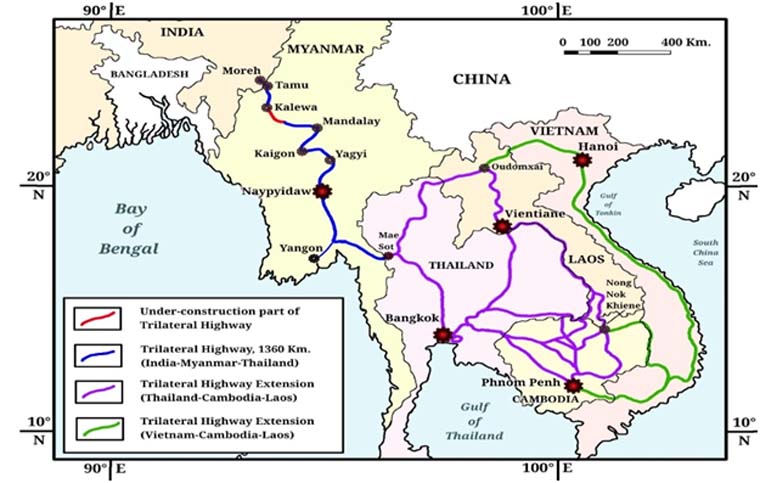
- Upgrading the India-Myanmar-Thailand Highway.
- Accelerating Kaladan connectivity.
- Strategic bridges and border roads.
- Upgradation of 69 bridges over Moreh – TKK corridor.
- Integrated Check Posts and logistics hubs.
Myanmar is the physical bridge that links India with Southeast Asia.
5. Sri Lanka and Maldives: Maritime Connectivity Partners
Infrastructure cooperation could include:
- Port access roads.
- Rail modernisation support.
- Airport infrastructure.
- Renewable energy connectivity projects.
- Coastal protection systems.
- Disaster-resilient engineering projects.
Such projects would strengthen India’s role as a preferred development partner in the Indian Ocean Region.
6. Southeast Asia: The Extended Frontier
Countries such as Vietnam, Laos and Cambodia offer opportunities for:
- Engineering partnerships.
- Highway and bridge construction assistance.
- Bridge projects.
- Capacity-building initiatives.
- Infrastructure diplomacy programmes.
These projects would extend India’s strategic footprint without creating military anxieties.
The Northeast: From Frontier to Gateway
This is where the argument for BRO Videsh becomes truly transformative.
For decades, the Northeast has been viewed through the lens of remoteness. Policymakers often describe it as a frontier, a periphery or a border region. Such thinking is increasingly outdated and strategically limiting.
The Northeast is not India’s edge. It is India’s gateway.
Historically, the region sat at the crossroads of civilisational exchanges linking the Indian subcontinent with Southeast Asia. Trade, culture and people moved through these corridors for centuries. Geography has not changed. What has changed is our perception of geography.
The strategic objective of the next two decades should be to transform the Northeast from a logistical cul-de-sac into the principal connectivity hub of eastern South Asia.
- Guwahati: Logistics Capital of East. Imagine Guwahati emerging as the logistics capital of Eastern India, connected through rail and road corridors to Bangladesh’s ports, linked by highways to Myanmar and integrated with multimodal transport networks stretching towards Southeast Asia.
- Agartala: Eastern Gateway to Bay of Bengal. Imagine Agartala becoming a major gateway city connected to Chattogram by rail and road, dramatically reducing transportation costs for industries across Tripura and beyond.
- Silchar: Multimodal Hub of Barak Valley. Imagine Silchar serving as a multimodal logistics node connecting river transport, highways and railways, creating a critical junction between the Northeast, Bangladesh and Myanmar.
- Imphal: India’s Land Bridge to ASEAN. Imagine Imphal evolving into a commercial gateway to ASEAN markets through improved connectivity with Myanmar, transforming it from a border city into a strategic centre of regional commerce.
Such a transformation would redefine the economic future of the entire region.
Connectivity would attract investment. Investment would generate employment. Employment would reduce outmigration. Economic growth would strengthen social stability. Greater prosperity would reinforce national integration. Strategic resilience would emerge naturally from economic vitality.
This is why infrastructure in the Northeast must no longer be viewed solely as a developmental undertaking. It is a national strategic project. Every road leading to a border crossing is a potential trade corridor. Every railway extending towards Bangladesh is an economic artery. Every bridge connecting remote districts is an investment in national security. Every logistics hub strengthens India’s position in the wider Indo-Pacific.
The future success of the Act East Policy will not be determined in diplomatic conferences. It will be determined on the ground—in freight terminals, border crossings, highways, bridges and railway stations.
The Northeast must therefore become the launch pad of India’s connectivity century.
Creating BRO Videsh
To achieve this vision, institutional innovation is necessary.
A BRO Videsh Wing should function as a specialised overseas infrastructure arm of the BRO, remaining institutionally anchored within the Ministry of Defence while operating under strategic guidance from the Ministry of External Affairs and in close coordination with other relevant ministries. Such an arrangement would combine BRO’s proven engineering expertise, operational discipline and experience in challenging terrain with India’s diplomatic and developmental objectives, ensuring that overseas connectivity projects serve both national strategic interests and regional partnership goals.
Infrastructure Diplomacy Fund
Jointly supported by:
- Ministry of External Affairs.
- Ministry of Finance.
- Development finance institutions.
- Partner governments.
Public-Private Partnerships. BRO working alongside Indian engineering and infrastructure companies.
Local Capacity Building. Training local engineers, contractors and technicians to create sustainable partnerships.
Rapid Reconstruction Teams. Engineering units capable of supporting partner countries following earthquakes, floods and cyclones.
BRO Videsh should become both a builder and a force multiplier for India’s diplomatic outreach.
Strategic Returns for India
The benefits of such an initiative would extend far beyond infrastructure.
- Stronger Neighbourhood First Policy. Projects create visible evidence of partnership.
- Effective Act East Policy. Connectivity turns aspiration into reality.
- Reduced Strategic Dependence on Competing Powers. Regional nations gain alternatives.
- Economic Integration. Trade volumes increase and logistics costs decline.
- Security Through Connectivity. Prosperous border regions are inherently more stable.
- Export of Indian Engineering Capability. Indian expertise gains regional recognition and influence.
Every bridge built by India becomes a bridge of trust. Every railway becomes a corridor of cooperation. Every road becomes a pathway for strategic partnership.
From Border Roads to Regional Roads
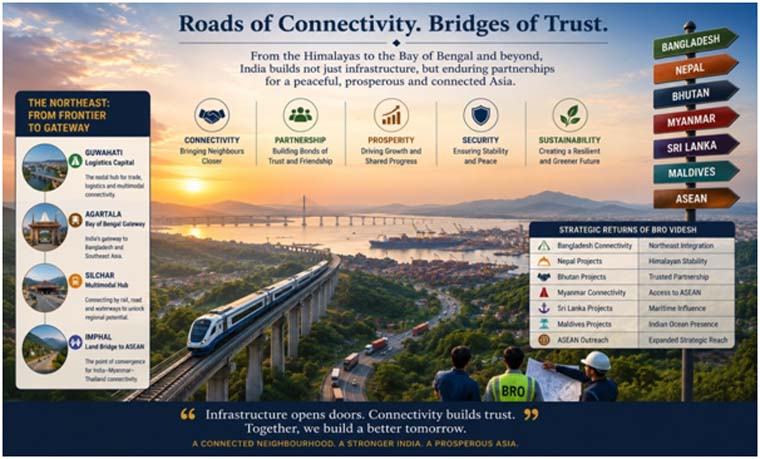
For 66 years, BRO has connected India’s most difficult frontiers.
The strategic demands of 21st century now call for a broader mission. India must think beyond border roads and begin building regional roads. It must reconnect the geography fragmented by history. It must integrate the Northeast into regional growth networks. It must create pathways that link the Himalayas with the Bay of Bengal and the Bay of Bengal with Southeast Asia.
A BRO Videsh Wing would be far more than an engineering initiative. It would be an instrument of statecraft, a vehicle of regional integration and a force multiplier for Indian strategy. By creating modern connectivity networks across South Asia and into ASEAN, India would not only accelerate trade and economic integration but also offer a credible, transparent and partnership–driven alternative to competing external infrastructure initiatives that have steadily expanded their strategic footprint across the region.
Equally important, such projects would serve as bridges of friendship and trust. Visible and timely delivery of roads, railways, bridges and logistics infrastructure would reassure smaller neighbouring countries that India’s engagement is rooted in shared prosperity and mutual respect rather than strategic dominance. In doing so, India would strengthen confidence in its Neighbourhood First policy and gradually soften perceptions of a “big brother” approach that have occasionally emerged from legitimate security concerns and asymmetries of size and power.
If connectivity is the currency of power in the Asian century, India must become one of its principal builders. A BRO Videsh would help transform geography into opportunity, partnerships into prosperity and connectivity into lasting influence. And the road to that future begins in the Northeast.
ABOUT THE AUTHOR

Lt Gen Rajeev Chaudhry (Retd) is a social observer and writes on contemporary national and international issues, strategic implications of infrastructure development towards national power, geo-moral dimension of international relations and leadership nuances in changing social construct.