Vinesh Phogat and the Cruel Irony
When Vinesh Phogat stepped onto the mat at the 2024 Summer Olympics and defeated Yui Susaki, the world witnessed one of the greatest upsets in Olympic wrestling history. Susaki was not merely another champion. She was an institution unto herself — undefeated in 82 international bouts, a multiple-time world champion and the overwhelming favourite for gold. Vinesh did not just beat a wrestler; she shattered an aura of invincibility.
For a brief moment, India celebrated what sport is truly supposed to represent — courage, endurance and the triumph of human will against impossible odds.
Then came the disqualification.
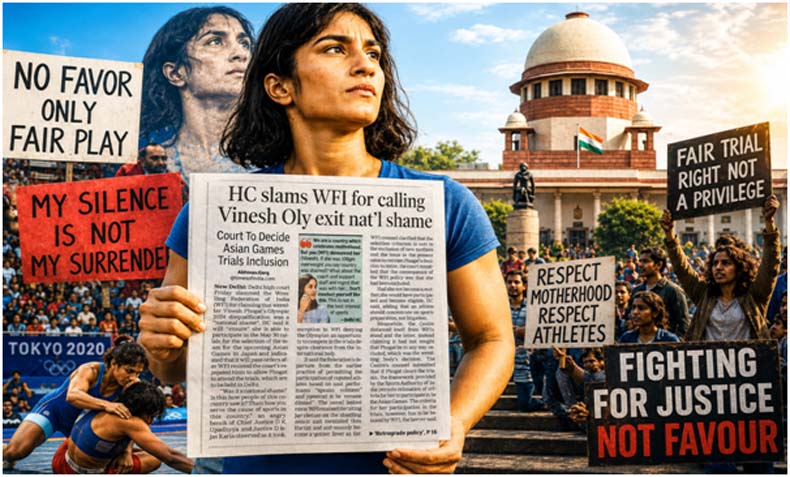
An athlete who had battled injuries, protests, political hostility and crushing expectations was suddenly reduced to a technicality of 100 grams. Worse followed. The Wrestling Federation of India (WFI) reportedly described the episode as a “National Shame.”
No. The shame was not Vinesh Phogat.
The real national shame is a system that repeatedly abandons its athletes, humiliates them in moments of vulnerability and then hides behind bureaucratic language to protect its own failures.
Indian Athletes Fight the System More Than Opponents
The tragedy of Indian sport is that our athletes often enter competitions already exhausted — not by rivals, but by their own institutions.
Behind every medal lies a story of administrative indifference. Delayed funding, arbitrary selections, poor facilities, opaque trials, factionalism, favouritism and humiliating uncertainty have become normalised across Indian sport. Athletes spend years preparing for global competitions while simultaneously battling federations, court cases, politics and ego wars.
Many sleep in poor training centres while officials travel business class. Athletes struggle for physiotherapists, nutritionists and mental conditioning support while sports administrators fight elections and lobby for posts. Talented youngsters disappear because they lack connections rather than ability. Careers are destroyed not by lack of potential, but by toxic governance.
India has mastered the art of ceremonial encouragement. We shower athletes with slogans, tweets and cash rewards after success, but rarely build systems that sustain them before success.
The truth is brutal: India produces champions despite the system, not because of it.
The recent years have exposed disturbing patterns — allegations of harassment, federation infighting, athlete protests, opaque decision-making and blatant disregard for accountability. The painful spectacle of wrestlers protesting on streets rather than training arenas should have shaken the conscience of the nation. Instead, institutions chose survival over introspection. The problem is not lack of policy. India has beautifully drafted sports policies, committees and codes.
The problem is implementation. In India, governance documents are often treated as decorative literature rather than binding obligations.
Sports Federations Have Become Political Kingdoms
One of the deepest cancers in Indian sport is the capture of sports federations by individuals who have little connection to sport itself.
Many Indian sports federations today function less like professional institutions and more like feudal estates controlled by politicians, businessmen, entrenched family networks and power brokers with little connection to sport itself. Federations governing Wrestling, Rowing, Football, Kabaddi and Boxing have, for years, been plagued by politicisation, opaque functioning and allegations of corruption that repeatedly overshadow athletic merit. The inevitable consequence is systemic neglect of talent, where promising careers are routinely undermined by administrative arrogance, factional politics and chronic governance failure rather than lack of sporting ability. Elections are often exercises in influence management rather than democratic accountability. Loyalty matters more than competence. Proximity to power matters more than sporting vision.
In many federations, athletes remain outsiders in institutions built supposedly for them.
This distortion has produced a grotesque imbalance. Those who have never stepped onto a wrestling mat, athletics track or rowing course often exercise complete control over careers of those who dedicate their entire lives to sport. Bodies such as the Sports Authority of India, the Indian Olympic Association and even the Sports Ministry frequently appear reactive instead of transformational. They intervene after scandals erupt, not before systems collapse. The result is predictable: athletes become expendable while administrators become permanent.
The National Sports Governance Act and Rules may be the best policy frameworks ever created but their enforcement remains weak and selective. Otherwise, Vinesh Phogat would not have approached Delhi High Court to challenge the WFI’s decision to declare her ineligible for domestic competitions and upcoming selection trials.
No serious sporting nation can succeed when power becomes more important than performance.
The Olympic Medal Table Is an Indictment
Every Olympic Games silently exposes the structural weakness of Indian sport.
Countries like Japan, South Korea and Australia consistently outperform India despite having far smaller populations. Jamaica, a tiny Caribbean nation, has built a sprinting culture powerful enough to dominate the world.
Why?
Because sporting excellence is not created by population size. It is created by systems.
These nations identify talent early, integrate sports into schooling, invest heavily in sports science and treat athletes as national assets rather than disposable performers. Their federations are not perfect, but they are significantly more professional, accountable and athlete-centric. India, meanwhile, continues to confuse emotional nationalism with sporting development.
A swimmer like Michael Phelps individually accumulated more Olympic medals (23, 03, 02) than entire generations of Indian athletes combined in individual events (02, 07, 16) post-independence. The statistic is humiliating, but the greater humiliation lies in our refusal to confront the reasons honestly.
India celebrates isolated heroes while ignoring the institutional vacuum around them. Every medal winner is projected as proof of national progress, yet the broader ecosystem remains broken.
A nation that cannot stand beside its athletes in defeat has no moral right to celebrate them in victory.
Talent Is Not India’s Problem
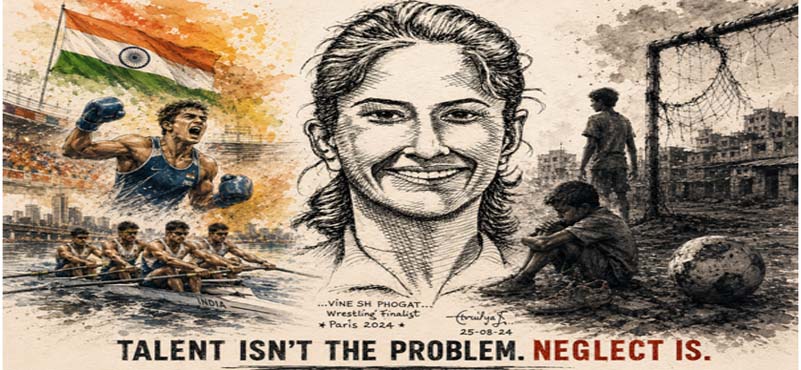
India does not lack talent or passion. It lacks structure.
Across villages, small towns and crowded urban neighbourhoods are countless children with extraordinary athletic potential. But talent without infrastructure becomes frustration. Dreams without support become abandonment.
Most Indian schools still treat sports as extracurricular decoration rather than educational necessity. Playgrounds disappear under real estate pressure. Coaching quality remains deeply uneven. Grassroots scouting is fragmented and inconsistent.
Cricket monopolises attention, sponsorship and aspiration while many Olympic sports survive on neglect. Parents continue to discourage sporting careers because they do not trust the ecosystem to provide stability, dignity or long-term security. And they are not entirely wrong.
In India, a failed athlete often falls into invisibility. There are few safety nets, weak institutional support systems and limited pathways after competitive careers end.
We celebrate medals emotionally every four years, but we refuse to build sporting culture systematically every day.
What Must Change
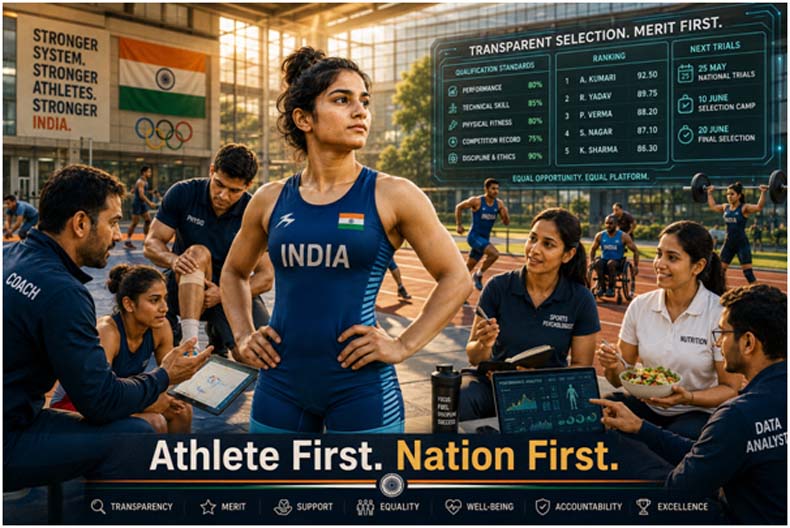
India does not need more slogans, committees or ceremonial outrage after every Olympic disappointment. It needs a complete restructuring of how sport is governed, funded and understood.
- Governance Reforms. Sports federations should face strict tenure limits, mandatory transparency norms and independent financial audits. Former athletes must occupy meaningful leadership positions instead of ceremonial roles. Conflict of interest rules should be enforced ruthlessly.
- Athlete Welfare. Every elite athlete should have access to scientific coaching, nutrition experts, physiotherapists and psychological support. Grievance mechanisms must be independent, fast and trustworthy. Harassment allegations should never be buried under institutional protectionism.
- Grassroots Transformation. Sports must become a serious part of school education, not a token annual event. District-level academies, community infrastructure and talent identification systems must expand aggressively.
- Accountability. Federations should be evaluated on measurable athlete development, international performance and governance standards — not political influence.
Most importantly, India must fundamentally change how it views athletes.
Athletes are not public relations tools for governments or federations. They are individuals who sacrifice childhoods, stability, health and often dignity in pursuit of excellence. They deserve systems that protect them rather than exploit them.
A nation is judged not by how loudly it celebrates medals, but by how honourably it treats those who strive to win them.
ABOUT THE AUTHOR

Lt Gen Rajeev Chaudhry (Retd) is a social observer and writes on contemporary national and international issues, strategic implications of infrastructure development towards national power, geo-moral dimension of international relations and leadership nuances in changing social construct.