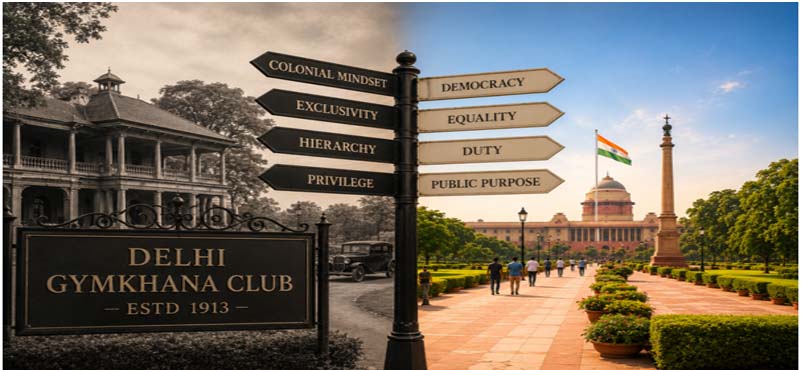
The recent debate around Delhi Gymkhana Club, Jaipur Polo Ground and The Race Club has triggered a larger national conversation that goes far beyond questions of land ownership. At one level, these are administrative and legal matters involving leases, security requirements and government policy. But at another level, they touch something much deeper in India’s public consciousness — our long and unfinished relationship with the colonial mind-set.
The Government’s argument in these cases is not without logic. Large tracts of prime land in the heart of the national capital are linked to highly sensitive security zones and strategic infrastructure requirements. In an era of evolving threats and rising security demands, the state has every right to reassess how such land is being used. National security and defence preparedness cannot become secondary to private recreational privilege, however historic or prestigious the institution may be.
At the same time, the debate has also reopened an older and uncomfortable question. In a democratic republic like India, should colonial-era islands of exclusivity continue occupying some of the country’s most valuable public spaces exactly as they did decades ago?
For many citizens, the discomfort is not really about horse racing, polo or sport itself. It is about symbolism. Massive green spaces in crowded cities continue to remain associated with privilege, restricted access and inherited social status while ordinary citizens struggle for basic public amenities and recreational spaces. Naturally, this creates resentment in an increasingly aspirational and democratic society.
Perhaps the real issue, therefore, is not merely Delhi Gymkhana Club, polo grounds or race courses. Those are only visible symbols. The deeper question is whether India, even after nearly eight decades of independence, has truly freed itself from the colonial mind-set.
Because colonialism was never only about buildings or land. It was also about hierarchy, distance, privilege and social signalling. In many ways, the British ruled India not just through laws and armies, but through carefully designed visible symbols of authority, exclusivity and status. Who entered which room, who sat where, who spoke English, who wore what, who had access to exclusive spaces — all these became instruments of power and quietly shaped the colonial order.
What is striking, however, is that while Britain itself gradually evolved into a far more functional and less ceremonial society, independent India often preserved many of these colonial habits with surprising enthusiasm. We still continue to nurture VIP culture, excessive protocol, ceremonial bureaucracy, elite institutional networks, restricted-access spaces, and social prestige attached to exclusivity. That colonial psychology still quietly survives around us.
Even language sometimes reflects this mind-set. Fluency in English is often unconsciously treated not merely as a useful skill, but as a marker of superiority. Bureaucratic behaviour can still occasionally carry traces of colonial distance rather than democratic accessibility. The tragedy is that while political power changed hands after independence, many social and psychological power structures simply adapted and survived.
That is why the present debate around colonial-era institutions evokes such strong emotions. Many people are not merely reacting to a piece of land or a club building. They are reacting to what these institutions represent psychologically — a lingering feeling that some spaces in India still belong more naturally to privilege than to the republic itself.
This is also why the Government’s broader effort to remove colonial symbols from public life resonates with many citizens. The renaming of Rajpath as Kartavya Path was not merely about changing a signboard. It was intended as a symbolic shift — from the imagery of imperial power toward the language of democratic duty. Similarly, several recent initiatives have attempted to replace colonial-era practices, ceremonies and symbols with institutions and language more rooted in Indian identity and republican values.
One may debate the methods or priorities of such initiatives, but the larger direction reflects an important national transition. A country that has been politically independent for nearly eight decades naturally seeks to redefine its public symbols, institutional culture and civic identity on its own terms rather than through inherited colonial frameworks. In that context, the questioning of elite colonial-era institutions was perhaps inevitable.
At the same time, a mature society must remain careful not to reduce every debate into anger alone. Democracies need continuity, civic culture and institutional memory. The answer therefore cannot simply be blind destruction or emotional revenge against the past. But continuity also cannot become an excuse for permanent exclusivity.
Institutions that occupy public land and derive prestige from public history must eventually align themselves with democratic realities. In a modern republic, legitimacy increasingly comes not from inherited status, but from public purpose and social relevance.
The deeper question before the country is not whether one particular club survives or disappears. The deeper question is whether India can finally move from a culture of hierarchy toward a culture of citizenship. Democracies evolve. Social expectations change. Citizens increasingly expect public institutions to reflect openness, accessibility and national purpose rather than inherited privilege. India removed British rule long ago. Removing colonial psychology is proving far more difficult.
The debate around Gymkhana clubs, polo grounds and race courses is therefore not only about land. It is part of a larger civilisational shift taking place within India itself — a slow movement away from inherited colonial prestige toward a more democratic understanding of public life.
And perhaps the day India finally stops admiring exclusivity more than accessibility, status more than service and hierarchy more than citizenship, we may truly become less colonial in our minds than we are today.
ABOUT THE AUTHOR

Lt Gen Rajeev Chaudhry (Retd) is a social observer and writes on contemporary national and international issues, strategic implications of infrastructure development towards national power, geo-moral dimension of international relations and leadership nuances in changing social construct.