

Bengal Is No Longer Merely a State Election
As the new government in West Bengal takes charge, the political significance of the moment extends far beyond Kolkata’s corridors of power. This is not merely the transfer of administrative authority from one political formation to another. It is the possible beginning of a strategic realignment in one of India’s most geopolitically sensitive regions.
For decades, India viewed Bengal primarily through the prism of ideology, culture and electoral arithmetic. But the strategic environment surrounding India has transformed fundamentally. The rise of hybrid warfare, the intensifying contest with China, instability in Bangladesh, demographic pressures along porous borders and the growing centrality of the Indo-Pacific have collectively elevated Bengal from a political theatre into a national security frontier.
The significance of the BJP’s victory therefore lies not merely in partisan success, but in the possibility of integrating India’s Eastern flank into a more coherent strategic architecture. For New Delhi, Bengal is no longer just another state. It is the hinge connecting mainland India to the Northeast, the Bay of Bengal and the wider Indo-Pacific theatre.
Who governs Bengal increasingly determines how secure India’s Northeast remains, how resilient its Eastern borders become and how effectively India can project power into the Bay of Bengal region.
The Geography of India’s Greatest Vulnerability
No Indian state occupies the geopolitical position that Bengal does.
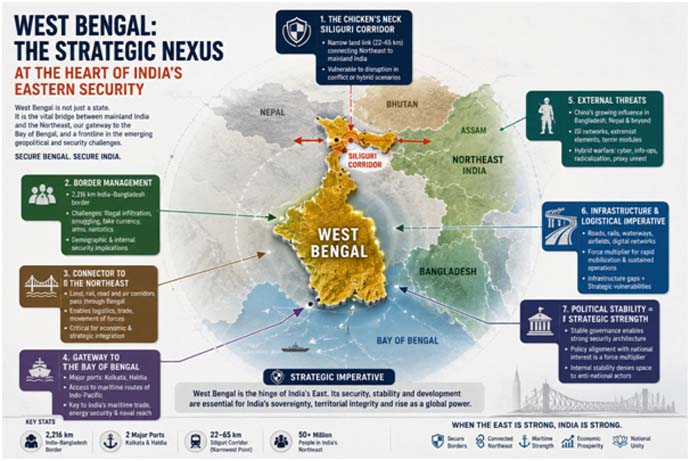
To its East lies India’s Northeast, connected to the mainland through the narrow Siliguri Corridor — the vulnerable “Chicken’s Neck” that remains one of India’s greatest strategic anxieties. To its South lies the increasingly contested Bay of Bengal. To its borders stand Bangladesh, while Nepal and Bhutan remain within immediate strategic proximity.
Few regions in Asia sit simultaneously at the intersection of continental security, demographic pressures and maritime competition.
The Siliguri Corridor alone explains why Bengal matters to Indian strategic planners. Barely a 22 Km narrow stretch at its most vulnerable points, this corridor serves as the sole land bridge connecting over fifty million Indians in the Northeast to mainland India. Any disruption — whether through military conflict, internal instability, sabotage or coordinated unrest — can severely impact India’s logistical and military posture in the entire Eastern theatre.
For decades, this vulnerability remained largely theoretical. Today, it no longer is.
China’s expanding footprint across South Asia, growing strategic competition in the Bay of Bengal and evolving hybrid warfare doctrines have transformed Eastern India into a highly sensitive strategic zone. Modern conflicts are no longer fought only through tanks and missiles. They are increasingly shaped through demographic pressure, information warfare, economic penetration, political destabilisation and cyber influence.
In such an environment, political instability in Bengal ceases to remain a state issue. It becomes a national vulnerability.
This is where this victory assumes deeper significance. A politically aligned Eastern corridor between New Delhi, Assam and now Bengal potentially allows far greater strategic coordination in border management, intelligence sharing, infrastructure development and crisis response.
For the first time in decades, India’s Eastern security architecture may begin functioning with political synchronisation instead of fragmentation.
The Long Shadow of Infiltration
One of the most politically contentious yet strategically unavoidable realities surrounding Bengal has been the issue of illegal infiltration across the India–Bangladesh border.

For years, the debate remained trapped within partisan accusations and electoral rhetoric. But national security agencies have consistently warned that uncontrolled migration in border regions creates long-term strategic complications extending beyond economics or local demographics.
The concern is not about ordinary migration alone. It is about the ecosystem that often develops around porous borders:
- Fake currency networks.
- Trafficking syndicates.
- Narcotics movement.
- Arms smuggling.
- Forged documentation.
- Potential radical infiltration routes.
Over time, such networks gradually weaken state capacity and alter local political incentives. Border management becomes vulnerable to patronage structures. Criminality acquires political protection. Demographic anxieties intensify social polarisation. What begins as a governance challenge eventually acquires strategic dimensions.
This becomes especially sensitive in Eastern India because demographic instability directly affects the security psychology of the Northeast. States like Assam have historically viewed unchecked infiltration not merely as a social issue, but as a question of identity, land security and political representation.
The victory in Bengal therefore carries symbolic weight far beyond electoral arithmetic. Supporters view it as a mandate for restoring stricter border governance, improving citizenship verification mechanisms and strengthening the integrity of India’s eastern frontier.
Whether these ambitions translate into effective governance remains to be seen. But politically, the message is unmistakable: the issue of border integrity has now moved from the margins to the centre of Bengal’s political discourse.
That shift alone marks a strategic transformation.
Why Bengal Matters to the Northeast
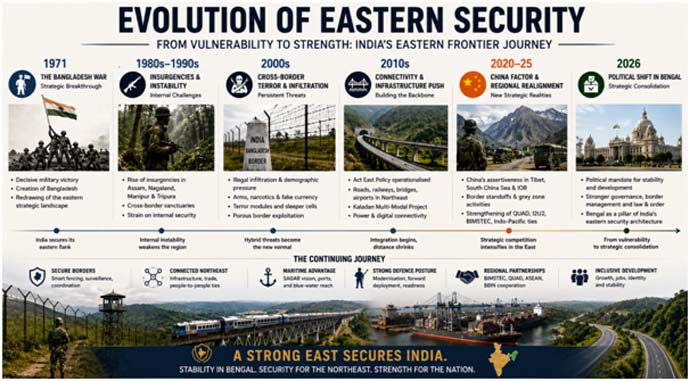
India’s Northeast cannot be secured in isolation from Bengal.
Historically, insurgencies in the Northeast exploited porous borders, weak connectivity and administrative fragmentation across Eastern India. Arms routes, smuggling channels and safe havens frequently depended on the broader vulnerabilities of the eastern corridor.
But beyond logistics lies something equally important: psychological integration.
For decades, many in the Northeast perceived themselves as geographically and politically distant from mainland India. Connectivity projects remained slow. Infrastructure gaps persisted. Economic integration moved unevenly. The Siliguri Corridor symbolised not only physical vulnerability but also strategic isolation.
In recent years, New Delhi has attempted to reverse this through massive investments in roads, railways, tunnels, airfields and border infrastructure across the Northeast. Yet such integration requires a stable and strategically aligned Bengal.
If Assam serves as India’s Eastern shield, Bengal is the handle that allows the shield to function.
The BJP’s rise in Bengal potentially creates, for the first time, a politically coherent Eastern arc stretching from the Hindi heartland into Assam and the Northeast. Such alignment can accelerate:
- Integrated border management.
- Intelligence coordination.
- Infrastructure execution.
- Counter-insurgency logistics.
- Strategic mobility across eastern India.
Most importantly, it reduces political friction in implementing national security priorities.
This matters enormously in an age where infrastructure itself has become strategic power. Roads, rail corridors, inland waterways, ports and digital connectivity now shape military readiness as much as conventional deployments.
A politically synchronised Eastern corridor could therefore transform India’s ability to secure and integrate its Northeast more effectively than ever before.
And that may ultimately become the deepest strategic meaning of Bengal’s political transformation.
The Bangladesh Factor and the Emerging Eastern Volatility
No assessment of Bengal’s strategic significance can ignore the changing realities in Bangladesh.
For much of the past decade, India benefited from relatively stable cooperation with Dhaka on issues such as counter-terrorism, border management and insurgent control. That cooperation significantly weakened anti-India militant sanctuaries that once threatened the Northeast. But the regional environment is no longer static.
Political volatility inside Bangladesh, rising Islamist mobilisation across segments of society and intensifying external influence operations have introduced new uncertainties into India’s Eastern security calculus. Simultaneously, China has steadily expanded its economic and strategic footprint in Bangladesh through infrastructure projects, port development and financial penetration.
For India, the concern is not merely diplomatic competition. It is the possibility that instability in Bangladesh could spill across the border into Bengal and the Northeast through:
- Migration surges.
- Radical networks.
- Organised criminal channels.
- Information warfare.
- Cross-border political mobilisation.
In modern hybrid conflict environments, unstable neighbourhoods become strategic vulnerabilities.
This is precisely why Bengal’s political orientation now carries national consequences. A government closely aligned with New Delhi allows faster coordination during border crises, improved intelligence sharing and stronger strategic coherence in responding to regional instability.
The Eastern frontier can no longer be treated as a passive border zone. It has become an active geopolitical theatre. And Bengal sits at its centre.
China’s Eastern Shadow
No serious strategic assessment of Eastern India can ignore the broader China factor. Over the past decade, China has steadily increased its influence across South Asia:
- Infrastructure in Bangladesh.
- Political outreach in Nepal.
- Connectivity ambitions in Myanmar.
- Maritime expansion across the Indian Ocean.
Collectively, these developments create strategic pressure points around India’s Eastern periphery.
The Siliguri Corridor remains particularly vulnerable in any future confrontation scenario. Military planners have long recognised that disruption in this narrow corridor could complicate India’s ability to reinforce and sustain the Northeast during conflict.
This is why infrastructure, political stability and demographic security in Bengal acquire heightened importance.
Strategic competition today is not merely about troop deployments. It is about who controls the surrounding ecosystem:
- Transport networks.
- Political influence.
- Ports.
- Narratives.
- Digital space.
- Economic dependencies.
This victory in Bengal may therefore be viewed in New Delhi not simply as an electoral breakthrough but as part of a wider strategic consolidation of India’s Eastern flank against emerging geopolitical pressures.
For the first time, the Centre potentially enjoys political synchronisation across a large segment of Eastern India at a time when the region itself is becoming central to Asian geopolitics.
That convergence could prove historically significant.
Maritime Bengal and the Battle for the Bay of Bengal
India’s strategic imagination historically remained land-centric, focused overwhelmingly on continental threats. But the twenty-first century is steadily shifting geopolitical competition toward the seas — particularly the Indo-Pacific.
In this emerging order, the Bay of Bengal is acquiring enormous strategic significance.
Energy routes, undersea cables, maritime trade corridors and naval mobility are turning the Bay into one of Asia’s most consequential theatres. China’s growing maritime presence through the so-called “String of Pearls” strategy has further intensified this competition.
This makes Bengal’s maritime geography critically important.
The Kolkata–Haldia port system, Eastern shipping infrastructure and connectivity to the Andaman and Nicobar chain collectively form a major component of India’s Eastern maritime posture. Bengal is no longer merely a land gateway to the Northeast; it is also an anchor for India’s Eastern seaboard strategy. A politically aligned government in Bengal could accelerate:
- Port modernisation.
- Coastal infrastructure.
- Logistics corridors.
- Industrial expansion.
- Inland waterway connectivity.
- Defence-linked manufacturing ecosystems.
Such developments are not merely economic initiatives. They strengthen strategic resilience.
Modern warfare depends heavily upon logistics, connectivity and supply chain depth. The side that moves faster, mobilises quicker and sustains infrastructure longer often gains decisive advantage.
Eastern India therefore cannot remain strategically underdeveloped while the Indo-Pacific emerges as the world’s central geopolitical arena.
For New Delhi, Bengal’s political transformation potentially opens the door to integrating eastern maritime strategy with national security planning in ways previously difficult to execute.
Conclusion: The Battle Beyond Ballots
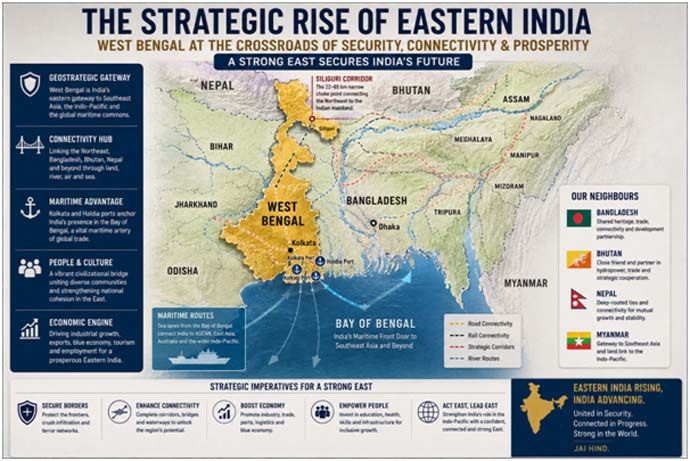
The state that once symbolised ideological movements and political upheaval now stands at the crossroads of some of the most defining strategic challenges of the century:
- China’s rise.
- Instability in South Asia.
- Demographic pressures.
- Maritime competition.
- Hybrid warfare.
- The future integration of the Northeast.
The political destiny of Bengal will increasingly shape the strategic destiny of Eastern India.
For New Delhi, this victory may represent the final missing piece in securing India’s Eastern arc — from the Siliguri Corridor to the Bay of Bengal.
And in the decades ahead, historians may perhaps view this moment not merely as a change of government in Kolkata, but as the beginning of a new strategic doctrine for India’s eastern frontier.
Because in the twenty-first century, the defence of sovereignty may begin not only at the borders — but in the political consolidation of the spaces that guard them.
ABOUT THE AUTHOR

Lt Gen Rajeev Chaudhry (Retd) is a social observer and writes on contemporary national and international issues, strategic implications of infrastructure development towards national power, geo-moral dimension of international relations and leadership nuances in changing social construct.