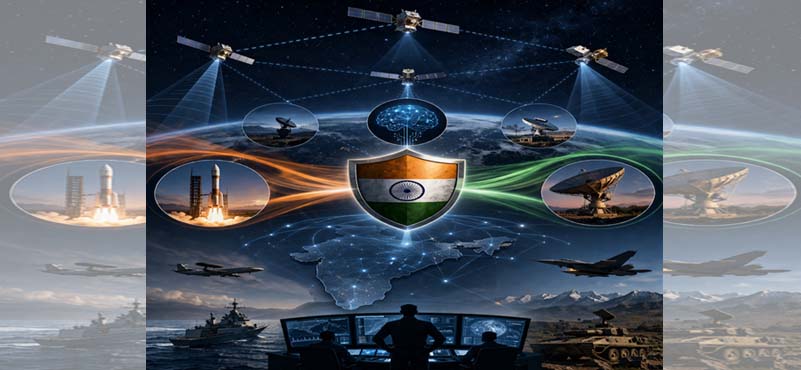
India has built a credible foundation in military space. Yet India’s military space journey is often measured by the number of launches and satellites. The conversation must shift from assets to integrated force design capability and strategic coherence.
The approval of the ₹26,968 crore SBS-III programme in October 2024 and the release of India’s first Joint Military Space Doctrine in September 2025 mark important shifts in intent. Yet, at their core, they remain major procurement and policy milestones atop a system that still lacks depth in planning.
What is missing is not ambition, but the institutional backbone that can continuously assess needs, set standards, and drive acquisitions in a steady, predictable manner, which is essential in a domain now widely accepted as integral to multidomain warfare. It calls for an integrated, long-term capability beyond incremental gains, without a decisive edge.
The contrast becomes clearer when viewed operationally. India’s current military and dual-use satellite strength remains modest, especially compared with China’s far larger and more active constellation. The difference is not just numerical; it shows up in how often critical areas are observed. While Indian systems may revisit key regions along the LAC every day or two, Chinese platforms can do so multiple times in a single day. That kind of persistence shapes decision dominance and the kill chain on the ground.
At the structural level, India has some of the finest space organisations, including the Indian Space Research Organisation, the Defence Research and Development Organisation, and the Defence Space Agency. Each brings depth to its domain. Yet no single entity, such as the Integrated Joint Space Command, exists to design the overall architecture for integrating these capabilities in a conflict scenario. The broader questions of force design, scale, and timelines often go unanswered.
The DSA, set up in 2019, has improved coordination to an extent but remains a limited structure without a direct role in top-level space decision-making. This is evident in how requirements are still raised service by service, leading to standalone projects rather than a connected architecture. Each service continues to push its own proposals, as seen in separate programmes such as GSAT-7, 7B, and 7C, rather than working from a common blueprint.
Even broader programmes, such as the 52 satellite-based SBS-III, move things forward, but they are treated as one-off efforts. Without a follow-on cycle, momentum tends to slow once the immediate programme is complete. India still lacks the institutional mechanism to translate that thinking into a consistent, long-term capability.
The gaps are not dramatic but are critical and require attention. Surveillance exists, but revisit rates need improvement. Navigation systems exist, but dependence on foreign capabilities or components, such as atomic clocks, needs to be eliminated. Satellite imagery must not only be downloaded in real time but also be available to warfighters in near-real time to enable decision dominance.
The bigger issue is integration. Space is still not fully integrated into a unified C5ISR framework. There is also a strong case for accelerating AI-driven image interpretation and data fusion. India already generates high-quality space data.
There is also an underused advantage in leveraging the broader space-strategic ecosystem. India’s civil space strength and growing private ecosystem could act as force multipliers. Civil space capabilities and a fast-growing private sector can meaningfully complement military requirements if integrated into a more structured framework.
The military space requirements need a stronger, unified voice in national decision-making, rather than being channelled through separate service channels. Some of the areas for focus are:
- First, it is not just about building to scale, but about developing space-based capabilities based on the lessons of Op Sindoor and multidomain warfare to achieve a decisive advantage in operations. What is needed is a system that can withstand threats, recover quickly if assets are lost, and remain persistent over the areas that matter most, such as the northern borders and the Indian Ocean. This requires an architecture that emphasises rapid reconstitution, distributed sensing, and theatre-specific coverage of the IOR and the northern borders. Programmes like SBS-III should not be one-off efforts. A steady cycle of smaller, time-bound acquisitions would sustain both capability and industrial momentum.
- Second, planning and funding have to move together. A long-term vision with assured budgetary support and an independent, fast-track procurement cycle is needed. India’s entire Department of Space budget was ₹13,416 crore ($1.57B) for FY2025-26 and is ₹13,705.63 crore for FY 2026–27. This is grossly inadequate. Further, realistic funding allocation must be matched by priorities for indigenous capabilities in PNT and space-based C5ISR over sensitive theatres of operations.
- Third, software and data integration in space need far greater emphasis. India already has the talent to handle complex networks and large-scale analytics, yet optimisation in the military domain remains below the desired level. Applying that capability to areas such as network management, real-time analytics, and decision support would significantly improve outcomes without requiring entirely new hardware.
- Fourth, there is a need for more rigorous civil-military fusion in the space sector. Startups in India are venturing into Earth observation, propulsion and space situational awareness. The SBS-III initiative, with a large proportion of satellites to be manufactured by industry, is a step towards distributed manufacturing, but the ecosystems remain un-integrated. India has the potential, but needs a platform to realise it. Industry needs predictability. Publishing clear standards and a rolling procurement pipeline would give companies the confidence to invest and build ahead of demand.
- Fifth, integrate AI into the core of Indian space-based capabilities. Whether in imagery interpretation, satellite tasking, or space situational awareness, the goal should be to reduce the time between data collection and action. The tools are available. What is needed is consistent adoption. The IFC-IOR at Gurugram (76 linkages across 28 countries) already applies AI for maritime domain awareness; scaling this approach to space-based ISR would leverage India’s strongest comparative advantage.
- Finally, the case for creating an Integrated Joint Space Command that integrates, prioritises, operationalises, and builds long-term capabilities to secure India is already delayed. The focus must be to move from the present system of the ‘threat cum capability” model to a ‘capability cum opportunity” model.
India lacks coherence, not capability, in the military space domain. The current approach produces capability, but not necessarily an advantage. Innovation needs a clearer path from prototype to deployment. India has the startups; what it needs is a more reliable bridge to induction. None of this requires reinvention. It just needs consistency.
An Integrated Defence Space Command offers a way forward. It brings together planning, technology, and operations under one roof, thereby creating accountability and responsibility. Most importantly, it enables India to think ahead rather than react.
The next conflict will not wait for systems to catch up. If India wants to compete as a major power in space, it must first organise itself accordingly.
(The author was the Former ADG, Perspective Planning and Space)
ABOUT THE AUTHOR
 Lieutenant General A B Shivane, is the former Strike Corps Commander and Director General of Mechanised Forces. As a scholar warrior, he has authored over 200 publications on national security and matters defence, besides four books and is an internationally renowned keynote speaker. The General was a Consultant to the Ministry of Defence (Ordnance Factory Board) post-superannuation. He was the Distinguished Fellow and held COAS Chair of Excellence at the Centre for Land Warfare Studies 2021 2022. He is also the Senior Advisor Board Member to several organisations and Think Tanks.