
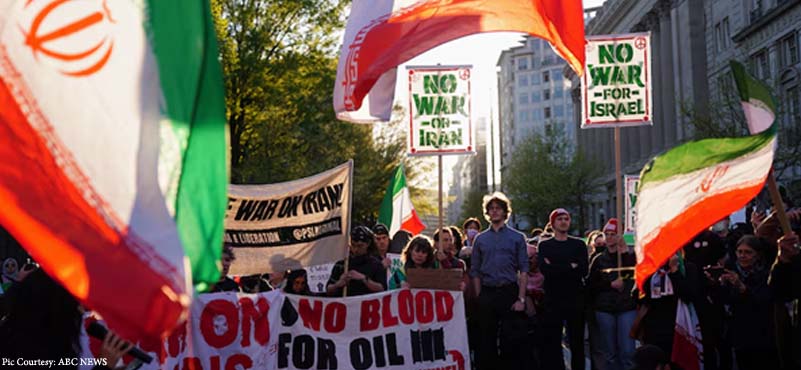
Wars rarely announce their turning points. They reveal them quietly, in pauses that appear tactical but carry strategic consequence. The two-week ceasefire now in place between Iran, Israel, and the United States is one such moment. It halts the violence, but it does not yet answer the question that matters: whether the war is being steered toward an end or merely interrupted before it resumes with greater force.
Iran enters this pause having achieved what many assumed it could not. It has absorbed sustained military pressure without systemic breakdown. Its command structure holds. Its capacity to retaliate remains credible. In the language of conflict, it has denied its adversaries a quick or decisive outcome. That alone has altered the psychological balance. Yet endurance, by itself, is not victory. It is a position. What follows determines whether that position matures into an advantage or dissolves under the weight of time.
The character of this conflict has already changed. For years, confrontation operated within limits. Proxies absorbed shocks. Cyber operations blurred attribution. Strikes were calibrated to signal intent without inviting full retaliation. That framework has now collapsed. The present phase is direct, visible, and immediate. Iranian territory has been struck openly. Israeli cities have come under sustained missile and drone fire. The United States has moved from distant enabler to active participant. In this environment, ambiguity no longer cushions escalation. Decisions are sharper, timelines shorter, and consequences harder to contain.
The ceasefire must therefore be read with care. It is not a settlement. It is not even stable. It is a pause shaped by necessity. The risks of continued escalation, amplified by warnings of catastrophic consequences from Washington, have forced all sides to step back at once. The inclusion of Israel in this arrangement marks a critical shift from earlier efforts that excluded it from the assurance framework. This matters. A ceasefire that excludes a principal combatant invites immediate breakdown. One that includes all actors at least creates the possibility of coordinated restraint. But possibility is not assurance.
Israel’s presence within the ceasefire removes one layer of fragility, yet it introduces another that is less visible but equally serious. Participation does not imply alignment. Israel has not entered this pause because its threat perception has changed. It has entered because the costs of immediate continuation have risen. Its core concerns remain intact. Its risk tolerance, shaped by direct attacks on its cities, is lower than before. If the negotiations that follow do not produce outcomes that are considered credible, the logic of independent action will return quickly.
This is the central tension of the moment. All sides have agreed to stop. None has yet agreed on what must come next.
A ceasefire holds when restraint becomes the preferred option, not just a temporary one. That requires a degree of convergence that is currently absent. Iran sees the pause as recognition of its resilience. The United States presents it as the result of pressure that has created diplomatic space. Israel treats it as a limited suspension, useful only if it leads to enforceable security outcomes. These are not opposing positions, but they are not aligned either. Between them lies the uncertainty that defines the ceasefire’s future.
The structural weaknesses are already visible.
There is no credible, shared system to verify compliance in real time. In a theatre defined by missiles, drones, and compressed decision cycles, ambiguity is dangerous. A single disputed incident can unravel restraint faster than diplomacy can repair it.
Domestic pressures remain active. In Iran, any pause must translate into tangible economic or political relief to sustain internal support. In the United States, engagement with Tehran remains politically contested. In Israel, public sentiment after direct attacks leaves little room for outcomes that appear partial or temporary. These forces do not pause with the ceasefire. They shape its limits.
Most importantly, the ceasefire still defers the core contradiction of the conflict. The Iran–Israel equation remains adversarial at its foundation. The current arrangement suspends interaction; it does not transform it. Without a framework that directly addresses this relationship, the pause rests on restraint rather than resolution.
For Iran, the implications are stark. It has reached a point where continuing the conflict offers diminishing returns. Economic strain will deepen. Infrastructure will erode. The risk of wider escalation, including maritime disruption and external intervention, will grow. The leverage it holds today is real, but it is not permanent. It exists because of current conditions, not guaranteed outcomes.
The strategic choice, therefore, is not between resistance and retreat. It is between prolongation and conversion. Iran can prolong the conflict and test its endurance further, or it can convert its current position into a negotiated advantage. The latter requires discipline. It demands a shift from battlefield signalling to political outcome without surrendering the narrative of resilience that has sustained it so far.
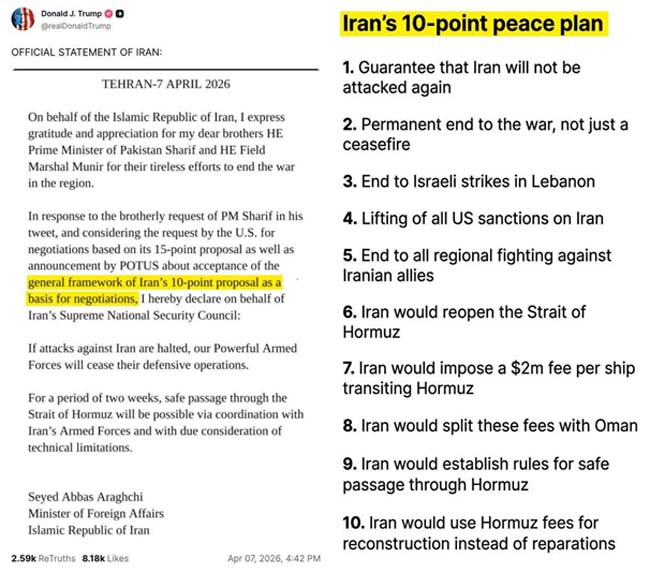
Such a transition would not be one-sided. It would require reciprocal movement. Signals on nuclear restraint within a verifiable framework would address one of the concerns. Assurance of uninterrupted maritime flow through Hormuz would stabilise another. In return, sanctions relief and economic access would provide the material basis for recovery. None of this resolves underlying hostility. It creates a structure within which it can be managed.
Israel’s role in this evolution is decisive. Its inclusion in the ceasefire gives it a seat within the process. What it does with that position will shape whether the pause becomes a pathway or a dead end. If it remains a participant without becoming a stakeholder in the outcome, the arrangement will struggle to hold. If its security concerns are integrated into a framework it considers credible, the chances of durability increase significantly.
For the United States, the ceasefire offers a narrow corridor. It allows de-escalation without visible retreat. It creates diplomatic space without conceding strategic posture. But this corridor is time-bound. If negotiations stall, the pressures that led to escalation will reassert themselves.
India watches this moment with practical interest. Stability in the Gulf is not abstract. It is tied to energy security, economic planning, and regional connectivity. The reopening of maritime flows offers immediate relief, but not predictability. India’s interest lies in the ceasefire evolving into a structure that reduces volatility rather than managing it episodically. That requires inclusion, verification, and above all, convergence.
The two-week window is therefore more than a pause. It is a test. Not of intent, but of discipline. Can adversaries who have stepped back together move, however reluctantly, toward a shared understanding of what must follow?
A ceasefire buys time. It does not create outcomes. This one is stronger because all sides are inside it. It remains fragile because they are not yet moving in the same direction. If this pause is used only to recover strength, the war will return sharper and less restrained. If it is used to shape a framework each side can live with, it may yet mark the beginning of an end. The difference will not be measured in these two weeks, but in whether they are used to change the logic of the conflict or merely delay it.
ABOUT THE AUTHOR
 Lieutenant General A B Shivane, is the former Strike Corps Commander and Director General of Mechanised Forces. As a scholar warrior, he has authored over 200 publications on national security and matters defence, besides four books and is an internationally renowned keynote speaker. The General was a Consultant to the Ministry of Defence (Ordnance Factory Board) post-superannuation. He was the Distinguished Fellow and held COAS Chair of Excellence at the Centre for Land Warfare Studies 2021 2022. He is also the Senior Advisor Board Member to several organisations and Think Tanks.