
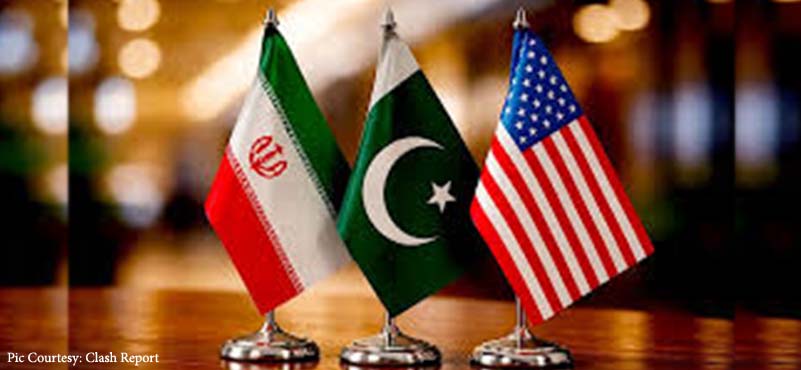
The current crisis in West Asia has a long history of hostility and resentment. It developed over many years as the restraint gradually diminished. Iran, Israel, and the United States operated in a tense but manageable pattern for years. While confrontation persisted, it was kept in check through distance, proxies, covert actions, and careful ambiguity. None of this reduced hostility; it merely prevented escalation into direct and sustained warfare.
That pattern has now shifted. The change is clear not only in the level of violence but also in its nature. Direct attacks on Iranian territory by the United States and Israel, followed by Iranian responses against Israeli cities and targets linked to American interests, have altered the pace and stakes. What was once carried out through layers of deniability is now done openly. Actions are acknowledged, responses are faster, and the room for error is smaller. The conflict has reached a stage where escalation is easier to provoke and harder to control.
In this context, the reported Islamabad Accord seems less like a diplomatic breakthrough and more like an effort to slow down events before they spiral out of control. Its scope is deliberately limited. A ceasefire, the reopening of the Strait of Hormuz, and a brief window for further engagement are its main components. There is no attempt to address deeper disputes at this stage. This restraint reflects the reality of the situation. When a crisis escalates, the primary goal is to stabilise it.
A ceasefire fulfils that role. It doesn’t resolve conflicts, but it changes the circumstances under which they are managed. It lessens the pressure for immediate retaliation and reduces the chance that a single incident will escalate the conflict. Even a short pause can provide space for reassessment, which is often scarce when quick responses are prioritised.
The emphasis on the Strait of Hormuz is well-founded. This is not a minor issue. It is a vital route for global energy flows, and disruptions there can have consequences that reach well beyond the region. Maintaining its openness is more about avoiding conflict than diplomacy. It helps keep the situation within tolerable limits for others.
The choice of Pakistan as an intermediary is more complex. On the surface, it seems logical. Direct communication between the main actors is politically limited and often avoided. Messages still need to be conveyed, and a third party can provide that channel without requiring public engagement. In that limited way, Pakistan serves a useful role.
But mediation is not only about access; it also depends on credibility. Pakistan has a mixed record in this area. Its history of selectively sticking to past commitments, including the Simla Agreement, continues to influence its diplomatic role. Trust, once broken, does not easily recover. In a context where even basic facts are disputed, the intermediary’s reputation is important. Currently, it remains questionable. This does not eliminate Pakistan’s role, but it does restrict the confidence others are likely to have in it.
Domestic pressures heighten this fragility. Decisions made during a crisis are scrutinised after the immediate urgency subsides. In Iran, restraint will be judged by its results. In the United States, engaging with Tehran remains politically delicate. In Israel, experiences of direct attacks on civilian areas shape expectations clearly, leaving little room for ambiguity. These pressures persist even after firing stops; they stay active, influencing how the arrangement is viewed and whether it endures.
The deeper issue, however, lies in the agreement’s structure. It seeks to stabilise a conflict while excluding one of its main participants. Israel is not on the edge of this crisis; it is at its core. Its security concerns are urgent, and its ability to act independently is firmly established. An arrangement that does not involve it directly remains uncertain.
This is more than just a participation gap; it questions the entire validity of the framework itself. An actor who does not join an agreement is not bound by it. If Israel decides that the arrangement does not adequately address the threat it faces, it has both the incentive and the capacity to act independently. That would not be a minor disruption; it would clearly reveal the limits of the accord in a direct and impactful way.
There is, however, a more limited reason to proceed despite this. In moments of high tension, partial steps are sometimes the only options available. If a broader understanding cannot be achieved right away, a small pause can still reduce the conflict’s intensity. It can prevent more harm and give space for a larger process to unfold.
The challenge is that such pauses are difficult to maintain unless they develop. Exclusion creates its own pressures. Those outside the framework are free to act and may feel driven to do so. Over time, this undermines the arrangement. What starts as a temporary measure risks turning into another source of instability.
The implication is clear. Any lasting arrangement must, at some point, include everyone involved in the conflict. This doesn’t mean agreeing on every issue, but having a structure that addresses the main concerns of each party and motivates them to maintain it. Without this, the arrangement remains temporary.
For India, the situation has clear implications. The Gulf remains vital for its energy security, and disruptions in the Strait of Hormuz have immediate economic effects. Price fluctuations, supply concerns, and broader market reactions influence domestic stability. India’s investments in regional connectivity also depend on a stable and predictable environment. Meanwhile, its relationships with Israel add another layer to its position.
These factors suggest adopting a cautious approach. India’s interest is in stability rather than taking sides. It benefits from lower tension and safe maritime routes. Supporting conditions that promote this goal help serve its purpose. Staying in touch with all parties allows it to do so without getting involved in the conflict itself.
There is also a broader perspective. A limited arrangement that excludes a central actor does not provide a strong base for stability. India has reasons to support a process that gradually becomes more inclusive. This does not need public statements. It can be achieved through consistent engagement and careful signals that inclusion is crucial for lasting stability.
The Islamabad Accord, as it currently stands, is a cautious attempt to slow a dangerous course. It may succeed in creating a pause, and that pause could be meaningful. Still, it does not address the core tensions, nor does it provide a framework capable of sustaining peace on its own. Its significance lies in what happens next.
A pause can be used effectively or as a ruse until strikes begin again. It can serve as the first step toward a more inclusive and credible arrangement, or it can revert to another cycle of escalation once immediate pressures reemerge. The outcome depends on whether the process expands to reflect the full reality of the conflict.
Currently, the accord, while offering a potential opening, lacks credibility due to the guarantor’s reliability and commitment to lasting peace, as well as the absence of a comprehensive, inclusive framework. Whether this opportunity will lead to a more inclusive framework that ensures lasting peace and a respectful exit remains uncertain.
ABOUT THE AUTHOR
 Lieutenant General A B Shivane, is the former Strike Corps Commander and Director General of Mechanised Forces. As a scholar warrior, he has authored over 200 publications on national security and matters defence, besides four books and is an internationally renowned keynote speaker. The General was a Consultant to the Ministry of Defence (Ordnance Factory Board) post-superannuation. He was the Distinguished Fellow and held COAS Chair of Excellence at the Centre for Land Warfare Studies 2021 2022. He is also the Senior Advisor Board Member to several organisations and Think Tanks.