
The Dawn of a New Battleground
When India celebrates its 100th year of independence in 2047, it will do so as a global titan. However, the prosperity of a nation is only as secure as its ability to defend it. By mid-century, the nature of warfare will be unrecognizable to the soldiers of the 20th century. We are moving away from an era defined by the clashing of heavy armour and bayonet charges into a “Grey Zone” where the lines between peace and war are blurred. Future conflicts will not be fought merely over frozen Himalayan peaks or vast oceanic expanses; they will be decided in the silent, invisible realms of space, the high-speed corridors of cyberspace, and the split-second logic of complex computer algorithms.
For decades, India has operated with a 20th-century mindset—importing heavy, expensive hardware and fighting in isolated silos. We were and still are a nation that reacts to threats rather than anticipating them. The recently released “Defence Forces Vision 2047″ is a refreshing departure from this reactive past. It gives the impression of an ultimate blueprint to transform the Indian military into a data-driven, unified, and self-reliant force. It envisions an India that does not just “buy” security but “engineers” it. To understand this document is to understand how a Viksit Bharat plans to build an unbreakable shield around its billion-plus citizens, ensuring that our economic rise is never held hostage by external aggression or technological blackmail.
The Smartphone Military: A “Software-First” Approach
Historically, military procurement has been like ordering a custom-built car that takes 15 years to deliver. By the time it arrives, the engine is obsolete, and the fuel it uses is no longer available. In today’s fast-paced tech world, a weapon system made of the strongest steel is useless if its software is outdated. Vision 2047 demands a shift to a “Software-First” approach.
Think of how your smartphone works. You don’t buy a new phone every time a new feature is invented; you simply download a software update overnight. The military must adopt this. We need to build modular hardware—the “phone”—and continuously upgrade its capabilities via software—the “apps.” For instance, instead of waiting ten years to build the “perfect” drone, India should build a basic, functional drone today. Next year, a software update can make it fly autonomously. The year after, another update can teach it to coordinate with a hundred other drones in a “swarm.”
The Ministry of Defence must abolish the rigid, decades-old rulebooks that demand a weapon be 100% perfect before purchase. Adopt “Spiral Development“—buy the 70% ready version now, deploy it, learn from it, and upgrade it on the fly through digital patches.
Strategic Autonomy: Owning the “Brain” of the Weapon
Being a powerful military means nothing if another country holds the remote control to your weapons. True independence—Strategic Autonomy—means India must completely own the “chokepoint” technologies of the future. Imagine buying a state-of-the-art smart TV, but the manufacturers in another country can turn off your screen anytime they disagree with what you are watching. If India imports the software brains of its missiles or radars, foreign nations could theoretically blind our military during a crisis. To prevent this, the focus shifts on:
- Hypersonics: Missiles that travel so incredibly fast—over 5,000 miles per hour—that they literally melt the air around them. Their speed and manoeuvrability make them impossible for current enemy shields to stop.
- Quantum Sensing: Future stealth fighter jets are designed to be invisible to normal radar. But a “Quantum Radar” doesn’t look for radio waves; it looks for changes in gravity or subatomic particles. Even an invisible jet has mass, and quantum sensors will spot it. India must build these at home to ensure no “stealth” threat can ever catch us off guard.
We must drastically scale up “Civil-Military Fusion.” The government needs to stop relying solely on slow-moving state labs and start handing appropriate research grants to cuttingedge tech startups in Bengaluru, Pune, and Gurugram to build futuristic sensors and platforms.
From Customer to Big Brother: The Global Security Provider
For years, India has been the world’s biggest customer in the global arms supermarket. Vision 2047 envisions India as the manager of a regional security cooperative, providing safety to smaller nations in the Global South. Recently, India sold the deadly BrahMos supersonic cruise missile to the Philippines. This was not just a business deal; it was a strategic masterstroke. By arming the Philippines, India creates a deterrent against bullying tactics in the South China Sea. When smaller countries buy Indian radars, helicopters, artillery guns and missiles, they link their security to ours. This creates a wall of “Tech-Diplomacy” that protects the entire Indo-Pacific region from hostile superpowers or predatory debt-trap diplomacy.
The Three-Phase Implementation Roadmap (2026–2047)
Phase I (2026–2030): Playing as Team India
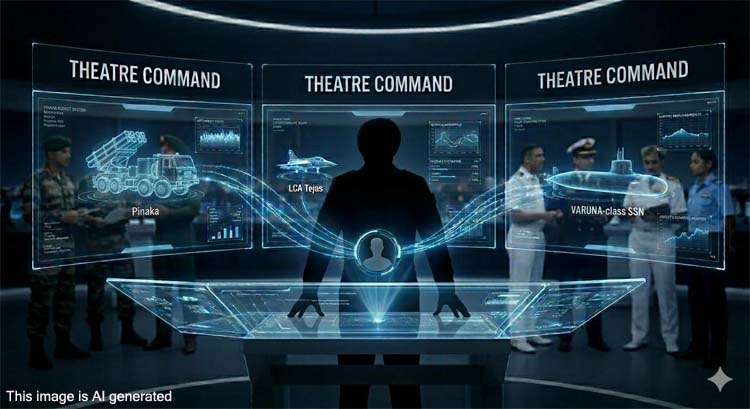
Currently, the Army, Navy, and Air Force often operate like separate teams playing different sports. Phase I introduces Integrated Commands, where instead of separate Chiefs commanding their forces, there will be one single “Commander” for a specific border who commands and controls all warriors, ships, and fighter jets in that area seamlessly. Simultaneously, through “Agniveer 2.0“, the military will shift its focus toward recruiting civilian hackers, AI coders, and drone racers to build a tech-savvy junior leadership. This will bridge the expertise gap required for data-centric warfare, ensuring that the foundational layers of the military are as digitally literate as they are physically resilient.
Phase II (2030–2040): The AI Brain and the Invisible Shield
In this decade, science fiction becomes reality. Artificial Intelligence will act like an ultra-advanced version of a logistics algorithm, instantly sensing enemy movements via satellites and deciding the best way to respond in seconds. To protect our cities, India will endeavour to build a 5-layer “Iron Dome”:
- Layer 1: High-energy lasers to deep fry cheap drones.
- Layer 2 & 3: Indigenous missiles like Akash to shoot down jets.
- Layer 4 & 5: Space-age interceptors that physically crash into incoming nuclear warheads at 15,000 miles per hour.
Phase III (2040–2047): The Era of Excellence
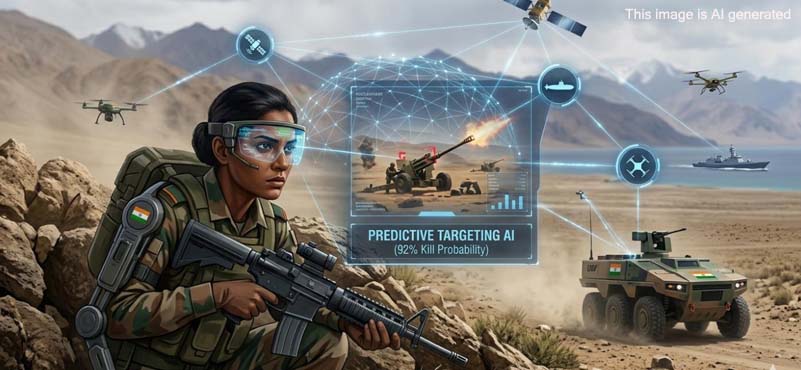
By 2047, the military dreams to achieve “full-spectrum dominance.” A frontline soldier in the Himalayan bunker will wear a smart visor that instantly displays enemy positions detected by a surveillance platform/gadget deployed several kilometres away. Everything will be seamlessly connected in a giant “Combat Cloud.”

A Reality Check
However, the journey toward modernisation and self-reliance also presents a striking paradox. Despite sustained policy efforts to promote indigenous manufacturing, India continues to remain the world’s second-largest importer of arms only after Ukraine. In the period between 2021 and 2025, according to the Stockholm International Peace Research Institute (SIPRI) March 2026 report, the country accounted for around 8.2 per cent of global imports. Seeking to build a self-reliant defence ecosystem, this reality underscores the scale of the challenge ahead. Building domestic capability in complex sectors such as aerospace, naval systems and advanced electronics requires sustained investment coupled with policy stability. The path ahead will not be without challenges. Bridging the gap between aspiration and capability will require sustained fiscal commitment, stronger research and development, industrial depth, global and domestic outreach and the easing of bureaucratic constraints.
While the vision has been masterfully articulated, the true ascent is yet to follow, though the document itself reflects a sober awareness of the climb ahead. Acknowledging its status as a set of “guidelines” rather than “directives,” it hastens to highlight a critical caveat: many of its most ambitious goals remain tethered to the complexities of multi-level bureaucratic approvals. This difference lies at the core of India’s implementation challenge. Historically, India’s military planning has never lacked for scale or ambition; rather, it has been perpetually haunted by the chasm between strategic aspiration and institutional execution.
Imperatives for Triggering the Transformation
- Create “Non-Lapsable” Defence Budgets: Move to a “rolling fund” that survives past the March 31st deadline, allowing for long-term development of complex technologies.
- Quality Over Price: Replace the “L1” (Lowest Bidder) system with Quality and Cost-Based Selection (QCBS) for high-tech military hardware. We cannot afford the cheapest software in our missiles nor the cheapest sighting systems in our guns.
- Abolish ‘Masquerade’ Indigenisation: Enforce total structural transparency in indigenous content. We must dismantle the culture where “Screw-driver Technology” or simple assembly masquerades as self-reliance. True indigenisation mandates that the intellectual property, core components, and the “digital heart” of every weapon system are birthed and owned within Indian borders.
- Embrace a “Fail Fast” Culture: Allow scientists to test, re-test and fail during the development of futuristic cutting-edge technologies without fear of audits. Innovation requires the freedom to experiment.
- Weaponizing Influence through Exports: Scale defence exports to secure global economies of scale and profound diplomatic leverage. In the 2047 landscape, arms sales will be recognized not merely as high-value commerce, but as a critical instrument of hard-power geopolitics—anchoring partner nations to India’s strategic orbit.
- Defence Industrial Parks: Establish “Free-Trade Defence Zones” near major tech hubs where startups get tax holidays and direct access to military testing ranges.
- The “Champion Industry” Model: Move away from treating Private Industry as mere “vendors.” We need to identify 10-15 “Strategic Partners” in the private sector and grant them long-term development cum production mandates to allow them to invest in world-class research, attracting global talent and setting up required infrastructure.
- Indigenous Military Operating System: Develop a sovereign, hardened OS for all Indian military hardware to prevent “backdoor” access by foreign entities.
- Space-Based Early Warning: Fast-track the deployment of a Low Earth Orbit satellite constellation for persistent, unblinking tracking of global threats. Unlike a traditional radar, this “high-ground” shield utilizes hyper-spectral sensors to detect the heat signatures of Hypersonic Glide Vehicles and ballistic missiles at the time of launch. This layer is critical for mid-course interception, providing the precious few extra minutes required for our 5-tier missile defence to engage threats before they reach Indian airspace.
- Corporatize all Defence Public Sector Undertakings to allow them to function as agile, profit-driven entities that can form joint ventures with global giants.
- Appoint a Technology Czar: Create a Technology Supremo for the Armed Forces to bridge the gap between civilian tech and its military application.
The Shield of a Viksit Bharat
The Defence Forces Vision 2047 is not merely a roadmap for waging war; it is a North Star in ensuring a lasting, dignified peace. History has taught us a brutal lesson: peace is not a natural state, nor is it granted by the goodwill of others. It is a prize that is only respected when it is backed by undeniable, terrifying strength. As India ascends to its rightful place as the world’s third-largest economy, its burgeoning wealth, its critical infrastructure, and its billion-plus dreams require an inviolable fortress.
This vision is an invitation to every Indian—the coder in Bengaluru, the engineer in Pune, and the soldier in Ladakh— to contribute to a collective shield. By shedding the bureaucratic baggage of the past, embracing the digital supremacy of software over steel, and placing unwavering trust in the brilliance of indigenous minds, India will step into 2047 as more than just a developed nation. It will emerge as a sovereign superpower; a beacon of stability in an uncertain world, protected by an invincible military machine that is entirely, proudly, and fearlessly “Made in India.” The era of the “Imported Sword” is over; the era of the “Indigenous Shield” has begun.
ABOUT THE AUTHOR
 Lt Gen Tarun Chawla, was commissioned into the Regiment of Artillery in Jun 1984. He has served with the United Nations Mission in Liberia and has been an instructor at the College of Defence Management at Secunderabad. The officer has commanded an Artillery Brigade in the LC Sector in J&K, and an Artillery Division as part of Army’s Western Command. He was the Director General Financial Planning, prior to assuming the role of Director General of Artillery.