
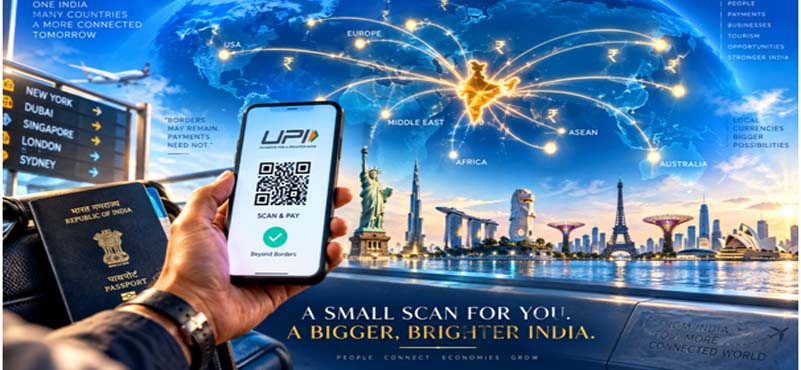
QR Code that Crossed the Border. A traveller in a foreign country opens his phone, scans a QR code and pays. There is no search for local currency, no counting of notes and, increasingly, no anxiety about whether an international card will work. The transaction takes seconds. To the traveller, it is convenience. To a strategist, it is something far more significant: an Indian digital payment system has crossed a national boundary. That small QR code represents a much larger transformation in the architecture of global finance. UPI began in 2016 as an Indian answer to a domestic problem—how to make payments instantaneous, interoperable and accessible to everyone. A decade later, it is beginning to emerge as an instrument through which India can connect its people, businesses and financial system with the wider world. The journey from a domestic payment platform to an international digital network may eventually prove to be one of India’s most consequential economic transformations.
From India’s Payment Revolution to the World. The scale of India’s domestic UPI revolution provides the foundation for this ambition. What was once an experiment in digital payments has become a mass financial infrastructure used by hundreds of millions of Indians. UPI now processes transactions on a scale that few payment systems anywhere in the world can match. Its international expansion has already reached 11 countries, including France, Greece, Singapore, the United Arab Emirates, Qatar, Nepal, Bhutan, Sri Lanka, Maldives, Mauritius and Cambodia, while India and Indonesia are moving towards deeper interoperability between UPI and Indonesia’s QRIS system. The significance is not simply that an Indian tourist can pay at an overseas merchant. The more important development is that India is beginning to export an architecture rather than merely a product. It is moving from being a consumer of global financial technology to becoming a provider of digital financial infrastructure.
Biggest Prize: Cross-Border Money. The first great dividend is remittances. India is the world’s largest recipient of remittances, receiving hundreds of billions of dollars from its diaspora and migrant workforce. Yet moving money across borders has traditionally involved a chain of banks, correspondent institutions, payment networks, foreign-exchange conversions and intermediaries. Every additional layer can add time, cost and opacity. International UPI linkages create the possibility of shortening that chain in selected corridors, making transfers faster, more transparent and potentially cheaper. For millions of Indian families dependent on money sent from abroad, this is not merely a technological improvement. It is an increase in the value of every dollar, dirham, euro or riyal that reaches home. If even a small percentage of the enormous remittance flow can be transferred with lower friction, the cumulative economic benefit to Indian households can be substantial.
The emerging possibility of connecting India’s UPI ecosystem with America’s Zelle network makes this prospect particularly interesting. The United States is one of India’s largest sources of remittances, and a more direct digital bridge between the two ecosystems could eventually make the movement of money between millions of people considerably simpler. The details of fees, foreign-exchange spreads, settlement arrangements and the precise scope of such a linkage will determine its eventual impact, but the strategic direction is unmistakable. India is seeking not merely to receive money from the world, but to create more efficient digital pathways through which that money can travel. The remittance corridor is therefore becoming a laboratory for a new kind of financial connectivity.
Six Dividends for India. There was a time when India’s economic power was measured primarily through its factories, farms, ports, highways, reserves and markets. Increasingly, another layer is being added to that definition: the invisible digital infrastructure through which economic activity flows.
- Remittance Dividend. Cheaper and faster cross-border transfers can ensure that a larger share of every dollar, dirham or dollar-equivalent sent by an Indian worker reaches the family in India rather than being absorbed by fees, spreads and intermediaries.
- Tourism Dividend. For Indian travellers, international UPI can reduce dependence on cash and conventional card networks, while making payments simpler and potentially less expensive. At the same time, foreign visitors using linked systems can experience similar convenience in India. Tourism is therefore not merely about hotels, airlines and attractions. It is also about reducing transactional friction. In a highly competitive global tourism market, that small advantage can become economically meaningful at scale.
- MSME Dividend. For India’s small businesses, payment interoperability can lower one of the invisible barriers to international commerce. A craftsman in Jaipur, a small manufacturer in Rajkot or a technology entrepreneur in Bengaluru does not necessarily need another complicated financial instrument. The easier it becomes to receive or make payments across borders, the easier it becomes for a small enterprise to participate in global trade.
- Trade Dividend. Payment friction is trade friction. Faster settlement, greater transparency and fewer intermediaries can make bilateral commerce more efficient, particularly for smaller transactions that may not justify elaborate international banking arrangements. . If more bilateral trade can eventually be settled through rupee-based mechanisms, the international role of the Indian currency can gradually expand.
- De-dollarisation Dividend. This may ultimately be the most strategically consequential. Where UPI linkages are accompanied by mechanisms that permit direct settlement between the currencies of two participating countries, transactions need not necessarily pass through the US dollar as an intermediate currency. UPI alone cannot displace the dollar, nor is that its stated purpose. But a growing web of local-currency payment corridors could gradually reduce the need for the dollar in portions of cross-border retail payments, remittances and trade. For India, that means greater flexibility in international transactions and, over time, a stronger case for the internationalisation of the rupee.
- Strategic and Soft-Power Dividend. Every country that connects its digital payment infrastructure with India’s creates another economic bridge to India. The cumulative effect is larger than any individual transaction. India begins to acquire network power—the ability to influence how people, businesses and eventually financial systems interact across borders.
UPI began by making the last mile of India’s payments instant; its internationalisation could now make the first mile of India’s global economic engagement faster, cheaper and increasingly independent.
Geopolitical Dividend — India Builds its own Digital Rails. This is where the story moves beyond fintech into geopolitics. For decades, much of the infrastructure governing international payments was built around institutions and networks in which India was a participant rather than a designer. India now possesses a home-grown digital public infrastructure that has demonstrated extraordinary scale and interoperability. UPI does not have to replace Visa, Mastercard or SWIFT to become strategically important. It needs to offer another set of digital rails through which particular categories of payments can move more efficiently. The objective is not isolation from the existing system; it is reducing unnecessary dependence on any single system.
Every additional country that connects its payment infrastructure with India creates another economic bridge. Ten bridges are useful. Twenty are more useful. A large network becomes something qualitatively different. Network effects begin to emerge. Merchants become familiar with Indian payment methods. Consumers become comfortable with cross-border transactions. Banks develop interoperable systems. Businesses discover new markets. Remittance corridors become more efficient. Digital trust begins to travel with the payment infrastructure itself. Economic connectivity, once established at scale, can eventually become a form of strategic influence.
QRIS, ASEAN and the Global South. Indonesia’s QRIS offers an important glimpse of this future. India and Indonesia are two major Asian economies with enormous populations, growing digital ecosystems and increasing economic interaction. Deeper interoperability between UPI and QRIS would not merely make life easier for tourists. It would demonstrate how two sovereign digital payment architectures can speak to each other. Across Southeast Asia, the Gulf and India’s neighbourhood, such connections could reinforce India’s wider economic engagement under Neighbourhood First and Act East. The larger proposition is compelling: India can offer countries not just products, capital and services, but a digital infrastructure through which their citizens can participate more easily in cross-border commerce.
New Economic Geography. The strategic opportunity, therefore, is much larger than making international payments convenient. India can use UPI’s global expansion to strengthen remittance flows, empower MSMEs, facilitate tourism, reduce transactional friction, encourage local-currency settlement, deepen rupee internationalisation and build economic relationships across regions. It can also give substance to India’s ambition of becoming a leading digital power. But this opportunity must be pursued with realism. International payment systems require trust, cyber-security, regulatory harmonisation, consumer protection, reliable foreign-exchange mechanisms and resilient settlement infrastructure. Technology can open the door; institutional credibility must keep it open.
There was a time when India’s economic power was measured primarily through its factories, farms, ports, highways, reserves and markets. Increasingly, another layer is being added to that definition: the invisible digital infrastructure through which economic activity flows. UPI began by changing the way Indians pay each other. Its next chapter could change the way India connects financially with the world. The transaction may still take only a few seconds, but the strategic consequences could last for decades.
The QR code is small. The network behind it is not. India is no longer merely joining the digital architecture of the global economy; it is beginning to build the rails on which a part of that economy can travel.
ABOUT THE AUTHOR

Lt Gen Rajeev Chaudhry (Retd) is a social observer and writes on contemporary national and international issues, strategic implications of infrastructure development towards national power, geo-moral dimension of international relations and leadership nuances in changing social construct.