

Threat that does not wear a Uniform
The traditional understanding of national security has been built around identifiable adversaries, territorial boundaries, military capabilities and the balance of power. Governments have invested heavily in defending borders, modernising armed forces and strengthening strategic alliances. Yet, an entirely different category of threat is steadily challenging the foundations of national security. It does not wear a uniform, carry weapons or announce its arrival. It comes through unprecedented heatwaves, devastating floods, prolonged droughts, unstable mountains, collapsing ecosystems and increasingly unpredictable weather patterns. Climate change has ceased to be an environmental concern alone; it is emerging as a defining security challenge of the twenty-first century.
The 31st Conference of the Parties (COP31), held at Antalya, Türkiye, from 9 to 22 November 2026, despite its failure to bring global consensus on the proposed Antalya Pact, provided an important moment to confront this reality. The world has spent three decades negotiating emission targets, carbon commitments and climate financing. These remain essential, but the central question has become more immediate: how do nations protect their populations, economies, infrastructure and strategic interests against a changing climate? The distinction between environmental policy and national security planning is becoming increasingly artificial.
The paradox is striking. A nation may possess formidable armed forces, sophisticated weapons and a growing economy, yet remain dangerously vulnerable if its agricultural systems fail, its rivers become unpredictable, its cities become uninhabitable during extreme heat or its critical infrastructure collapses under climatic stress. The next national security emergency may not cross a border; it may emerge from within the country’s own geography.
When Climate Becomes a Strategic Adversary
Climate change rarely creates conflict in isolation. Its more consequential role is that of a threat multiplier, intensifying existing political, economic and social vulnerabilities. When agricultural productivity declines, food prices rise and rural livelihoods become uncertain. When water becomes scarce, competition between communities, states and neighbouring countries can sharpen. When extreme weather destroys homes and livelihoods, displacement increases pressure on urban centres, public services and already fragile institutions. What begins as an environmental disruption can eventually become an economic, humanitarian and political crisis.
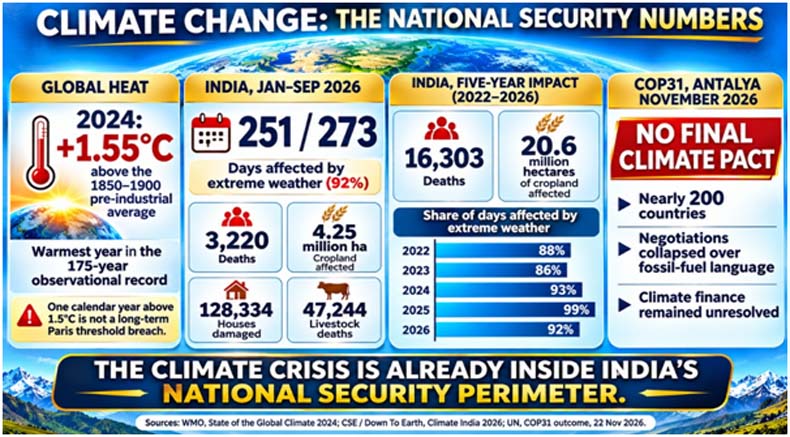
The scale of the challenge is global. The World Meteorological Organization confirmed that 2024 was the warmest year in the observational record, approximately 1.55°C above the pre-industrial average. Although a single calendar year above 1.5°C does not mean that the long-term Paris Agreement temperature threshold has been permanently breached, the warning is unmistakable. The world is approaching climatic conditions for which existing infrastructure, agricultural practices and public institutions are inadequately prepared.
The strategic implications extend well beyond food and water. Ports, airports, power grids, communication networks, transport corridors and energy installations are increasingly exposed to climate-related disruption. A cyclone can interrupt maritime trade; a flood can paralyse an industrial region; a prolonged heatwave can increase electricity demand while reducing the efficiency of power systems. Climate vulnerability can therefore translate directly into economic vulnerability and strategic dependence.
There is also a geopolitical dimension. Countries with greater financial and technological capacity can invest in adaptation, secure alternative supply chains and rebuild damaged infrastructure. Poorer nations often lack these options. Climate inequality can consequently deepen existing global inequalities and intensify competition over resources, migration and development opportunities. Climate change does not need to start a war to make a country less secure.
India: A Continent of Climate Vulnerabilities
India’s geographical diversity is also a source of climatic exposure. The Himalayas, Indo-Gangetic plains, arid western regions, drought-prone Deccan plateau, densely populated coastal belts and rapidly expanding cities face different but interconnected risks. Climate change is not a distant possibility for India. It is already influencing the conditions under which its people live, its economy operates and its infrastructure functions.
The Centre for Science and Environment’s assessment of January–September 2026 presents a sobering picture. India experienced extreme-weather events on 251 of the 273 days examined. These events were associated with 3,220 reported deaths, damage to approximately 4.25 million hectares of crops and damage to 128,334 houses. These figures illustrate the human and economic consequences of extreme weather, although individual events cannot automatically be attributed solely to climate change.
The consequences are distributed unevenly. Heat-waves threaten outdoor workers, public health and productivity. Erratic rainfall affects agricultural planning and groundwater replenishment. Floods damage settlements, transport networks and industrial assets, while prolonged dry spells increase pressure on water supplies. Along the coastline, rising sea levels, erosion and stronger storm-related impacts threaten communities, ports and critical economic installations.
India’s cities represent another emerging security concern. Rapid urbanisation, concretisation, inadequate drainage, shrinking water bodies and expanding heat islands are creating dangerous combinations. A prolonged heat-wave can simultaneously increase hospital admissions, reduce labour productivity, strain electricity networks and disrupt public transport. Urban climate resilience must therefore be treated as an economic and public security priority, not merely a municipal responsibility.
The strategic lesson is clear: India’s climate vulnerability is not confined to its environment. It runs through its agriculture, economy, public health, infrastructure, social stability and national security architecture.
Himalayas: Where Climate meets National Defence
The Himalayas deserve particular attention because they represent the intersection of India’s environmental vulnerability, geopolitical competition and national defence. They are the source of major river systems, sustain millions of livelihoods and constitute a critical military operating environment. Their changing ecology has implications that extend far beyond environmental conservation. Rising temperatures, changing precipitation patterns, glacier retreat, permafrost degradation and unstable slopes are altering the risk profile of this strategically sensitive region.
The consequences are already visible in the increasing exposure of mountain communities and infrastructure to landslides, flash floods, glacial lake outburst floods and extreme precipitation. The 2023 South Lhonak glacial lake disaster in Sikkim demonstrated how a natural hazard can damage hydropower installations, bridges, roads and settlements across a large area. Such events can isolate communities, interrupt essential supplies and impose enormous rehabilitation costs. The strategic implications become even more serious when the affected infrastructure supports military movement and forward logistics.
India’s border infrastructure must therefore be planned against the climatic conditions of the next three to five decades, not merely the historical weather patterns of the past. Roads, tunnels, bridges, airfields and forward logistics installations require rigorous geological investigation, hydrological modelling, slope stabilisation, drainage engineering and continuous monitoring. Infrastructure resilience must become an integral component of deterrence. A road that cannot remain operational during extreme weather is a vulnerability in the national security architecture.
Climate change also affects the operating environment of armed forces through heat stress, changing snow conditions, water availability, equipment performance and the sustainability of high-altitude deployments. These factors require deeper integration between military planners, meteorological agencies, geologists, engineers and disaster-management institutions. The Border Roads Organisation has an important role in developing climate-resilient strategic connectivity in difficult terrain. Its engineering experience must increasingly be complemented by predictive climate intelligence.
The Himalayas are not simply a mountain barrier to be defended; they are a living ecosystem whose stability supports India’s security. A strategically located road has limited deterrent value if the mountain supporting it is no longer stable.
New Security Doctrine: Disaster Response to Climate Preparedness
India’s disaster-management architecture has made significant progress, but the changing nature of climate risks demands a transition from predominantly reactive intervention to anticipatory national preparedness. Rescue, relief and rehabilitation remain indispensable, yet they cannot substitute for prevention, risk reduction and resilience. The difference between a manageable disruption and a national emergency often lies in the quality of preparation undertaken before the event.
The National Disaster Management Authority, National Disaster Response Force, State Disaster Response Forces, armed forces and state administrations must function within a more integrated climate-risk framework. Early-warning systems should be linked to district-level vulnerability maps, evacuation plans, critical infrastructure inventories and pre-positioned response capabilities. Forecasting a disaster is only half the task; ensuring that institutions and communities can act upon that forecast is equally important.
Climate risk assessments should become mandatory for major public infrastructure, including highways, dams, airports, ports, power installations and urban development projects. Every strategically important asset should undergo periodic climate stress-testing. Investments should account for future rainfall intensity, temperature extremes, flood exposure, coastal vulnerability and geological instability. The cost of preventive engineering may appear high during construction, but the cost of rebuilding repeatedly damaged infrastructure is substantially greater.
Food, water and energy security must also enter the national security planning process. Strategic reserves, diversified supply chains, efficient irrigation, groundwater management, decentralised renewable energy and resilient electricity networks are no longer merely developmental choices. They are instruments of national resilience.
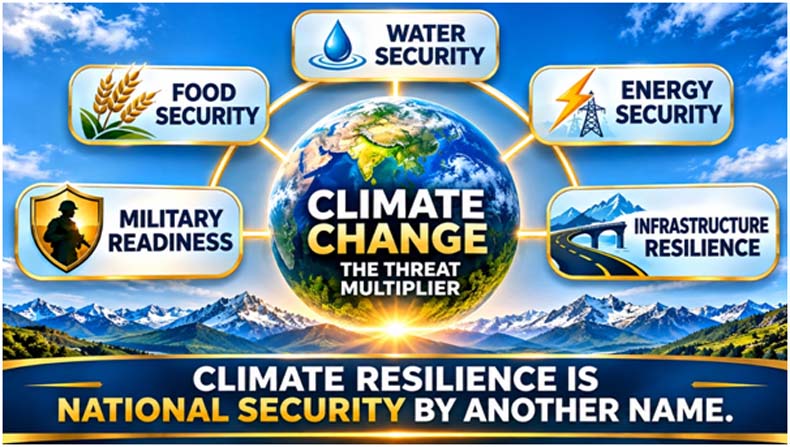
A country is not resilient because it responds efficiently to disasters. It is resilient because it prevents foreseeable disasters from becoming national emergencies.
COP31: Collapse of Climate Consensus
COP31 at Antalya has ended in an unprecedented diplomatic failure. After two weeks of negotiations, followed by nearly two days of overtime discussions, participating countries failed to agree on an overarching climate pact. The immediate disagreement centred on the omission of any explicit reference to fossil fuels in the proposed final political declaration. The European Union, the United Kingdom and several other countries rejected the draft, arguing that it failed to reflect the scientific urgency of the crisis. Oil-producing nations and countries dependent on fossil-fuel revenues resisted stronger language on transitioning away from coal, oil and gas. The conference thus exposed a fundamental contradiction: the world recognises the principal drivers of climate change but remains divided over confronting them.
The failure was not confined to fossil fuels. Climate finance remained another major fault line. Developing countries demanded predictable financial support to adapt to extreme weather, protect vulnerable populations and transform their energy systems. The proposed commitment to increase adaptation finance lacked the clarity and credible financial baseline demanded by developing nations. For countries already struggling with floods, droughts, heatwaves and coastal erosion, finance is not an accounting issue; it is a question of survival. The divide between those historically responsible for accumulated emissions and those bearing disproportionate consequences continues to undermine international trust.
The geopolitical significance of the collapse is even greater. Climate diplomacy has become hostage to energy security, domestic economic interests, strategic competition and the politics of fossil-fuel dependence. The absence of effective leadership from major powers and the inability of nearly 200 participating countries to reconcile competing interests expose the limitations of a consensus-driven multilateral system. The world can negotiate trade agreements, strategic partnerships and military arrangements, yet struggles to agree on a collective response to a threat that recognises no national boundary. The crisis is no longer simply one of climate ambition; it is also a crisis of international political will.
For India, Antalya reinforces the need for a dual strategy. We must defend the principles of climate justice, common but differentiated responsibilities and equitable access to finance and technology, while refusing to allow diplomatic deadlock to delay domestic preparedness. India’s development needs, energy security and poverty-reduction priorities cannot be compromised, but neither can climate resilience be postponed until international consensus emerges. Some progress on just transition and implementation initiatives survived the collapse, and existing Paris Agreement obligations remain intact. The failure of a new overarching pact does not invalidate the climate process, but it exposes its limitations.
The deeper lesson from Antalya is that humanity cannot outsource its survival to annual climate conferences. Multilateral negotiations remain necessary, but national action, regional partnerships, technological innovation and enforceable domestic commitments must advance independently of diplomatic outcomes. COP32 in Addis Ababa will inherit the unresolved questions of fossil-fuel transition, adaptation finance and global accountability. Whether it can restore confidence remains to be seen.
COP31 has demonstrated that the world does not lack climate science, warnings or diplomatic forums; it lacks the political consensus to translate knowledge into collective action. The planet cannot wait for geopolitics to find common ground.
India Must Prepare for the Climate Century
India must now move from treating climate change as an environmental and developmental challenge to recognising it as a core national security priority. This requires a National Climate Security Framework bringing together the Ministries of Defence, Home Affairs, Environment, Agriculture, Jal Shakti and Power, alongside the armed forces, NDMA, IMD, scientific institutions and infrastructure agencies. The objective should not be to create another bureaucratic establishment, but to integrate existing capabilities into a common national risk-management architecture.
Such a framework should maintain a national climate-security risk register, identify vulnerable strategic assets, undertake periodic infrastructure stress assessments and develop predictive models for geographically sensitive regions. District-level vulnerability mapping should inform development planning, while climate intelligence should become part of strategic infrastructure and military logistics planning. Dedicated adaptation funding must be treated as an investment in national resilience rather than an expenditure that competes with development.
India should also strengthen regional cooperation. The Himalayas, major river systems and the Indian Ocean do not recognise political boundaries. Shared early-warning mechanisms, scientific collaboration, trans-boundary water dialogue and coordinated disaster response can reduce vulnerabilities across South Asia. India’s position as a major regional power provides an opportunity to lead such cooperation while safeguarding its national interests.
Ultimately, climate security must become a shared national responsibility. Governments can establish frameworks, armed forces can strengthen preparedness, engineers can build resilient infrastructure and scientists can improve prediction. But communities, local institutions and citizens must also become active participants in adaptation. National resilience cannot be manufactured exclusively in government offices.
India can shape a new security doctrine in which environmental sustainability, economic growth, infrastructure resilience and military preparedness reinforce one another. Its strategic ambitions in the coming decades will depend not only on industrial capacity, technological advancement and military strength, but also on the stability of its ecological foundations.
We have spent centuries preparing our nations to defend their borders against adversaries. The coming century will demand that we also defend them against the consequences of a changing planet. The security of a nation will increasingly depend not merely on the strength of its armed forces, but on the resilience of its rivers, mountains, farms, cities, infrastructure and institutions. The climate crisis has already entered the national security perimeter. The question is whether our national security thinking has caught up.
ABOUT THE AUTHOR

Lt Gen Rajeev Chaudhry (Retd) is a social observer and writes on contemporary national and international issues, strategic implications of infrastructure development towards national power, geo-moral dimension of international relations and leadership nuances in changing social construct.