
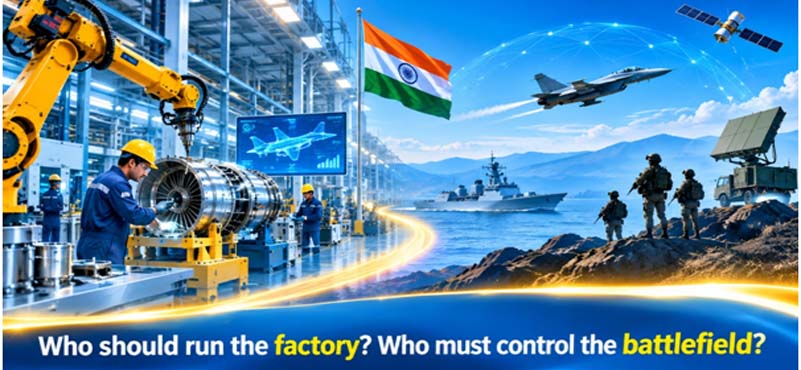
Why India must separate military strategic control from industrial administration to build a more competitive, technologically advanced and resilient defence manufacturing ecosystem.
The Central Proposition. The Ministry of Defence must remain the ultimate custodian of India’s military capability, but it need not necessarily remain the administrative parent of every enterprise manufacturing equipment for the Armed Forces. Selective redistribution of manufacturing responsibilities among relevant ministries could unlock industrial efficiencies, technological synergies and greater competitiveness. However, such a reform must be designed around one non-negotiable principle: national security cannot become subordinate to commercial profitability.
An Uncomfortable Institutional Question
India’s defence preparedness is no longer determined exclusively by the number of tanks, aircraft, guns and warships it possesses. Increasingly, it depends on semiconductors, artificial intelligence, advanced materials, robotics, cyber capabilities, telecommunications and precision manufacturing. These technologies are being developed across the country’s industrial and technological landscape, much of it outside the Ministry of Defence.
This raises an important institutional question. Should the ministry responsible for preparing India for war also be responsible for administering the factories that manufacture its weapons? The two responsibilities are related, but they are not necessarily identical.
The Ministry of Defence must determine what the Armed Forces require, establish operational specifications, ensure timely acquisition and guarantee military preparedness. Manufacturing enterprises, meanwhile, must concentrate on productivity, innovation, investment, technological competitiveness and delivery. India should therefore examine whether selected defence manufacturing enterprises could be administratively placed under ministries whose core competencies are better aligned with their industrial activities.
This is not an argument for weakening the Ministry of Defence. It is an argument for making it more strategically focused.
How India Arrived at the Present Structure
India’s defence manufacturing architecture evolved around the requirements of strategic self-reliance in the decades following Independence. The Ordnance Factory Board and subsequently established Defence Public Sector Undertakings provided the country with an indigenous industrial foundation when private-sector capabilities were limited.
This model served an important national purpose. It created manufacturing capacities in ammunition, armoured vehicles, artillery, aerospace, electronics, shipbuilding and specialised equipment. It also reduced dependence on foreign suppliers in several critical areas.
However, the structure gradually became relatively self-contained, with production enterprises operating predominantly within the administrative ecosystem of the Department of Defence Production.
An important reform came into effect on 1 October 2021, when the Ordnance Factory Board was dissolved and its 41 factories were reorganised into seven government-owned Defence Public Sector Undertakings. The objective was to provide greater managerial autonomy, improve accountability, encourage innovation and enhance competitiveness.
Corporatisation was a significant step, but it did not change the administrative parentage of these enterprises. They remained under the Ministry of Defence.
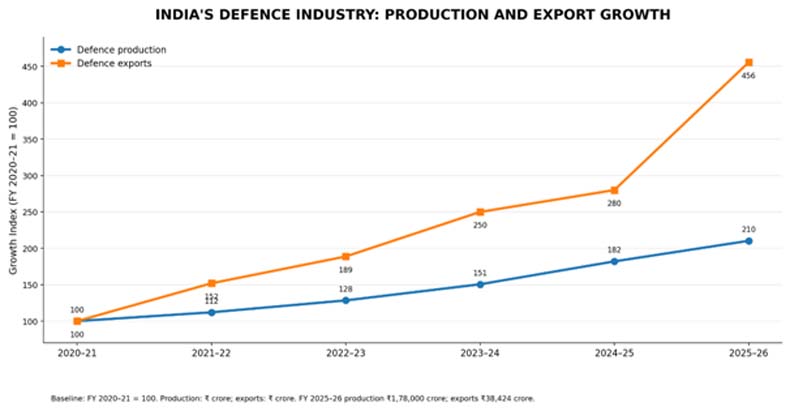
India has nevertheless made considerable progress. Defence production reached approximately ₹1.51 lakh crore in FY 2024–25, compared with ₹46,429 crore in FY 2014–15. Defence exports increased to ₹23,622 crore in FY 2024–25, against approximately ₹686 crore in FY 2013–14. These figures demonstrate the substantial expansion of India’s defence industrial base.
The question now is whether the next stage of reform requires more than corporatisation. Could integration with the wider industrial ecosystem produce another leap in performance?
Breaking the Industrial Silos
Modern defence manufacturing increasingly overlaps with civilian industrial and technological capabilities. The boundaries between military and civilian technologies are becoming progressively indistinct.
Consider the opportunities.
- Ministry of Heavy Industries oversees an ecosystem involving automobiles, machine tools, heavy engineering, industrial machinery, robotics and advanced manufacturing. These capabilities have direct relevance to armoured vehicles, artillery platforms, engines, mobility systems and precision engineering.
- Ministry of Electronics and Information Technology (MeitY) is positioned within India’s semiconductor, electronics, artificial intelligence, computing and digital technology ecosystem. Defence electronics, sensors, electronic warfare systems, autonomous platforms and battlefield computing could benefit from closer institutional integration.
- Department of Telecommunications (DoT) is connected to developments in secure networks, 5G, 6G, spectrum management and advanced communication infrastructure. These technologies are increasingly central to network-centric warfare.
The advantages extend beyond technology. A manufacturing enterprise with access to civilian markets can potentially increase production volumes, improve capacity utilisation, attract investment and reduce unit costs. It can also build relationships with private manufacturers, MSMEs, research institutions and international technology partners.
The objective should be to eliminate industrial isolation and enable defence manufacturers to participate in India’s larger manufacturing revolution.
What the Ministry of Defence Stands to Gain
The administrative responsibilities of MoD have expanded considerably. It must deal with military modernisation, capital acquisition, force restructuring, indigenisation, research and development, exports, production oversight and coordination among the three Services.
These responsibilities compete for institutional attention.
Selective transfer of manufacturing administration could allow MoD to concentrate on strategic planning, capability development, procurement, operational preparedness and military integration.
It could also strengthen the relationship between the Ministry and manufacturing enterprises. MoD would increasingly function as an informed, demanding and professionally equipped customer, defining requirements, quality standards, delivery schedules and operational performance.
However, reducing administrative responsibilities should not mean reducing accountability. MoD must retain sufficient technical expertise to assess production capabilities, evaluate technological choices and challenge manufacturers on cost, quality and delivery.
Ultimately, the Ministry should be judged by the combat capability it delivers to the Armed Forces, rather than by the number of manufacturing enterprises it administratively supervises.
The Other Side of the Argument: National Security Cannot Be Outsourced
The case for transferring selected defence manufacturing enterprises is persuasive, but the risks are equally significant. Defence manufacturing cannot be treated as an ordinary industrial activity in which profitability, market share and commercial efficiency are the principal measures of success. Its ultimate purpose is to sustain military capability, particularly under conditions of conflict.
- Dilution of Military Priorities. A factory producing ammunition, armoured vehicles or critical electronic components may have to maintain production even when orders are commercially unattractive. During a prolonged conflict, the Armed Forces may require production to be increased several times over, irrespective of the financial implications. A civilian industrial ministry may naturally be guided by investment returns, capacity utilisation and commercial viability. These considerations cannot override operational urgency.
- Fragmentation. Modern weapons systems are integrated combinations of platforms, electronics, software, communications, sensors and precision engineering. An advanced weapon system cannot be divided into convenient administrative compartments without creating coordination problems. If its constituent manufacturing units report to different ministries, disagreements over priorities, funding and production schedules could delay delivery. Administrative boundaries must not become technological boundaries.
- Compromised Strategic Autonomy. Certain manufacturing capabilities must be maintained domestically even when importing the product appears cheaper. Ammunition, explosives, specialised alloys, critical electronic components and strategic equipment cannot be subjected entirely to commercial calculations. Their value lies partly in the insurance they provide against external supply disruptions.
- Security Considerations. Defence manufacturing involves classified designs, sensitive technologies, intellectual property and supply-chain vulnerabilities. Transferring an enterprise to another ministry must not dilute the security architecture governing its personnel, technology, procurement and production facilities.
- Bureaucratic Multiplication. If transferring factories creates additional reporting structures, approval procedures and inter-ministerial committees, the reform could produce precisely the opposite of what it intends to achieve. A factory should not have to negotiate with three ministries to manufacture a component urgently required by the Army.
The fundamental distinction must remain clear: manufacturing can be commercially managed, but military preparedness cannot be commercially negotiated.
International Lessons: Integration Without Institutional Confusion
International experience suggests that there is no single ideal model of defence industrial governance.
- American Model. The United States has a largely private-sector defence industrial base, but the Department of Defense retains an active role in industrial-base policy, supply-chain resilience and production preparedness. Its first National Defense Industrial Strategy, released in January 2024, explicitly emphasised resilient supply chains, workforce readiness, flexible acquisition and economic deterrence.
- French Model. France has retained a strong defence industrial architecture within its defence establishment through the Direction Générale de l’Armement (DGA). It combines procurement, technical expertise, industrial policy and strategic autonomy. The DGA reports that it managed €38 billion in industrial orders in 2025, demonstrating that a strong relationship between defence administration and industrial capability can coexist with substantial private-sector participation.
- The British Model. The British model retains defence leadership within the Ministry of Defence while building a closer partnership with industry. Its 2025 Defence Industrial Strategy links procurement reform, sovereign industrial priorities, innovation, resilient supply chains and economic growth. A National Armaments Director helps connect military capability requirements with industrial delivery. The lesson is institutional coordination, not necessarily transferring factories between ministries alone.
The United States demonstrates how a predominantly private industrial base can function under strong military oversight and an explicit national industrial strategy. France demonstrates the value of retaining specialised acquisition, engineering and industrial-policy expertise within the defence establishment. The United Kingdom’s Defence Industrial Strategy 2025 seeks to combine military requirements with private investment, industrial growth, innovation and supply-chain resilience.
The American lesson is the importance of a resilient industrial ecosystem. The French lesson is the importance of preserving strategic and technical expertise within defence institutions. The British lesson is that defence procurement can become an instrument of industrial development rather than merely a mechanism for purchasing equipment.
India needs a synthesis of these approaches. It should encourage wider industrial participation without surrendering military oversight and promote commercial efficiency without compromising strategic autonomy.
A New Architecture for India: Selective Transfer, Strategic Control
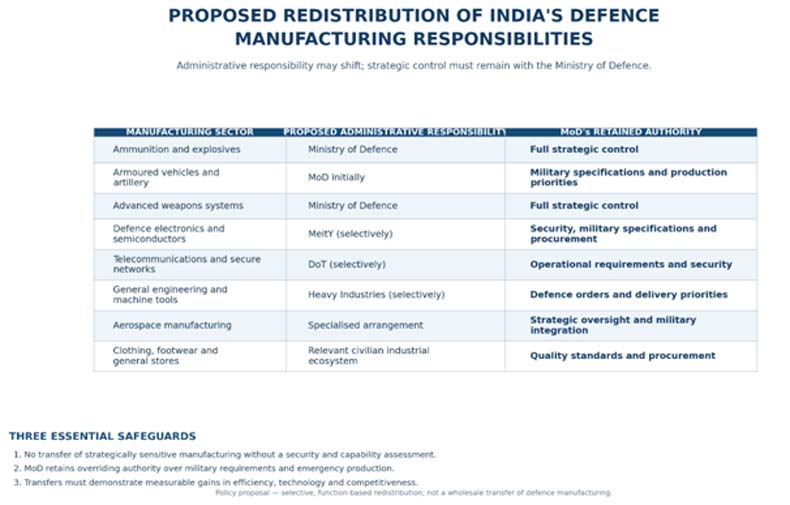
The way ahead should not be a wholesale transfer of Defence PSUs from the Ministry of Defence to other ministries. Such a move would be disruptive, difficult to implement and potentially counterproductive. What India requires is a carefully designed, function-based redistribution of administrative responsibilities.
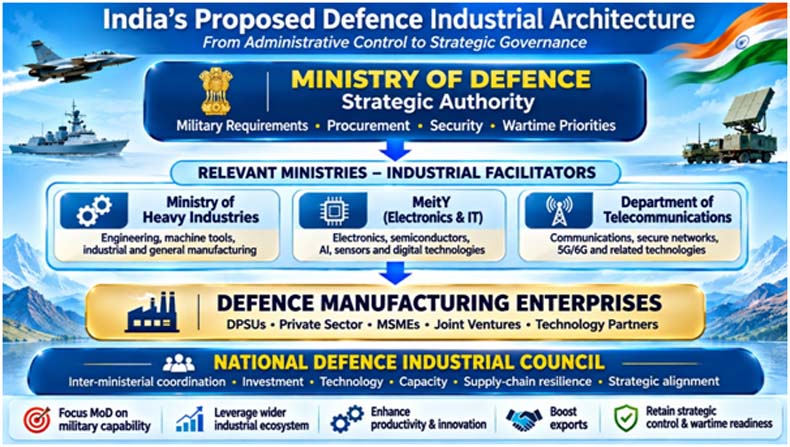
I propose a three-tier National Defence Industrial Architecture.
- First tier: Ministry of Defence as the Strategic Authority. MoD must retain responsibility for threat assessment, military requirements, capability planning, operational specifications, acquisition priorities and strategic oversight. It must also retain the authority to determine which technologies and manufacturing capacities are indispensable to national security.
Its relationship with manufacturers should evolve from administrative supervision towards performance-based strategic management. Contracts must specify delivery schedules, quality benchmarks, technology-transfer obligations, lifecycle support and emergency production commitments.
- Second tier: Relevant ministries as Industrial Facilitators. Selected enterprises or clearly separable business units could be considered for administrative integration with ministries whose industrial competencies match their manufacturing activities.
The Ministry of Heavy Industries could be considered for general engineering, machine tools, automotive technologies and selected heavy manufacturing activities. MeitY could provide a more appropriate ecosystem for semiconductor-related manufacturing, electronics, sensors, computing and artificial intelligence. DoT could support enterprises specialising in communications infrastructure, secure networks and telecommunications technologies.
However, this must be a function-based assessment, not an automatic transfer of entire DPSUs. A defence electronics enterprise producing highly classified military systems, for example, may be better retained under MoD despite its technological overlap with civilian electronics.
- Third tier: Manufacturing Enterprises as Competitive Industrial Organisations. The enterprises themselves must be empowered to operate with greater professional autonomy. They should be free to enter joint ventures, collaborate with private industry, invest in research, develop civilian applications and pursue exports, subject to national security restrictions.
Their performance should be measured through productivity, cost competitiveness, delivery reliability, technological advancement, export performance and customer satisfaction.
This architecture requires an institutional mechanism to prevent fragmentation. I propose establishing a National Defence Industrial Council, chaired by the Defence Minister, with representation from the relevant industrial ministries, Finance Ministry, DRDO, the three Services and other appropriate national security institutions.
Its purpose should not be to create another layer of routine administration. It should resolve policy conflicts, coordinate investment, identify critical technologies, monitor industrial capacity and ensure that national security priorities are reflected in industrial policy.
The reform should proceed in four phases.
- Functional Audit. Classify all defence manufacturing enterprises according to strategic criticality, technology intensity, civilian applications, supply-chain vulnerability and wartime requirements.
- Pilot Integration. Identify one or two suitable dual-use manufacturing units in electronics, telecommunications or general engineering for administrative integration with the relevant industrial ministry.
- Performance Evaluation. Review the pilots over three years against productivity, investment, research expenditure, export growth, delivery performance and military readiness.
- Selective Expansion. Transfer additional enterprises only where demonstrable improvements justify the change.
Most importantly, Parliament and the Government should establish clear legal safeguards. MoD must have enforceable rights over emergency production priorities, strategic inventories, classified information, critical intellectual property and the availability of essential equipment during national emergencies. Funding arrangements must also ensure that civilian ministries cannot defer essential defence orders merely because they are commercially unattractive.
The success of the reform must be measured by one overriding test: Does it improve the Armed Forces’ ability to obtain technologically superior equipment, on time and in adequate quantities, during peace and war?
From Defence Production to National Industrial Power
India’s defence industrial transformation is already gathering momentum. Defence production rose from ₹46,429 crore in FY 2014–15 to approximately ₹1.51 lakh crore in FY 2024–25. Defence exports reached ₹23,622 crore in the same year. The Ministry of Defence has set a target of ₹3 lakh crore in defence manufacturing and ₹50,000 crore in exports by 2029.
The latest Ministry of Defence Annual Report for FY 2025–26 records defence exports of ₹38,424 crore, indicating the pace at which the sector is expanding. These achievements must now be translated into a more ambitious institutional vision. India’s defence manufacturing future cannot depend exclusively on the capacities of government-owned defence enterprises. It must harness the combined strength of public-sector undertakings, private industry, MSMEs, research institutions, universities and technology companies.
The proposed restructuring is not about transferring factories for the sake of administrative convenience. It is about placing industrial capabilities where they can grow fastest while ensuring that military requirements remain paramount.
India needs a Ministry of Defence that is strategically stronger, industrially better connected and administratively more focused. It needs manufacturing enterprises that are commercially competitive but strategically accountable. The ultimate objective is not to move factories from one ministry to another. It is to create a national industrial ecosystem capable of supporting India’s military ambitions, technological sovereignty and geopolitical aspirations.
The future of India’s defence preparedness will depend not merely on how many factories the Government owns, but on how intelligently it mobilises the entire industrial strength of the nation.
ABOUT THE AUTHOR

Lt Gen Rajeev Chaudhry (Retd) is a social observer and writes on contemporary national and international issues, strategic implications of infrastructure development towards national power, geo-moral dimension of international relations and leadership nuances in changing social construct.