
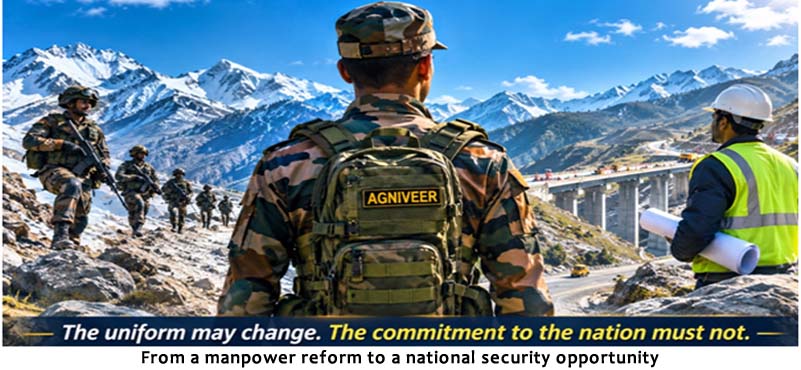
A Policy at an Inflection Point
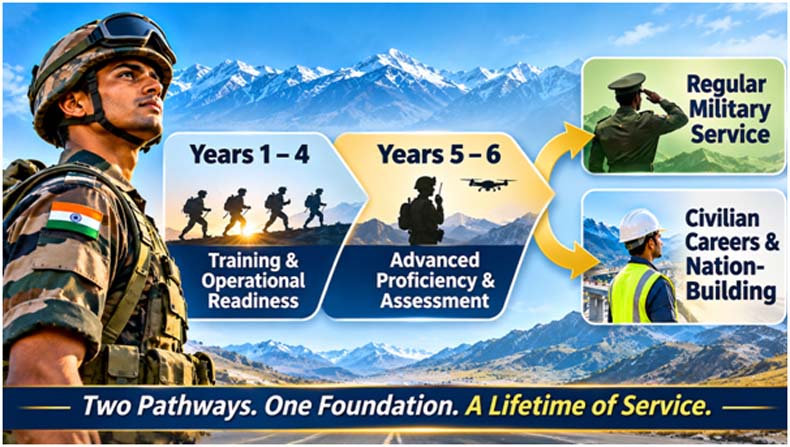
The announcement by Chief of Defence Staff General NS Raja Subramani on 4 November 2026 marks an important development in the evolution of the Agnipath scheme. The Union Cabinet has approved an additional two-year engagement for the 75 per cent of Agniveers who would otherwise have completed their initial four-year tenure and returned to civilian life. At the end of six years, those willing to continue will have an opportunity for enrolment into the regular Armed Forces, subject to objective selection criteria. The extended engagement will carry enhanced remuneration. The announcement also includes changes in recruitment sequencing, with the written examination preceding the physical test, and recognition of skills acquired during military service through certificates.
This development should be viewed neither as a routine administrative adjustment nor merely as an extension of contractual service. It represents an opportunity to refine the relationship between military manpower, operational capability and national human capital. The original scheme sought to maintain a younger military profile while creating a trained pool of disciplined youth for society. The revised arrangement potentially strengthens both objectives by providing the Armed Forces a longer period to develop and assess personnel, while giving Agniveers additional time to acquire professional competence and plan their futures.
The more important question is what India does with this opportunity. An additional two years can become a valuable period of operational consolidation, institutional learning and professional development. Equally, it could become merely an extension of the existing arrangement without producing commensurate gains. The distinction will depend on implementation, manpower planning and the seriousness with which the next phase is designed.
Six Years to Soldier On
Military proficiency is acquired through a combination of training, repetition, operational exposure and experience within a unit. The initial four years provide the foundation, but in many military occupations, particularly technical and specialist trades, the individual begins delivering his or her fullest potential only after considerable exposure to equipment, procedures and operational conditions. An additional two years can therefore improve the return on the considerable investment made in recruitment, training and equipping each Agniveer.
The advantages are particularly relevant in high-altitude warfare, communications, aviation support, maintenance, electronic systems, logistics and equipment management. In these areas, familiarity with terrain, machinery, procedures and unit routines is not easily replaced by another training cycle. Longer engagement can also strengthen collective effectiveness because soldiers who have worked together develop mutual confidence, coordination and an understanding of each other’s capabilities.
However, additional tenure must translate into additional proficiency. The services should use the extension to introduce advanced trade qualifications, progressive weapon training, tactical exercises and greater responsibility. Agniveers should not spend the fifth and sixth years simply repeating their earlier duties. Their training pathways must evolve with experience, and their assignments should reflect demonstrated competence.
There is also a manpower-planning dividend. Longer engagement offers commanders greater continuity and reduces the frequency with which trained personnel must be replaced. This could be particularly useful in formations where specialised skills and accumulated operational knowledge are essential. The objective should be to develop a younger force without sacrificing the experience necessary to sustain combat effectiveness.
The Institutional Dividend
The greatest institutional opportunity lies in creating a more informed and comprehensive selection process for regular service. Four years of continuous assessment, followed by another two years of performance and professional development, can provide a substantially broader evidence base than a single selection exercise. The services can assess operational performance, discipline, physical standards, technical competence, adaptability, leadership potential and conduct under pressure.
Selection, however, must be demonstrably fair. The criteria should be published in advance, differentiated according to service and trade requirements, and supported by standardised performance records. Commanding officers’ assessments should carry appropriate weight, but subjective recommendations must not become the sole determinant. An independent review and grievance mechanism would strengthen confidence in the process.
The revised arrangement also calls for careful integration with the existing regular cadre. The objective should not be to create two categories of soldiers performing identical duties with different expectations, status or institutional belonging. Agniveers must remain integral members of their units, with access to appropriate training, equipment, welfare facilities and professional opportunities throughout their engagement.
Regimental traditions, unit cohesion and comradeship are not administrative accessories. They are essential components of military effectiveness. The services must consciously preserve these institutional strengths while adapting their manpower model. A younger military is useful only when youth is accompanied by competence, commitment and collective confidence.
Agniveer’s Second Horizon
For the Agniveer, the additional two years offer more than extended employment. They provide another opportunity to establish a military career, improve financial security and acquire greater professional maturity. Enhanced remuneration is a welcome measure, but the larger requirement is to make the entire six-year engagement a structured period of personal and professional development.
Every Agniveer should have an individual development plan covering military qualifications, specialist skills, financial literacy and future career options. The services should introduce structured counselling well before the end of the sixth year, rather than leave personnel to begin thinking about civilian employment close to their release. Financial planning, educational opportunities and information about available government and private-sector employment should form part of this preparation.
An important recommendation would be to establish a national Agniveer Skills and Qualifications Framework. Military competencies should be mapped to recognised civilian qualifications through appropriate assessment and accreditation. A certificate stating that an individual has served in the Armed Forces is valuable, but a certificate demonstrating proficiency in vehicle maintenance, communications, logistics, electrical systems, emergency response or equipment management has greater practical employment value.
The system should also recognise the distinction between military experience and civilian certification. Not every military skill automatically translates into a civilian occupational qualification. Appropriate bridging courses, examinations and practical assessments will be necessary. Partnerships with the National Skill Development Corporation, industrial training institutes, universities and sector skill councils could facilitate this transition.
Most importantly, those who are not selected for regular service should never be perceived as unsuccessful soldiers. They will have completed an honourable period of national service and acquired valuable experience. Their contribution must be recognised through a dignified and predictable transition into civilian life.
Beyond the Uniform: Building a National Resource
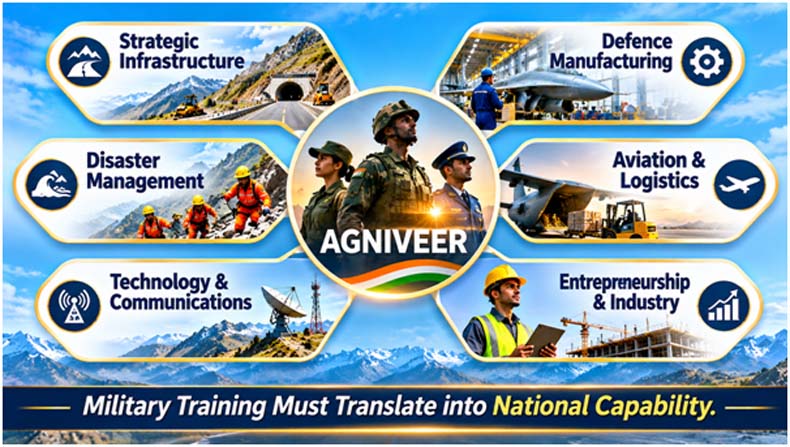
The national dividend from Agnipath will ultimately depend on how effectively India absorbs the trained manpower returning to civilian society. The country should move beyond general assurances of employment reservations and develop a coordinated Agniveer-to-National-Asset framework. This should connect military experience with specific occupational requirements across government, industry and the wider economy.
- Border Roads Organisation offers an interesting opportunity. Its activities in difficult terrain involve construction, equipment management, transport, logistics, maintenance and support to strategic infrastructure. Trained Agniveers with relevant engineering, vehicle, communications and logistical experience could be considered for suitable civilian positions, subject to prescribed qualifications and recruitment rules. Similar possibilities exist in NHAI, infrastructure companies, defence manufacturing, aviation support and industrial maintenance.
- Disaster management is another promising area. Personnel trained in fieldcraft, first aid, communications, emergency response and working under difficult conditions could strengthen state disaster response mechanisms, provided they undergo the additional training and certification required for specialised responsibilities. Their experience could also benefit emergency services, critical infrastructure protection and industrial safety organisations.
- Private sector must become an active partner rather than a passive beneficiary. Defence manufacturers, automobile companies, aviation enterprises, logistics providers, telecommunications firms and infrastructure corporations should be encouraged to establish structured recruitment and apprenticeship programmes for Agniveer veterans. Industry associations could identify occupational requirements and help translate military qualifications into employable skills.
- Entrepreneurship deserves equal attention. A dedicated credit facilitation mechanism, mentoring network and access to government enterprise schemes could help interested Agniveers establish businesses in transport, equipment maintenance, security management, logistics and other suitable sectors. The objective should be to create multiple pathways, not push every individual towards salaried employment.
Announcement to Implementation: The Way Ahead
The revised arrangement requires an implementation architecture that is measurable, transparent and adequately funded.
- Comprehensive Service-specific Guidelines. Ministry of Defence should issue comprehensive service-specific guidelines covering eligibility, performance assessment, remuneration, extension conditions and regular enrolment. Ambiguity at this stage could generate avoidable anxiety among serving Agniveers and difficulties for unit commanders.
- Common Assessment Framework. Three services should establish a common assessment framework with trade-specific parameters. A soldier’s operational contribution, technical competence, physical fitness, discipline and leadership potential should be recorded systematically. Digital performance portfolios, maintained throughout service, would provide an auditable basis for selection and professional development. The process should incorporate independent scrutiny and a defined appeal mechanism.
- Revised Manpower Planning. Manpower planning must be revisited. An extended engagement will affect recruitment cycles, training establishments, unit strengths, accommodation, equipment requirements and pension liabilities over time. The services should undertake a detailed assessment of the ideal balance between Agniveers, regular personnel and experienced specialists. Financial savings should not become the overriding consideration if they compromise operational readiness or essential institutional experience.
- Agniveer Transition and Placement Authority. The government should establish an Agniveer Transition and Placement Authority, functioning through a coordinated mechanism involving the Ministry of Defence, Ministry of Skill Development and Entrepreneurship, Ministry of Labour and Employment, state governments and industry. It should maintain a national skills database, coordinate employer partnerships, facilitate certification and track employment outcomes. A publicly available annual report could measure placement rates, wages, entrepreneurship, further education and retention in regular service.
- Civilian Employment Opportunities. Civilian employment opportunities must be made credible before personnel complete their tenure. Central and state government departments should examine suitable vacancies and establish transparent recruitment pathways, without diluting essential professional standards. The existing provisions and announced employment preferences should be consolidated into a clear, accessible framework. Private employers should be encouraged to offer apprenticeships and preferential consideration based on verified competencies.
- Periodic Independent Evaluation. The revised scheme should undergo periodic independent evaluation. Operational performance, unit cohesion, training effectiveness, financial sustainability and post-service employment outcomes should be assessed separately. This will enable policymakers to distinguish between improvements in military capability and improvements in civilian rehabilitation, rather than treating one as evidence of the other.
A Stronger Military, A Stronger Nation
The revised Agnipath arrangement should ultimately be judged by three outcomes: a more capable Armed Forces, a more secure and professionally equipped Agniveer, and a society that benefits from the experience of those who have served. These outcomes are interconnected, but they require separate institutional mechanisms and measurable objectives.
There is also an opportunity to develop a larger national philosophy around military service. India has a substantial young population, expanding industrial capabilities and growing requirements in infrastructure, technology, disaster resilience and national security. A structured military-to-civilian transition can help bridge these requirements. The experience of serving in uniform, when supplemented by recognised qualifications, can become an asset across several sectors of the economy.
However, the Armed Forces must remain the primary consideration in any military manpower reform. Operational requirements, combat effectiveness, unit cohesion and professional standards cannot be compromised in pursuit of financial efficiencies or employment objectives. Equally, the responsibility towards those who serve cannot end when their military engagement concludes. Both obligations must be addressed through careful planning and sustained institutional commitment.
The announcement of 4 November provides an opportunity to move Agnipath into its next phase. The task ahead is to convert an additional two years into greater military proficiency, better career prospects and a stronger national talent pool. This requires a partnership between the Armed Forces, government, industry and educational institutions, supported by transparent policies and accountable implementation.
Agnipath must eventually be remembered not simply as a method of recruiting younger soldiers, but as a system that strengthened the military while creating a generation of skilled, disciplined and confident citizens. The true Agniveer advantage will emerge when the nation gains from their service, whether they continue to wear the uniform or move beyond it.
ABOUT THE AUTHOR

Lt Gen Rajeev Chaudhry (Retd) is a social observer and writes on contemporary national and international issues, strategic implications of infrastructure development towards national power, geo-moral dimension of international relations and leadership nuances in changing social construct.