
The Golden Hours that India cannot afford to Lose
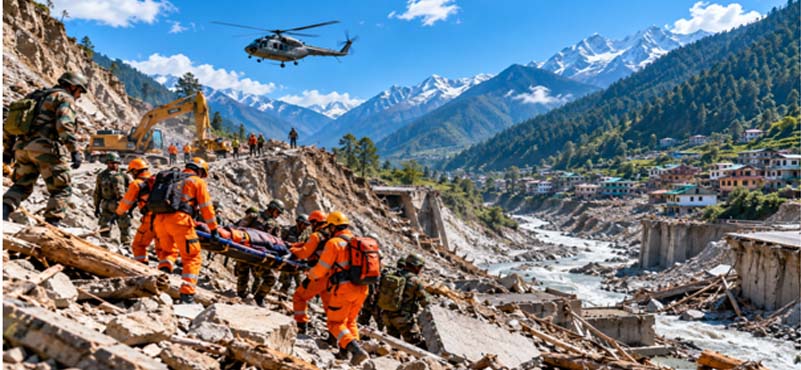
A major disaster is a race against time, terrain and uncertainty. When a cloudburst tears through a Himalayan valley, a landslide buries a highway or a flash flood isolates an entire settlement, the difference between survival and tragedy may depend on whether trained rescuers, engineering equipment, medical support and reliable communications reach the affected area before the situation deteriorates beyond recovery. India’s disaster-management architecture must therefore be judged not simply by the institutions it has established, but by their ability to deliver the right capabilities at the right place and at the right time.
India has made substantial progress. The National Disaster Response Force (NDRF), raised in 2006 under the Disaster Management Act, 2005, has developed into a specialist force with 16 battalions. Its official 2025 Raising Day release reported a sanctioned strength of 18,556 personnel, a presence at 68 locations, including 28 Regional Response Centres and 24 Tactical Pre-positioning Locations.
Yet institutional growth does not automatically guarantee optimal response. The next phase of reform must examine whether forces are appropriately positioned, adequately staffed, professionally led and capable of operating seamlessly with State authorities, district administrations, the Armed Forces and infrastructure organisations such as the Border Roads Organisation (BRO).
The central argument is simple: India must move from possessing disaster-response capabilities to ensuring that those capabilities produce the fastest, most coordinated and most effective response possible.
India’s Disaster Response Capability must follow Risk
India’s disaster profile is becoming more complex because natural hazards increasingly interact with population density, infrastructure vulnerability, climate variability and rapid urbanisation. The Himalayas face combinations of extreme rainfall, landslides, flash floods, glacial-lake outbursts and earthquake risk. Coastal States confront cyclones and storm surges, while large cities face urban flooding, heatwaves, fires and cascading failures of electricity, communications and transport.
The institutional response must reflect this diversity. A force configured for flood rescue cannot automatically substitute for a specialist team trained in collapsed-structure search, mountain rescue, hazardous-material incidents or complex urban emergencies. Equally, the same deployment model cannot be assumed to work in the plains, coastal regions and high-altitude valleys.
The Disaster Management (Amendment) Act, 2025, which came into force on 9 April 2025, sought greater institutional clarity, stronger functioning of national and State authorities, and national and State disaster databases. However, legislation must translate into operational capability.
The Parliamentary Standing Committee on Home Affairs, in its 261st Report presented in August 2026, highlighted uneven implementation, regional capacity constraints, coordination gaps and deficiencies in risk mapping. It also recommended updating the National Policy on Disaster Management, 2009, and the revised National Disaster Management Plan, 2019. The implication is clear: disaster management must be designed around changing risk, not merely inherited administrative arrangements.
A modern disaster system must anticipate where the next emergency is most likely to strike, not merely decide where to send help after it does.
The Geography of Response: Are Forces Where They Are Needed?
The location of response forces is a strategic decision, not simply an administrative convenience. The recurring disaster exposure of Himachal Pradesh, Uttarakhand, Sikkim and the Northeastern states warrants particular attention because rugged terrain, landslide-prone roads, river valleys and seasonal weather can turn relatively short distances into lengthy journeys. A battalion’s nominal proximity to a hazard does not necessarily mean that its teams can reach the affected community quickly.
India already has elements of a geographically distributed NDRF network. Official unit listings identify battalions at Nurpur in Himachal Pradesh, Gadarpur in Uttarakhand and Itanagar in Arunachal Pradesh, alongside other locations across the country. The issue, therefore, is not simply the absence of forward presence; it is whether existing locations, regional centres, transport arrangements and deployment priorities provide the best achievable response times across the full risk landscape.
A national deployment review should overlay historical disaster frequency, exposed populations, hazard intensity, seasonal accessibility, travel times, airlift availability and the possibility of simultaneous emergencies. It should also assess the distribution and readiness of State Disaster Response Forces (SDRFs), whose organisation and resourcing are primarily the responsibility of State governments.
The following reforms merit priority:
- Risk-based force positioning. Reassess battalion locations, regional response centres and forward staging points using transparent, periodically updated hazard and response-time data.
- Seasonal pre-positioning. Deploy appropriately equipped teams before predictable high-risk periods, supported by weather forecasts and local intelligence.
- Regional reinforcement plans. Establish clear arrangements for neighbouring States to share specialist teams and equipment when one State’s resources are overwhelmed.
- Access-based planning. Calculate actual travel times using road closures, terrain, weather and transport constraints rather than straight-line distances.
- Concurrent-disaster planning. Retain sufficient mobile reserves so that an emergency in one region does not leave another dangerously exposed.
These measures should be tested through scenario modelling and exercises before changes in permanent basing are approved.
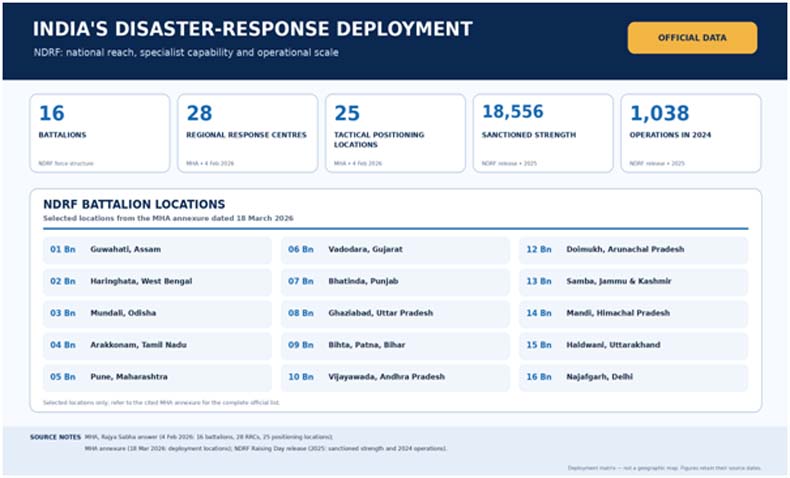
Disaster-response geography must be drawn around the time needed to save lives, not merely the convenience of locating units.
The Golden-Hour Gap: When First Responders become Late Responders
In remote Himalayan areas, the first organised assistance may come from personnel already present for other duties. BRO teams work in difficult terrain to construct and maintain strategic roads, bridges and tunnels, while Army units are positioned forward to fulfil national-defence responsibilities. Their presence, engineering capability, equipment and familiarity with local terrain can make them invaluable during emergencies.
This creates an important operational question. When BRO personnel or Army units begin rescue, evacuation or access-restoration efforts before specialist disaster-response teams arrive, is the national system using these capabilities as part of a deliberately coordinated response—or relying on them because specialist reinforcement cannot reach the site quickly enough?
The distinction matters. BRO’s primary task is not disaster rescue, and the Army cannot be treated as a substitute for a properly organised civilian disaster-response system. Their personnel and equipment may also be committed to road restoration, border security and other essential duties. The objective must be to complement their early intervention with specialist capabilities, not to transfer the burden of disaster response to organisations with different primary missions.
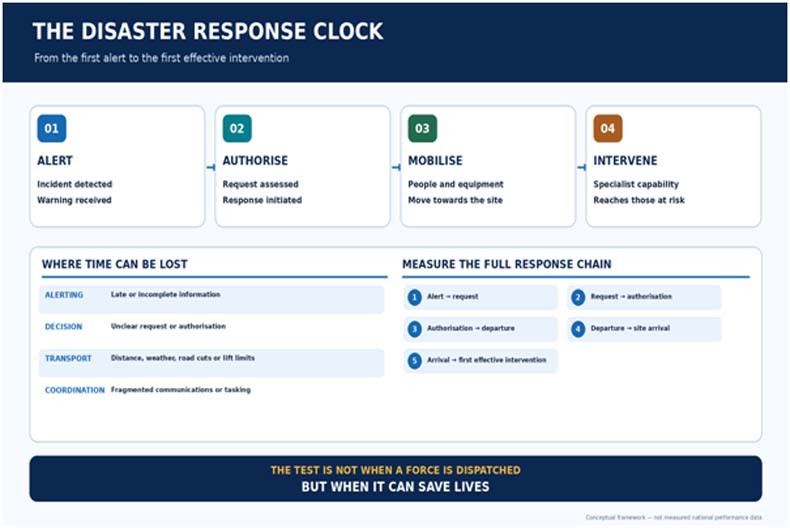
India needs a common operational timeline that records when a warning is issued, assistance is requested, deployment is authorised, a team moves and specialist capability reaches the incident site. Without these measurements, claims about delayed arrivals remain difficult to verify and correct.
Corrective measures should include:
- Establishing terrain- and hazard-specific response-time benchmarks, rather than imposing one unrealistic national deadline.
- Simplifying pre-agreed procedures for requesting assistance, authorising deployment and arranging transport.
- Creating standing liaison arrangements between NDRF, SDRFs, BRO, the Armed Forces, civil aviation and State emergency services.
- Identifying emergency landing zones, equipment staging areas and alternative access routes in vulnerable districts.
- Conducting post-operation reviews to identify delays in alerting, mobilisation, transport and entry into the affected area.
The performance measure must be more sophisticated than whether a team was eventually deployed. It must assess how quickly the required capability became operational.
The decisive measure is not when a force leaves its base, but when it begins making a difference at the disaster site.
From Deputation to Professional Specialisation
A disaster-response force requires discipline, physical endurance and organisational cohesion, but it also demands specialist knowledge accumulated through training and field experience. NDRF draws personnel from Central Armed Police Forces (CAPFs), while State response-force arrangements vary across jurisdictions. Deputation provides access to an established pool of disciplined personnel, but frequent turnover can create challenges in retaining specialist skills and institutional memory.
There is evidence that personnel availability deserves closer scrutiny. PRS Legislative Research’s analysis of the Union Home Affairs Ministry’s 2026–27 demands for grants reported that the Parliamentary Standing Committee in 2025 had identified an approximately 21% vacancy rate in NDRF, alongside staffing shortages in the CAPFs from which it draws personnel. The figure should be treated as a reported baseline, not assumed to represent the current vacancy rate without updated official confirmation.
The broader question is whether a force dependent on deputation can consistently maintain sufficient experience in mountain rescue, flood operations, collapsed-structure search, hazardous-material response, medical first response, engineering and logistics. Personnel rotation can be useful, but it must not repeatedly strip specialist teams of their accumulated expertise.
India should therefore consider a more stable professional model:
- Permanent specialist core. Retain experienced personnel in critical operational, instructional, technical and planning appointments.
- Longer specialist tenures. Establish minimum tenure norms for trained personnel and key appointments, subject to service requirements.
- Professional qualifications. Introduce structured certification and career pathways for rescue, engineering, medicine, communications, logistics and hazardous-material operations.
- Lateral expertise. Explore formal attachments or induction arrangements for suitable personnel and specialists from the Army, BRO, engineering services, health services and other relevant organisations.
- Joint training. Conduct regular exercises involving NDRF, SDRFs, police, fire services, medical teams, BRO and the Armed Forces.
- Retention incentives. Review allowances, career recognition and promotion policies to encourage qualified personnel to undertake and continue specialist assignments.
The aim should not be to replace police or paramilitary personnel with another service. It should be to create a professional disaster-response cadre that combines disciplined manpower with enduring technical competence.
Disaster response cannot become a mature profession if its most valuable expertise repeatedly leaves before it can be fully developed.
Command Without Continuity? Leadership and Operational Cohesion
A force’s effectiveness depends on more than equipment and numbers. Leadership determines whether personnel train together, whether operational plans are understood, whether specialist capabilities are employed correctly and whether decisions are taken under pressure. The concern about command appointments held by Indian Police Service officers should therefore be examined through the lens of professional qualifications, operational experience and continuity—not as an automatic judgement on any particular service.
Police leadership provides valuable experience in public order, crisis management, coordination and administration. Nevertheless, disaster-response command also requires familiarity with rescue doctrine, hazard assessment, technical limitations, incident management, logistics and multi-agency operations. These competencies should be demonstrated and maintained rather than presumed from rank or service background alone.
The official NDRF organisational structure already provides designated command responsibilities from the Director General and zonal leadership down to battalion commandants. The reform question is how to strengthen professional continuity and operational performance within this existing chain.
Recommended reforms:
- Prescribe relevant disaster-management qualifications and operational experience for critical command appointments.
- Introduce structured command courses, scenario-based assessments and periodic recertification.
- Provide continuity in key appointments wherever feasible, particularly where specialist capabilities require sustained development.
- Clarify strategic direction, administrative control, operational tasking and incident-site command through common standard operating procedures.
- Establish joint command-post exercises to test decision-making, communications and resource allocation under pressure.
- Evaluate leadership against readiness, mobilisation, training, safety and operational outcomes.
A common incident-management framework should enable national, State and local responders to operate together without ambiguity over who directs the response, who supplies resources and who remains accountable for decisions.
In a crisis, authority matters—but authority matched by professional competence and continuity matters far more.
An Underpowered Apex? Revitalising NDMA
NDMA cannot drive nationwide reform effectively unless its own institutional capacity is adequate. Concerns have been raised about prolonged vacancies among its members. These should be substantiated through current sanctioned-strength and incumbency records, but the underlying principle is clear: vacancies in key statutory or specialist positions can weaken strategic direction, oversight and continuity.
The challenge is particularly important because the policy framework itself requires renewal. The 2026 Parliamentary Standing Committee recommended reviewing the National Policy on Disaster Management and updating the National Disaster Management Plan. It also called for standardised State and district plans, regular revisions, stronger hazard mapping and improved monitoring.
NDMA must be equipped to turn these recommendations into measurable improvements rather than another layer of policy documentation.
The reform agenda should include:
- Filling critical statutory and specialist vacancies through a transparent, time-bound process.
- Strengthening multidisciplinary expertise in engineering, climate science, public health, geospatial analysis, logistics, finance and emergency operations.
- Establishing clear responsibility for monitoring the implementation of national guidelines.
- Requiring periodic assessments of State, district and urban preparedness.
- Publishing an annual national disaster-readiness report, identifying gaps, corrective actions and progress.
- Linking lessons from major incidents to revised doctrine, training standards and investment priorities.
NDMA should function as the national architect of resilience, setting standards, coordinating institutions, identifying capability gaps and ensuring that implementation is evaluated systematically.
An authority tasked with strengthening the nation’s preparedness must itself possess the capacity, continuity and credibility to lead reform.
The Reform Compact: Seven Changes India Needs
The preceding diagnosis points towards a coherent reform programme rather than isolated administrative adjustments. India’s disaster-response system should be redesigned around readiness, speed, professional competence, interoperability and accountability. The objective is not necessarily to create more institutions or increase every force’s strength, but to ensure that existing and additional resources produce measurable operational gains.
- Adopt a national force-design and deployment doctrine. NDMA and MHA should commission a periodic review of NDRF and State force composition, geographical distribution, specialist capabilities and reserve capacity. The assessment should model different hazards and simultaneous disasters, allowing decision-makers to compare alternative basing and resource-allocation options before committing expenditure.
- Establish a professional disaster-response career structure. Specialist personnel should receive recognised qualifications, sustained training and incentives for retaining operational expertise. The appropriate mix of permanent specialists, deputed personnel and external technical expertise should be determined by evidence and operational requirements.
- Create a common command-and-control framework. National, State, district and incident-site authorities should have clearly defined responsibilities for requesting assistance, authorising deployment, assigning tasks, sharing information and coordinating resources. Common operating procedures should preserve constitutional and statutory responsibilities while eliminating avoidable ambiguity.
- Institutionalise joint operational readiness. Multi-agency exercises must test actual mobilisation, communications, transport, medical evacuation, equipment availability and command decisions. The Parliamentary Standing Committee has recommended at least two multi-agency drills annually at State and district levels, accompanied by structured evaluation and time-bound corrective action.
- Integrate technology with field decisions. A common operational picture combining weather forecasts, satellite imagery, GIS hazard maps, field reports, transport accessibility and force availability could improve deployment decisions. Technology must accelerate decisions and action rather than create another reporting layer.
- Shift investment towards risk reduction and readiness. The national and State budgets should separately track prevention, mitigation, preparedness, response and recovery. Funding should be linked to measurable improvements in capability, equipment serviceability, infrastructure resilience and response performance—not merely expenditure.
- Institutionalise accountability and learning. Every major operation should generate an after-action review, identify responsible agencies and record corrective measures. National indicators should include warning-to-action time, mobilisation time, arrival time, rescue outcomes, equipment readiness and restoration of essential services. Comparisons must account for differences in hazard severity, terrain and accessibility.
These reforms should be implemented in phases: first, establish the evidence base and fill critical readiness gaps; next, pilot revised deployment and command arrangements in selected high-risk regions; and finally, scale up measures shown to improve operational outcomes.
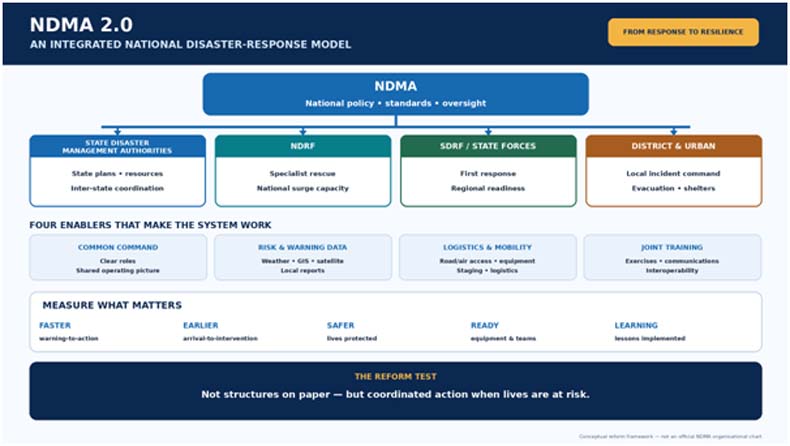
The measure of reform is not how many new orders are issued, but how much faster, safer and more effectively the system responds when lives are at stake.
One Nation, One Coordinated Response
India has built a substantial disaster-management framework, developed specialist response forces and demonstrated the capacity to conduct large-scale rescue and evacuation operations. The next challenge is to convert these achievements into a consistently integrated national capability, particularly in remote mountains, vulnerable river basins and densely populated urban centres. That requires better deployment, a more stable professional cadre, qualified leadership, clear command relationships and an NDMA equipped to drive implementation.
BRO and the Armed Forces will remain important partners in emergencies, especially where their forward presence, engineering resources and logistical capabilities can help reach isolated communities. But their contribution must complement—not compensate for avoidable weaknesses in—the dedicated disaster-response architecture. Equally, State governments must be supported in developing capable SDRFs and district-level response systems, since national forces cannot be everywhere at once.
The ultimate objective is a system that anticipates risk, mobilises early, commands coherently, learns from experience and restores essential services quickly. Its effectiveness must be demonstrated through evidence, operational exercises and transparent performance measures.
India does not need to choose between building stronger institutions and improving coordination; it needs both. The true test of NDMA reform will be whether the entire system works as one when disaster strikes.
The India of tomorrow must not merely be better at responding to disasters; it must be organised to ensure that every minute, every specialist and every available capability counts when a human life depends on them.
ABOUT THE AUTHOR

Lt Gen Rajeev Chaudhry (Retd) is a social observer and writes on contemporary national and international issues, strategic implications of infrastructure development towards national power, geo-moral dimension of international relations and leadership nuances in changing social construct.