
The Promise of 2047
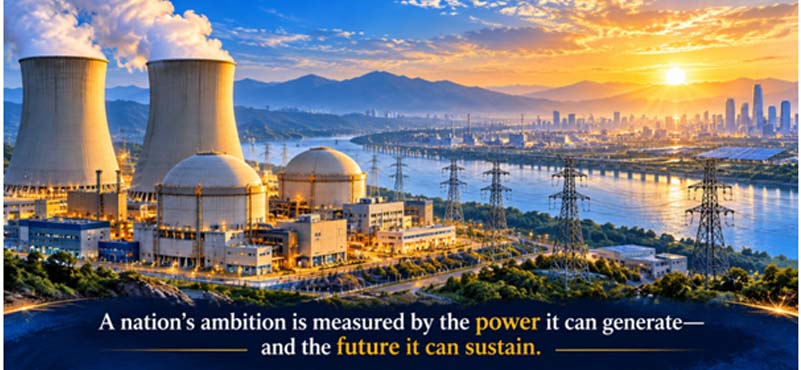
A nation’s rise is ultimately measured not merely by the wealth it creates, but by the energy that sustains its ambitions. As India approaches the centenary of Independence, its aspiration to become a developed economy will depend on reliable electricity for industry, infrastructure, digital technologies and millions of households. Nuclear power, long confined to a relatively modest corner of India’s energy landscape, is now being positioned as an important pillar of this transformation.
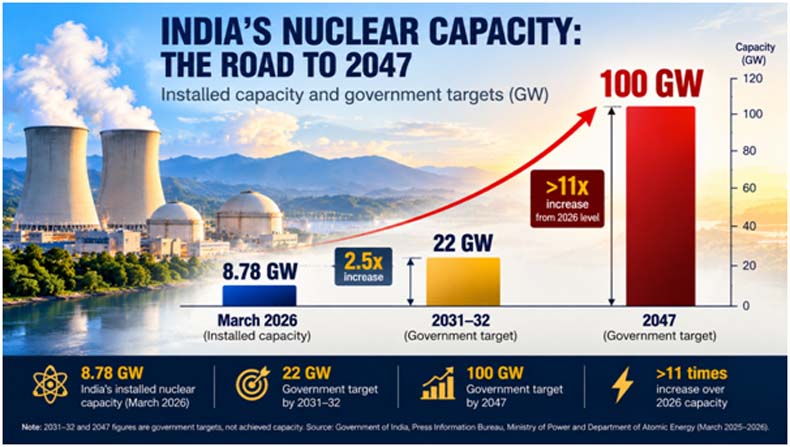
The numbers capture the scale of the ambition. India had an installed nuclear capacity of 8.78 gigawatts (GW), excluding the 100 MW Rajasthan Atomic Power Station Unit 1, according to government statements in 2025–26. The national target is 100 GW by 2047, an expansion of more than elevenfold. Yet nuclear energy contributed only about 3.1 per cent of India’s total electricity generation in 2024–25. The gap between the present contribution and the proposed future is therefore substantial.
Nuclear power offers something particularly valuable to a growing economy: dependable, low-carbon electricity that can complement variable renewable sources. Manufacturing facilities, data centres, advanced industries and strategic installations require power that is available when needed, not merely when the sun shines or the wind blows. Nuclear generation can help meet this requirement while diversifying India’s energy mix and reducing some exposure to imported fossil fuels.
The ambition, however, must be understood in its proper context. Nuclear power is neither a substitute for renewable energy nor a solitary solution to India’s energy challenges. Its value lies in building a balanced, resilient system in which different technologies serve different needs.
A developed India will need not just more energy, but greater control over the energy that powers its rise.
The Arithmetic of Ambition
The distance between 8.78 GW and 100 GW is approximately 91.22 GW of additional capacity. Spread across the 21 years from 2026 to 2047, this translates into an average net addition of roughly 4.3 GW annually. This is a simplified arithmetic benchmark, not a construction schedule; actual additions will depend on project commissioning dates, retirements, capacity factors and delays. Nevertheless, it conveys the magnitude of the undertaking.
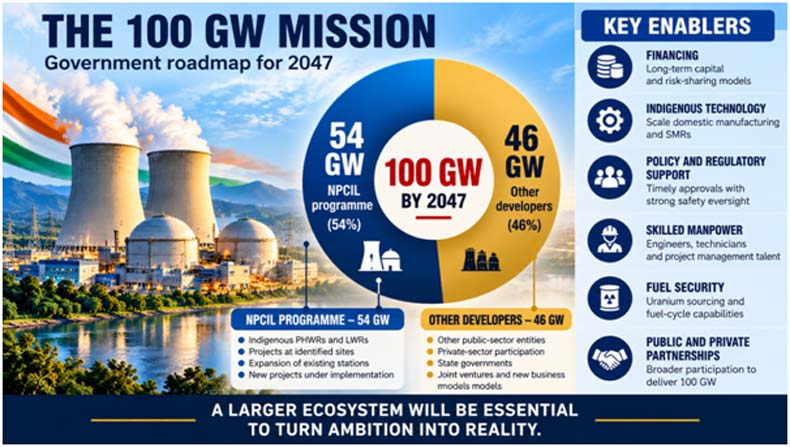
The government’s roadmap envisages nuclear capacity reaching approximately 22 GW by 2031–32 through projects already at various stages of implementation. Beyond that milestone, the Nuclear Power Corporation of India Limited (NPCIL) is expected to develop another 32 GW through indigenous pressurised heavy water reactors and light water reactors, taking its envisaged contribution to around 54 GW. The remaining 46 GW is expected from other public-sector enterprises, state governments, private-sector participation and joint ventures under different business models.
This distribution is strategically significant because it acknowledges that the expansion cannot be delivered through the existing institutional framework alone. It requires a much wider industrial ecosystem, predictable financing, manufacturing capacity, technology partnerships and clearly assigned responsibilities. The challenge is not simply to approve reactors, but to move them through planning, site preparation, construction, testing and commissioning at a sustained pace.
Historical performance reinforces the urgency. India’s nuclear electricity generation increased from 16,956 million units in 2007–08 to 56,681 million units in 2024–25, more than tripling over the period. This is meaningful progress, but it also illustrates how long nuclear expansion can take.
The real measure of ambition will not be the gigawatts promised, but the gigawatts commissioned on time.
Obstacles Beneath the Ambition
Nuclear expansion is a capital-intensive enterprise in which substantial expenditure precedes the first unit of electricity. Long construction periods, financing costs, specialised equipment and the consequences of delays can influence project economics. India will therefore need financial arrangements that recognise the distinctive risks of nuclear development without transferring unreasonable costs to consumers or taxpayers.
Execution is equally important. Delays in land preparation, regulatory approvals, component delivery, civil construction and coordination between institutions can undermine even technically sound projects. Standardising reactor designs, improving supply-chain reliability and strengthening project management could reduce avoidable delays. Equally, realistic cost estimates and independent assessments of progress must replace optimism unsupported by evidence.
Technology and fuel security present additional challenges. Domestic manufacturing must expand to supply specialised components, control systems and precision-engineered equipment. Uranium procurement, fuel fabrication and long-term fuel-cycle planning must remain aligned with the proposed growth in reactor numbers. International cooperation can accelerate development, but excessive dependence on external suppliers could create new vulnerabilities.
Safety must remain non-negotiable. Nuclear accidents, although uncommon, can have consequences extending far beyond the plant boundary. Independent regulatory oversight, emergency preparedness, transparent communication, responsible radioactive-waste management and meaningful engagement with local communities are essential to public confidence. These safeguards should not be treated as bureaucratic inconveniences; they are foundational to a credible nuclear programme.
India’s challenge is thus institutional as much as technological. The country must mobilise capital, talent and industrial capacity while preserving the discipline that nuclear operations demand. The proposed scale of participation also requires clear accountability for project delivery and the allocation of commercial risks.
A nuclear programme becomes credible when its institutions are as dependable as its engineering.
The Small Modular Reactor Opportunity
One of the most consequential elements of India’s nuclear strategy is the pursuit of small modular reactors (SMRs). In the Union Budget for 2025–26, the government announced a Nuclear Energy Mission with an outlay of ₹20,000 crore for research and development, targeting at least five indigenously developed SMRs operational by 2033. The initiative signals a recognition that future expansion may require different reactor sizes, construction models and applications.
SMRs offer the potential for greater standardisation, factory-based manufacturing and modular construction. If these advantages can be realised commercially, repeated deployment could improve construction efficiency and make nuclear power suitable for a wider range of industrial applications. Smaller reactors may also be relevant to energy-intensive industrial clusters and selected locations where dependable, low-carbon electricity is valuable.
India has identified designs including the 200 MWe Bharat Small Modular Reactor and a 55 MWe SMR. The government has also referred to high-temperature reactor development for hydrogen production. These initiatives could strengthen domestic intellectual property, create specialised manufacturing capabilities and support applications beyond conventional electricity generation.
However, technological promise must not be confused with demonstrated commercial performance. SMRs still face questions concerning licensing, first-of-a-kind costs, construction schedules, fuel availability and the economics of mass production. Smaller individual units do not automatically mean cheaper electricity, particularly if manufacturing volumes remain low or projects require expensive site-specific adaptations.
The correct strategy is to develop and demonstrate viable designs, establish credible safety and regulatory frameworks, and scale deployment when evidence supports it. SMRs should complement large reactors, not become an excuse to postpone decisions on either.
The promise of SMRs will be realised not when India designs its first reactor, but when it can build successive units safely, economically and reliably.
Energy Security is National Security
In an uncertain geopolitical environment, energy dependence can become a strategic vulnerability. Disruptions to shipping routes, commodity-price shocks and international conflicts can affect the cost and availability of imported fuels. Nuclear power cannot eliminate these risks, but a diversified domestic generation base can reduce exposure to them and strengthen India’s freedom of strategic choice.
The implications extend beyond electricity. Reliable power supports defence manufacturing, transport infrastructure, communications, advanced computing and industrial competitiveness. As artificial intelligence and data-intensive technologies expand, access to dependable electricity will increasingly influence where investment flows and where strategic capabilities develop. Nuclear energy can contribute to this foundation, provided that generation costs, grid integration and operational reliability remain competitive.
Technological sovereignty is equally important. India needs capabilities in reactor design, component manufacturing, maintenance, fuel management and safety systems. International partnerships remain valuable, particularly where they provide access to technology, finance and experience, but they should strengthen rather than displace domestic competence.
The environmental argument also deserves careful treatment. Nuclear power has low lifecycle greenhouse-gas emissions compared with fossil-fuel generation, while its ability to provide firm power can complement renewables. Nevertheless, nuclear expansion must be assessed alongside transmission investment, storage, demand management, hydroelectricity and the continued development of solar and wind. The objective is a resilient energy system, not a contest between technologies.
Ultimately, nuclear capacity is valuable only when it contributes to affordable, dependable electricity and reduces vulnerabilities without creating new ones. Strategic autonomy must be measured in operational capability, not declarations of self-reliance.
Energy security is not simply the freedom to keep the lights on; it is the freedom to make national choices without avoidable energy vulnerability.
From Target to Transformation
India’s 2047 ambition needs a delivery architecture that converts a distant target into measurable annual progress.
- Clear Roadmap. The first priority should be a transparent, phased roadmap identifying which projects will contribute to each milestone, their expected commissioning dates, financing arrangements and principal risks. Regular public reporting would help distinguish operational capacity from projects merely announced, planned or under construction.
- Predictable Financing. Financing must be predictable and responsibilities clearly allocated. The envisaged division between NPCIL and other developers will require institutional coordination, commercially credible business models and appropriate sharing of construction and operational risks. Private-sector participation can mobilise capital and industrial expertise, but it must operate within a framework that preserves rigorous safety standards and public accountability.
- Investment beyond Reactors. India must invest in the capabilities beneath the reactors: skilled manpower, specialised manufacturing, research and development, reliable fuel arrangements and efficient project management. Standardisation can improve repeatability, while independent regulatory oversight and public engagement can strengthen confidence. The development of indigenous SMRs should be judged through demonstrable milestones rather than announcements alone.
- Integrated Expansion. Finally, nuclear expansion must remain integrated with the wider electricity system. Generation targets need to reflect demand growth, grid requirements, competing investment priorities and the economics of alternative technologies. Success will require a consistent national commitment that survives short-term political and fiscal pressures.
The 100 GW target is undeniably ambitious, but ambition acquires strategic value only when it changes national capability. By 2047, India should aim not merely to possess more nuclear reactors, but to have developed an industrial ecosystem capable of designing, financing, building and operating them with confidence.
The ultimate test will be whether nuclear power strengthens India’s economic resilience, technological independence and energy security while maintaining the highest standards of safety and accountability.
India’s greatest nuclear achievement in 2047 should not merely be 100 gigawatts of capacity; it should be a nation capable of turning technological ambition into dependable strategic power.
ABOUT THE AUTHOR

Lt Gen Rajeev Chaudhry (Retd) is a social observer and writes on contemporary national and international issues, strategic implications of infrastructure development towards national power, geo-moral dimension of international relations and leadership nuances in changing social construct.