The world is no longer shaped only by decisions taken in Washington, Beijing and Moscow. Other powers are acquiring greater capacity to influence outcomes. Geography, markets, energy, technology, critical minerals, manufacturing and military capability are creating new centres of leverage. The result is not the disappearance of great-power competition, but the emergence of a more networked strategic environment.
The US-China-Russia triangle remains a major driver of contemporary geopolitics. Their competition influences military alliances, technology controls, financial systems, energy markets and global supply chains.
Yet viewing the emerging order primarily through this triangular lens risks overlooking a more consequential development: the redistribution of strategic agency across Eurasia, the Indo-Pacific and West Asia.
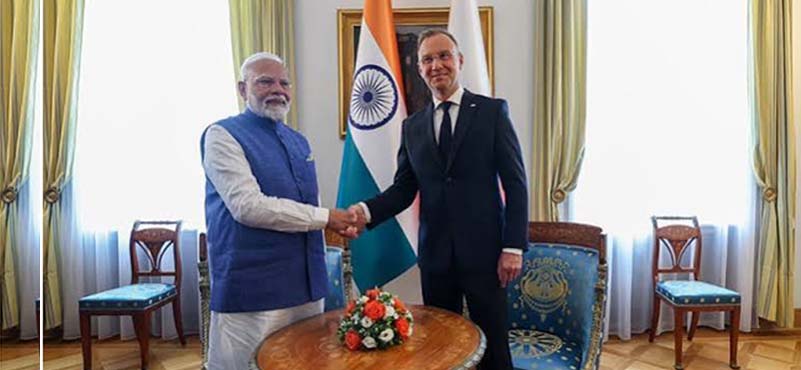
India is in kind of a unique spot right now. Instead of just picking one side on the world stage, it’s keeping things close with the US and Western partners, while still hanging onto its long-time relationship with Russia. Moreover, India sits at the table with groups like BRICS and the SCO, but turns around and builds solid deals across Europe, the Gulf, and the Global South.
Look at how this plays out in real life: when Western sanctions hit Russia, India stepped up and became one of the biggest buyers of discounted Russian crude oil to keep its domestic gas prices down. But at the same time, it inked massive defense and tech deals with the US—like co-producing GE jet engines for its fighter jets and buying high-tech Predator drones.
Basically, India isn’t playing for just one team—it’s playing on different fields at the same time. But here’s the catch: the more friends you make to keep your options open, the more every single one of them expects you to have their back when push comes to shove.
The Value Of Multiple Tables
There is considerable logic in India being present at multiple tables. Defence partnerships can provide access to technology, platforms, training and operational capabilities. Economic partnerships can open markets, attract investment and diversify supply chains. Multilateral groupings can provide diplomatic leverage and platforms through which India can shape discussions rather than merely respond to them.
The case for multiple partnerships should therefore not be confused with an attempt to keep every major power equally satisfied. Nor should strategic autonomy be interpreted as equidistance.
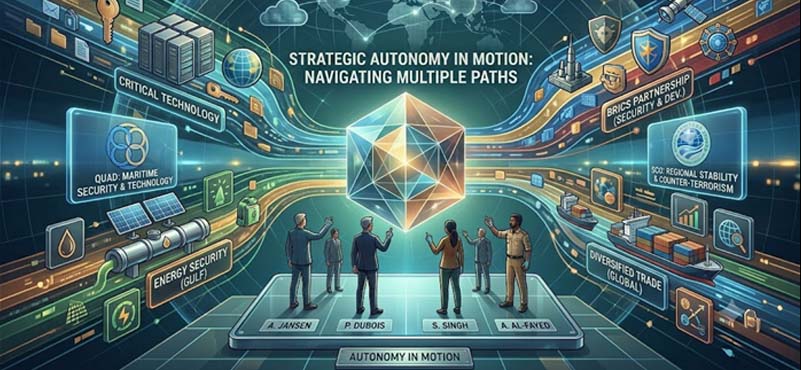
Forget diplomatic theory—foreign policy isn’t about loyalty; it’s more about transactional leverage. India doesn’t join groups like the Quad, BRICS, or the SCO out of ideological commitment. It uses them as specific instruments to extract hard power, economic advantage, and geopolitical insurance:
- The Quad is an insurance policy against Chinese hegemony in the Indo-Pacific, giving New Delhi access to advanced American technology and maritime weight.
- BRICS and the SCO are hedges against Western overreach, ensuring India maintains direct leverage in Eurasia and a foot in non-Western financial structures.
- Relationships with Washington, Moscow, Paris, and Riyadh aren’t emotional alliances; they are based on cold calculations balancing weapons sourcing, energy security, and regional dominance.
Playing on every side of the board isn’t a contradiction—it’s realpolitik in action. By refusing to commit to a single bloc, India maximizes its bargaining power and prevents any single superpower from taking it for granted.
The critical test for New Delhi, however, isn’t how skillfully it juggles these partnerships. It’s leverage versus friction. The more indispensable India tries to make itself into competing power blocs, the more every bloc will press India to break ranks when global crises peak. True strategic autonomy depends entirely on whether that network expands India’s freedom of maneuver—or traps it in a web of conflicting obligations.
When Partnerships Create Expectations
Every partnership comes with expectations. A defence relationship may provide valuable capability, but it can also generate expectations regarding interoperability, operational cooperation or strategic convergence. An economic agreement may widen market access, but it can also affect India’s room for manoeuvre on tariffs, standards, investment and domestic industry.
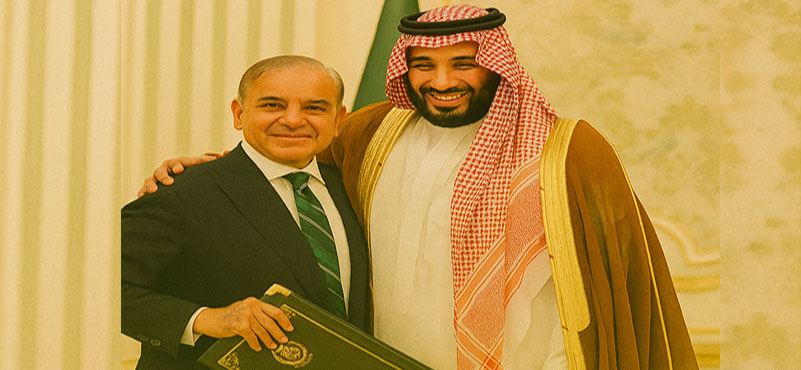
The same applies to strategic groupings. The United States and its Indo-Pacific partners attach importance to India’s role in shaping the regional balance. Russia places value on preserving its longstanding strategic relationship with India. BRICS provides a platform for countries seeking greater influence in global governance. European partners increasingly see India as an important economic, technological and strategic partner. The Gulf states have their own expectations centred on trade, investment, energy, technology and regional stability.
These interests overlap in some areas and diverge in others. The consequence is subtle but important. Strategic relevance carries a price. The more valuable India becomes to different partners, the more consequential its refusal to accommodate their expectations can become.
Strategic autonomy, therefore, is not simply the ability to maintain multiple relationships. It is the ability to manage the expectations arising from those relationships without surrendering independent judgement. Relying on other countries doesn’t mean we lose your freedom to make our own choices.
In a networked globalised, interdependent environment, no nation can do everything alone anymore. No country produces every single high-tech microchip, jet engine, or barrel of oil it needs—not even the US or China. So trying to be 100% self-sufficient isn’t just impossible, it’s a waste of time and resources. The real problem isn’t needing help from outside. The real problem is putting all eggs in one basket.
This dynamic can be analyzed through the framework of institutional risk management: reliance on a single external partner creates strategic exposure, whereas engaging multiple partners distributes operational risk and preserves decision-making flexibility.
- Defense Sourcing: Relying primarily on a single foreign nation for military hardware creates vulnerabilities to supply chain bottlenecks, sanction regimes, or geopolitical shifts. Distributing defense procurement across multiple international sources—such as acquiring French Rafale aircraft, American MQ-9B drones, and expanding domestic defense production—reduces exposure to unilateral supply interruptions or export restrictions.
- Trade Architecture: Economic concentration in a single region leaves national trade vulnerable to localized conflicts, policy shifts, or market shocks. Establishing bilateral and regional trade frameworks—spanning Europe, the Gulf, the United Kingdom, and Australia—provides alternative export markets and trade route redundancies during global disruptions.
- Technology Transfer & Capability Development: Joint technological initiatives, such as jet propulsion co-production agreements with the United States, provide immediate access to advanced technical standards while supporting long-term domestic industrial capacity.
Expanding international partnerships can increase strategic options rather than restrict them. However, the long-term effectiveness of a multi-partner framework depends on maintaining sufficient domestic capacity to manage global supply disruptions and shifting foreign policy alignment.
If different defence relationships create excessive dependence on foreign spares, software, ammunition, upgrades or specialised components, diversification may merely replace one vulnerability with several. Similarly, trade agreements that increase market access can be beneficial, but their cumulative effect on domestic manufacturing, critical sectors and policy space requires careful assessment.
The measure, therefore, cannot be the number of partnerships. It must be whether those partnerships increase India’s capability, resilience and decision-making agency.
National Interest As The Anchor
India’s partnerships are instruments of national strategy; they are not ends in themselves. Membership of a grouping should provide India with influence, capability, access or diplomatic leverage. A defence partnership should strengthen national security. An economic agreement should contribute to prosperity and resilience.
A technology relationship should build capability rather than perpetuate dependence.
The ultimate test is straightforward. Does the relationship expand India’s choices or progressively define them? This does not mean that India should avoid difficult compromises. Foreign policy inevitably involves trade-offs. Security may require a decision that carries an economic cost.
Economic opportunity may create strategic vulnerability. A diplomatic position may improve one relationship while complicating another. Strategic autonomy does not eliminate these trade-offs. It ensures that India makes them on its own terms. This is why strategic autonomy cannot rest upon diplomacy alone.
Autonomy Requires Capability
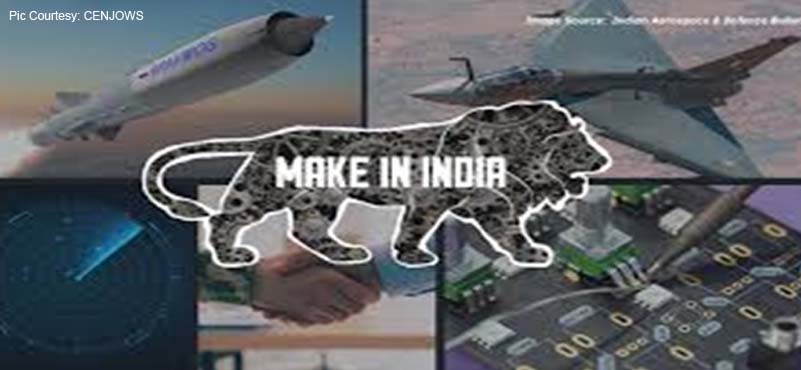
A country cannot preserve freedom of action indefinitely if it lacks the economic, technological and military capacity to exercise it. Strategic autonomy therefore has a hard-power foundation. Indigenous defence production, resilient supply chains, technological competence, energy security, critical-mineral access, manufacturing strength, secure communications and financial resilience all contribute to the space within which foreign-policy choices can be made.
Diplomatic flexibility without national capability can eventually become dependence disguised as autonomy. India’s growing emphasis on domestic manufacturing and technology, while simultaneously expanding external partnerships, reflects this reality. The objective should not be autarky. It should be the capacity to engage the world without becoming captive to any particular external source of capability.
This is perhaps the most important distinction between strategic autonomy in the past and strategic autonomy in the emerging networked order.
India’s policy of strategic autonomy has long rested on a pragmatic calculus: avoiding binding security alliances while engaging multiple, often competing, global powers to maximize national leverage. By balancing relationships with the United States, Russia, European nations, and key Gulf states, India has successfully turned multi-alignment into a flexible toolkit.
This approach allows India to secure discounted energy, acquire advanced defense technology, and maintain a seat at major multilateral tables—from the Western-oriented Quad to Eurasian platforms like BRICS and the SCO—without tying its foreign policy to any single superpower’s agenda.
However, this strategy faces severe operational limits when a major global crisis forces competing powers into zero-sum demands. Multi-alignment relies on a stable international environment where transactional hedging is tolerated. In the event of an acute systemic shock—such as a direct military conflict in the Indo-Pacific or aggressive enforcement of global secondary sanctions—strategic ambiguity can quickly transform from an asset into a strategic liability. Western partners may start conditioning high-tech defense transfers and intelligence sharing on explicit political support, while Eurasian powers view India’s operational ties with Western security frameworks with growing suspicion.
Furthermore, diversification across suppliers is not the same as genuine self-reliance. While sourcing weapons, oil, and technology from multiple nations prevents total reliance on a single partner, it leaves India vulnerable to external supply chain disruptions and political pressure during a major conflict. Operating a mix of Russian, Western, and domestic military hardware creates logistical, maintenance, and interoperability challenges under sustained operational stress. Meanwhile, critical dependencies on Western-dominated financial networks and advanced semiconductor supply chains mean India cannot fully insulate its economy from unilateral global sanctions.
Ultimately, the true test of strategic autonomy is not how many partnerships a nation can manage simultaneously, but whether those relationships preserve its freedom to act when national interests demand an uncomfortable choice. Moving forward, India’s challenge will be converting “diversified dependency” into true internal strength. By accelerating indigenous capabilities in defense manufacturing, critical technology, and domestic energy production, India can ensure that its web of international partnerships opens up real strategic choices without letting any external power dictate them.
ABOUT THE AUTHOR
 Lt Gen Tarun Chawla, was commissioned into the Regiment of Artillery in Jun 1984. He has served with the United Nations Mission in Liberia and has been an instructor at the College of Defence Management at Secunderabad. The officer has commanded an Artillery Brigade in the LC Sector in J&K, and an Artillery Division as part of Army’s Western Command. He was the Director General Financial Planning, prior to assuming the role of Director General of Artillery.