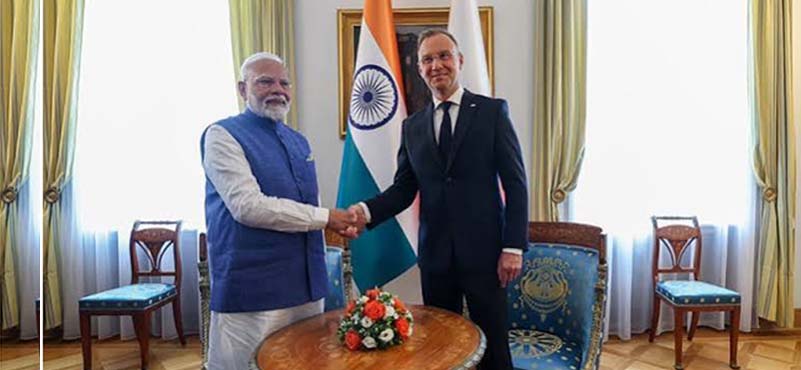
Donald Tusk’s three-day visit (21–23 October) follows Narendra Modi’s trip to Warsaw two years earlier, which elevated ties to a “strategic partnership” and produced a 2024–2028 action plan. The programme is heavily commercial: Finance and Economy Minister Andrzej Domański is travelling with the Prime Minister, accompanied by nearly 100 companies. Business forums are scheduled in Delhi on 22 October and in Bengaluru on 23 October. Defence, space, emerging technology, the Ukraine war and India–EU relations are on the agenda.
The record warrants some scepticism. The “sixteen years” framing is slightly misleading, as Tusk was in Delhi in 2017 as President of the European Council. The real gap is sustained bilateral commerce. India has gained many “strategic partners” in recent years, and the label has often outrun the results. The test is whether this partnership produces more than the others.
Modest Numbers
Measured against the size of both economies, the numbers are modest. Bilateral trade reached about $6.36 billion in 2025, up roughly 9.6%, according to the Indian Embassy in Warsaw. Indian exports accounted for $4.83 billion and imports for $1.53 billion. Poland’s own figures, reported in euros, show the same imbalance: Polish exports of €1.37 billion against imports of €4.32 billion, leaving Warsaw with a deficit of nearly €3 billion.
This deficit is politically important. Warsaw wants to raise trade to $10 billion, but a larger total will not satisfy Polish industry, should the gap widen. Poland’s exports to India are dominated by a few items: turbojet engines, coke, scrap metal and synthetic rubber. India’s sales to Poland are broader, led by textiles (about €912 million), machinery, pharmaceuticals, base metals and footwear. A balanced relationship needs Polish exports with more value added, such as rail and mining equipment, food technology and environmental engineering.
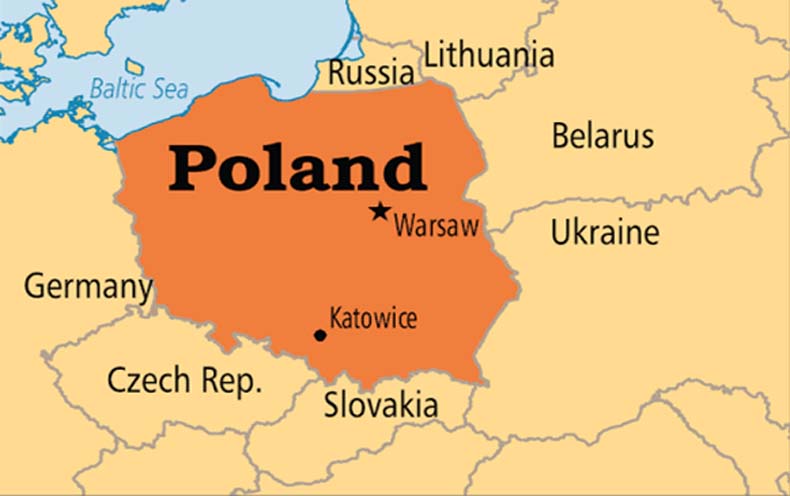
Two further points show how modest the numbers are.
- The target is not ambitious. At the 2025 growth rate, trade passes $10 billion in about five years with no new policy at all. A target that can be achieved without any change in policy is a projection, not an ambition. To be meaningful, it needs a date and a higher bar, perhaps $15 billion by 2030.
- The relationship is small against the larger one. India–EU goods trade was about $136.5 billion in FY2024–25, so Poland accounts for under 5% of it. Poland has a roughly $1 trillion economy and is the largest in Central Europe, but India’s engagement with it still lags that weight.
Investment data is also unclear. The embassy puts Indian investment in Poland at over $3 billion, while Poland’s central bank figure cited by Polish authorities is above PLN 1.8 billion, which is much lower at current exchange rates. The gap may reflect different definitions, such as reinvested earnings and third-country routing. Until the two governments agree on a shared dataset, it’s difficult to say whether the investment relationship is growing.
India–EU Agreement -Real Context
The most significant fact in the background is not the Tusk–Modi meeting. It is the India–EU Free Trade Agreement, concluded on 27 January 2026 after almost two decades of talks. The EU says it will remove or cut tariffs on 96.6% of its goods exports to India and save European firms about €4 billion a year in duties. Commerce Minister Piyush Goyal has said signing is planned for December 2026, with entry into force in February–March 2027. The text is still in legal scrubbing.
This changes how the Polish visit should be read. Much of the tariff architecture Polish and Indian firms will operate under will be set in Brussels, not Warsaw or Delhi, so a bilateral visit cannot promise market access on its own. Warsaw can help ratification move smoothly and push the agreement’s agenda. This includes the missing investment protection pillar: the FTA concluded without a finished investment protection agreement, a gap lawyers have flagged. Investors from both sides, including Polish and Indian companies planning long-horizon projects, will want that settled.
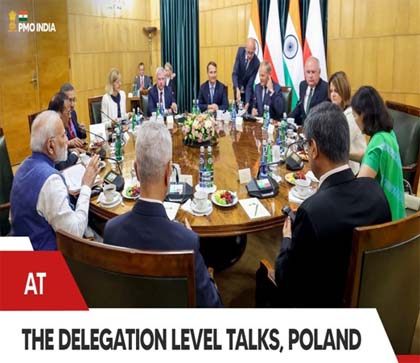 The agreement also cuts both ways for Poland. India’s duty cuts on machinery, chemicals and other industrial goods benefit Polish manufacturers, but they also benefit German, Italian and French competitors with deeper India networks. Poland’s advantage must come from cost, speed and proximity to Central European supply chains, not from preferential access.
Technology – Most Promising Field
The Bengaluru leg signals ambition in IT and space, and the plausible complementarity is real. Poland has a large pool of engineers, a growing space-sector cluster and manufacturing capacity close to German industry. India offers scale in software services, low-cost launch capability and a deep startup base. A Polish firm seeking an Indian software partner, or an Indian firm seeking a European manufacturing base for components, has an obvious reason to talk.
Even so, announcements in space, artificial intelligence, battery recycling, green hydrogen and green ammonia are easy to make and hard to execute. These fields need financing, intellectual-property rules and commercialisation paths, and they are the areas where memoranda most often stay on paper. Pilot projects with named partners and funding would say more than another list of “areas of interest”.
Defence: Opportunity With Real Constraints
Polish defence companies are in the delegation, and a Joint Working Group is expected to meet. Poland is rebuilding its armed forces at a pace unusual in Europe, and India is trying to broaden its supplier base and develop its own industry. In principle, this implies co-development and co-production rather than simple purchases.
The constraints are substantial. Poland’s procurement is driven overwhelmingly by NATO interoperability and urgent needs on its eastern flank, and India’s systems and supply chains are shaped by a different set of partners, including long-standing dependence on Russian equipment. Export controls, certification and the commercial case for each programme will decide what is possible. The honest expectation is a narrow work programme, perhaps in components, ammunition inputs or niche technologies, not a major joint platform.
Ukraine: Agree to Disagree
Ukraine is the clearest point of strategic difference. Poland is a frontline state that has taken in large numbers of refugees and is among Kyiv’s most committed supporters. India has maintained relations with Russia, including energy purchases, and has avoided condemning Moscow. Neither will move far on this.
India and Poland should acknowledge their differences without allowing them to obstruct cooperation. Disagreement over Russia need not prevent progress in trade, technology or education. Regular consultations on the war and its implications for food, energy and security would be more productive than diplomatic communiqués that gloss over fundamental differences.
Frictions Masked by Headline Figures
Several practical obstacles are worth stating plainly.
- Agriculture. Polish interest in food exports runs into Indian limits on dairy and poultry, and India’s own sensitivities in farm trade. The India–EU agreement does not make these disappear.
- Regulation and compliance. EU standards, including the carbon border adjustment mechanism, still apply to Indian exporters. Reporting on the steel quota under the EU deal notes that Indian firms must still pay European carbon costs.
- Mobility and people. The India–EU package includes steps on legal pathways for students and skilled workers, and a bilateral social security agreement with Poland has been described as pending. Movement of Indian students and professionals to Poland is a practical advantage for Polish employers short of skilled labour. Settling it would signal seriousness.
- Logistics and connectivity. Without reliable shipping, aviation and rail links, trade targets are hard to hit. India–Middle East–Europe Corridor plans are long-term and uncertain.
Delivery Agenda -Syntax of Transformation
A strategic partnership is judged by what it produces. These calibrated strategic steps would mark seriousness and, therefore, need to be handled with care:
- Annual delivery matrix. Turn the 2024–2028 action plan into a published schedule naming responsible ministries, partners and milestones, with six-monthly public reviews.
- A higher, dated trade target with a balance goal. Set an explicit goal such as $15 billion by 2030, with a commitment to raise Polish value-added exports, not just total turnover.
- A shared data standard. Reconcile trade and investment figures between the two statistical systems so progress can be measured.
- A business-obstacle mechanism. Create a standing channel for companies to raise market-access, visa, certification and payment problems, with answers within a fixed time.
- A short list of technology pilots. Choose a few projects in space applications, industrial AI or battery recycling, with funding and intellectual-property terms agreed from the start.
- A bounded defence programme. Limit it to areas that pass export-control and commercial tests, and report outcomes.
- Institutionalised dialogue on disagreements. Hold regular, private consultations on Ukraine and West Asia so differences do not leak into economic cooperation.
- Link the process to India–EU ratification. Use the December signing as a deadline to align Polish and Indian business plans with the agreement’s schedules.
Transformed Narrative -Strategic Options and Choices
For more than four decades, I have argued that political problems are, at their core, economic problems. I articulated this position most explicitly in my article, “The North–South Dialogue,” published in The Eastern Anthropologist in October–December 1981. Conflicts framed in ideological, diplomatic or strategic terms often reflect deeper tensions over resources, production, wealth and economic power.
North–South relations illustrate this clearly. Questions of sovereignty, governance, conflict and cultural assertion cannot be understood in isolation from inequalities in wealth, market access, natural resources, technology and terms of trade. Political alignments may shift and ideological narratives change, but economic dependence, development and distribution remain powerful underlying forces. Politics is, in large measure, the organised expression of economic interests.
This perspective also underscores the need to diversify trade and investment across geographies, countries, economic systems and stages of development. Against this backdrop, Donald Tusk’s visit is welcome, though long overdue. After a gap of over a decade, the visit is a useful beginning, not an achievement. Bilateral trade of approximately $6 billion is modest for two economies of this size, while the $10 billion target, though welcome, is hardly ambitious. The greater opportunity is to forge a wider, deeper and more commercially meaningful economic partnership.
These are early days, but much more is possible with sincerity of purpose, a clearer appreciation of shared developmental priorities and personal chemistry between the two Prime Ministers. The India–EU agreement will, in this larger context, shape the commercial landscape far more profoundly than any single bilateral announcement.
This relationship is here to stay and grow with a sequenced policy programme and a delivery agenda. The partnership will be judged by what it delivers. Reconciling trade and investment data, easing market-access barriers, funding pilot projects and publishing progress reports is slow, unglamorous work, but it is what separates a real partnership from a ceremonial one. Pursued seriously, it could turn Tusk’s visit into the foundation of a lasting economic relationship. Neglected, the visit will join the long list of diplomatic gestures that promised more than they delivered.
ABOUT THE AUTHOR
 Dr. Manoranjan Sharma has been the Chief Economist for 25 years with Canara Bank and Infomerics Ratings.
Globally recognised as an expert in global economy, Indian economy, banking, finance, MSMEs, sustainable development and financial inclusion, he has chaired sessions at national and international conferences and is recognised as one of the 30 global experts by the UN Virtual University (UNVU) for SDGs.
He has been on over a dozen Advisory Councils in seven states, viz. Member, Rajasthan Governor’s Advisory Council; Governor’s Senate Nominee on Rajasthan University; Governor’s Senate Nominee on SNDT University, Mumbai; and Expert on selection panels for IIMs, Vijay Patil School of Management, SAIL, IDBI Bank, Canara Bank, Bank of India, Union Bank of India.
He has been published widely and quoted extensively in major Indian and international media and publications.