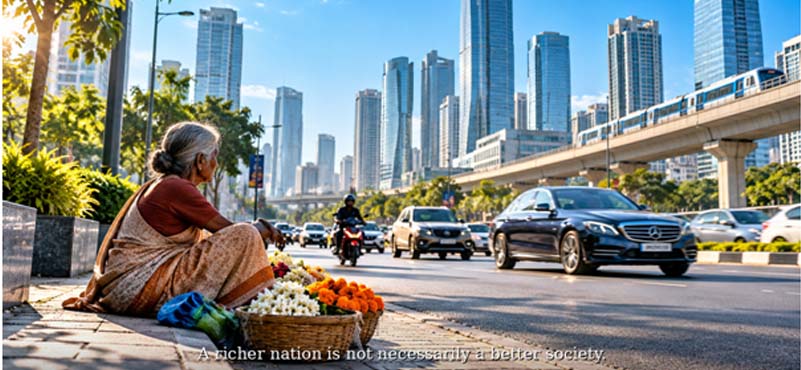
A nation can grow richer without growing kinder. Its highways may stretch across mountains, its cities may glitter beneath dazzling skylines, and its citizens may enjoy unprecedented access to technology, yet something essential may remain impoverished. Consider an elderly person struggling to cross a busy road while hurried commuters look away. Within that fleeting moment lies a question no economic survey can adequately answer: what is the real worth of a society that possesses the means to prosper but forgets the meaning of caring? Perhaps the time has come to examine not merely our gross domestic product, but our moral domestic product.
Gross Domestic Product has earned its place as a measure of economic activity. Rising incomes, better infrastructure, productive industries and expanding opportunities can transform lives, lift families out of poverty and strengthen national security. Material progress matters because hunger cannot be answered with philosophy, unemployment cannot be cured by sermons, and a struggling family needs opportunity as much as encouragement. Yet a measure designed to capture economic production was never meant to tell us whether we are becoming better human beings.
The difficulty begins when a useful economic indicator becomes our dominant definition of success. We celebrate the size of our economy, the number of billionaires we produce, the height of our buildings and the speed of our digital transactions. Meanwhile, corruption quietly taxes the honest, cruelty humiliates the vulnerable, dishonesty corrodes trust and indifference allows suffering to become somebody else’s problem. Prosperity can become an impressive exterior concealing an increasingly fragile moral foundation.
Moral GDP offers a different lens through which to examine progress. It is a way of asking whether the character of our collective life is improving alongside our material circumstances. Are we becoming more truthful in our dealings, more responsible in exercising power, more considerate towards strangers and more courageous when confronted with wrongdoing? Do we respect public property as carefully as our own possessions, treat workers with dignity regardless of their status, and extend opportunity without prejudice? These everyday choices may escape official accounts, but their consequences shape the quality of a nation.
The foundations of moral wealth are often laid in ordinary moments when nobody is watching. A shopkeeper returning money mistakenly paid in excess, a motorist stopping to help an injured stranger, an official refusing an improper favour, or a citizen disposing of waste responsibly may never make the news. Yet each act strengthens the habits on which a trustworthy society depends. When we offer a bribe to avoid inconvenience, misuse a public resource because enforcement appears unlikely, or remain silent when another person is humiliated, we help normalise the very conduct we condemn in others. Character is not built by declarations; it emerges from repeated decisions.
India possesses a rich philosophical inheritance that places ethical conduct at the centre of meaningful living. Dharma reminds us that responsibility accompanies privilege, seva elevates service beyond self-interest, and the ideal of Vasudhaiva Kutumbakam invites us to recognise humanity as an interconnected family. Their relevance lies in their practical application: how we treat those who cannot benefit us, how fairly we exercise authority, and whether our ambitions leave room for the dignity of others. Civilisational greatness is not secured by celebrating the wisdom of our ancestors alone; it must be renewed through the choices of each generation.
Moral responsibility cannot be placed entirely upon individuals while institutions escape scrutiny. Families must nurture empathy, schools must cultivate integrity alongside achievement, and public institutions must reward honest conduct rather than merely punish misconduct after damage has occurred. When authority is exercised transparently, promises are honoured and mistakes are acknowledged, public trust grows. When hypocrisy is rewarded and accountability becomes selective, cynicism spreads from the corridors of power into everyday life. A country’s moral climate is shaped not only by the goodness of its citizens but also by the incentives, examples and safeguards governing their collective conduct.
The same principle applies to technology and modernisation. Digital payments may reduce friction, artificial intelligence may improve efficiency, and sophisticated infrastructure may connect remote communities to new opportunities. Technology can expose corruption or automate discrimination; social media can unite people in compassion or mobilise them into cruelty. Progress depends not simply on what our tools can accomplish, but on the values directing their use. A technologically advanced society without ethical restraint may become more efficient at doing harm, while a morally grounded society can employ innovation to widen access, protect dignity and improve human welfare. The future will demand intelligence, but it will also demand conscience.
None of this requires us to choose between economic ambition and moral aspiration. Trustworthiness lowers the hidden costs of business, fairness broadens participation, responsible governance strengthens institutions, and social cohesion helps societies withstand adversity. Moral strength can reinforce economic resilience, just as economic security can create greater space for generosity and public service. The challenge is to ensure that development serves human flourishing rather than allowing human beings to become instruments of development. Growth should expand not only what people can afford, but also what they can contribute to one another.
Perhaps the most revealing annual national assessment would ask questions that statistics alone cannot settle. Did fewer people suffer indignity? Did public money reach its intended beneficiaries? Did institutions become more accountable, communities more inclusive and citizens more willing to help without expecting recognition? Moral GDP must ultimately resist becoming another slogan or bureaucratic scorecard. Its true value lies in making us examine our conduct honestly, beginning with ourselves rather than waiting for society to change first.
A nation’s ultimate wealth is reflected not only in the prosperity of its citizens, but also in the humanity they extend to one another. We must continue building stronger economies, smarter cities and a more capable India, but never forget the purpose behind these achievements. The real test of national growth is not merely whether we are becoming wealthier, but whether we are becoming more worthy of our wealth.
ABOUT THE AUTHOR

Lt Gen Rajeev Chaudhry (Retd) is a social observer and writes on contemporary national and international issues, strategic implications of infrastructure development towards national power, geo-moral dimension of international relations and leadership nuances in changing social construct.