
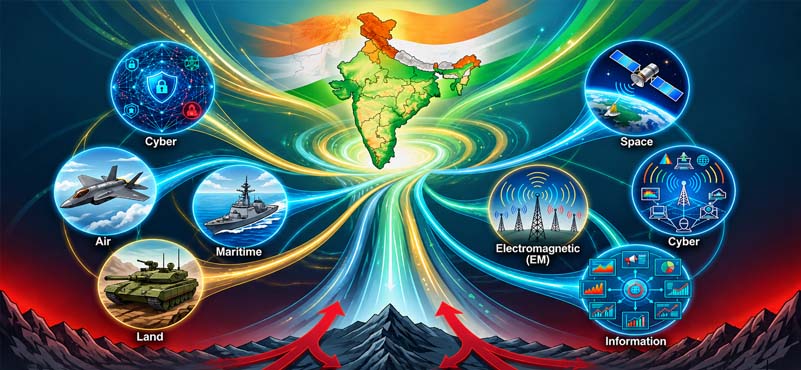
India’s strategic challenge is no longer defined only by geography. The next conflict will be contested simultaneously across land, air, maritime, cyber, electromagnetic, space and information domains.
For decades, India’s military planning has been shaped by the possibility of a two-front contingency: Pakistan in the west and China in the north and east. That formulation remains relevant, but it is no longer sufficient. The battlefield has evolved faster than the vocabulary used to describe it. A conflict that begins on one frontier can now rapidly spread across several domains, with effects felt thousands of kilometres from the point of physical confrontation.
The question India therefore needs to ask is no longer simply how it would fight on two fronts simultaneously. It is how it would fight across multiple domains on either front while preventing an adversary from exploiting vulnerabilities beyond the traditional battlefield. The two-front problem has become a multi-domain problem, and that requires a corresponding transformation in doctrine, force structure, technology and command.
The distinction is important. Geography still matters enormously. The Himalayas, the Line of Actual Control, the western border, the Indian Ocean and the approaches to the subcontinent remain physical theatres of military competition. But geography no longer contains conflict. A confrontation along the LAC can be accompanied by cyber operations against military networks, electronic interference with communications and navigation, attacks on satellites or their supporting infrastructure, information operations to shape public perception, and maritime manoeuvres to exert pressure far from the immediate land battlefield.
India’s recent experience has already underscored this shift. The Ministry of Defence has described Operation Sindoor as involving land, maritime and air operations, alongside cyber, space and information warfare. The Integrated Defence Staff has placed greater emphasis on multi-domain operations and on enhanced attention to cyber and space capabilities. The significance lies not merely in the number of domains involved, but in their interaction. The future battlefield will increasingly be defined by the ability to create effects in one domain that alter the balance in another.
The northern challenge illustrates the point. India and China have continued to maintain military and diplomatic mechanisms along the LAC. In September, senior military commanders from both sides met at Wacha in Arunachal Pradesh and at Damai on the Chinese side, following discussions through established diplomatic and military channels. The Indian government described these as the first meetings at that level under the new arrangements. Dialogue matters, but military preparedness cannot be separated from the wider strategic competition.
The Himalayan battlefield itself is changing. Roads, bridges, surveillance systems, unmanned platforms, long-range fires, air defence, satellites and communications increasingly shape a force’s ability to operate in difficult terrain. The side that sees farther, communicates more reliably, moves faster and sustains its forces better can gain a disproportionate advantage even without occupying large areas. The contest therefore begins well before troops come into contact.
The western front presents a different geography but an increasingly similar technological challenge. Pakistan’s military modernisation, growing use of unmanned systems, and continued development of precision and networked capabilities mean that India’s western military posture cannot remain centred exclusively on conventional land formations. The experience of recent conflict has underscored the growing importance of drones, counter-drone systems, electronic warfare, air defence, precision strike, and intelligence fusion. The traditional distinction between the battlefield and the supporting information architecture is rapidly disappearing.
The maritime domain adds another dimension. India’s geography gives the Indian Ocean strategic importance that cannot be reduced to naval operations alone. Sea lanes, ports, undersea cables, satellites, logistics networks and maritime surveillance systems form part of the wider national-security architecture. A crisis on the northern or western land front could therefore put pressure on the maritime domain, whether through naval deployments, disruption of commercial flows, information operations, or attempts to stretch India’s military resources across geographically separated theatres.
This is why India’s answer cannot be simply more troops or platforms. It must be greater integration.
A tank formation without access to real-time intelligence is increasingly vulnerable. A fighter aircraft without a resilient sensor and communications network cannot realise its full potential. A warship without persistent maritime awareness operates with an incomplete picture. A satellite without protected communications and redundancy is a potential single point of failure. A cyber capability disconnected from operational commands cannot realise its full military effect.
The requirement is therefore for a force that can operate as a system rather than as a collection of services and platforms. The central concept should be decision dominance: the ability to build a more accurate picture of the battlespace, make decisions faster, and impose dilemmas on the adversary before its own decision cycle matures.
This requires a different approach to command and control. India’s future theatre architecture must integrate information from land, air, maritime, space, cyber and electromagnetic domains into a common operational picture. The objective should not be a giant, centralised headquarters attempting to control every battlefield activity. It should be a resilient network in which commanders at different levels can access mission-relevant information and continue to operate even when communications are degraded.
The electromagnetic spectrum deserves particular attention. It is increasingly the invisible terrain where modern forces compete. Radar, satellite communications, data links, navigation systems, drones and precision weapons all depend, to varying degrees, on access to the spectrum. An adversary that can disrupt, deceive or deny access to those systems can impose effects without firing a conventional weapon. Spectrum dominance must therefore become a core component of military planning rather than a specialist function left to a narrow segment of the force.
Space has similarly shifted from an enabling domain to an operational one. Intelligence, surveillance, navigation, communications, weather information and targeting increasingly rely on space-based assets. India therefore needs resilient satellite architectures, redundancy, protected communications and the ability to operate when space support is degraded. The objective should not simply be to place more assets in orbit, but to ensure that military operations can continue when an adversary attempts to disrupt access to these assets.
Cyber and information operations pose an equally difficult challenge because they can begin before conventional hostilities. Adversaries can target military networks, logistics systems, financial infrastructure, communications, and public information environments. Consequently, the dividing line between military and national resilience is increasingly thin. Cyber defence can no longer be regarded as merely a technical responsibility. It is an element of operational readiness and national power.
The implications for force development are substantial. India cannot build a genuinely multi-domain force by merely adding a cyber command, acquiring more satellites, or procuring additional drones. Each capability must be designed to contribute to a broader operational architecture. New platforms should be interoperable by design. Sensors should feed into common networks. Data should be shareable across services. Artificial intelligence should support information fusion. Electronic warfare should be integrated into manoeuvre. Space and cyber capabilities should be available to operational commanders. Training must increasingly replicate the degraded, contested, and information-saturated environment in which future forces will operate.
This also demands a change in professional military education. Officers must understand not only their own service’s capabilities but also the effects they can achieve across domains. A land commander should understand how space degradation could affect his formation. An air commander should understand the electromagnetic environment in which his aircraft operates. A naval commander must consider cyber and information vulnerabilities alongside traditional maritime threats. The future joint commander will need to think in terms of effects rather than platforms.
There is also a strategic requirement to retain freedom of action. India’s growing emphasis on indigenous defence production is therefore relevant not only for economic reasons but also because dependence on critical technologies can pose a military vulnerability. The government has reported record defence production and a continuing push towards domestic design, development and manufacturing. The priority should now extend beyond platforms to the underlying technologies that connect them: semiconductors, secure communications, sensors, electronic warfare, artificial intelligence, space systems, cyber resilience and advanced computing.
The two-front challenge will not disappear. India must keep preparing for the possibility of simultaneous pressure from multiple directions. But the nature of that pressure has changed. The next conflict may begin on a border and quickly escalate into a contest for the electromagnetic spectrum, satellite access, information space, communications networks and maritime freedom of action.
The strategic objective must therefore shift from two-front preparedness to multi-domain resilience. India needs forces that can fight across domains, commanders who can think across domains, and a national-security architecture that can absorb disruption without losing decision advantage. The two-front war was once a matter of geography. The next war will be a contest of systems.
ABOUT THE AUTHOR
 Lieutenant General A B Shivane, is the former Strike Corps Commander and Director General of Mechanised Forces. As a scholar warrior, he has authored over 200 publications on national security and matters defence, besides four books and is an internationally renowned keynote speaker. The General was a Consultant to the Ministry of Defence (Ordnance Factory Board) post-superannuation. He was the Distinguished Fellow and held COAS Chair of Excellence at the Centre for Land Warfare Studies 2021 2022. He is also the Senior Advisor Board Member to several organisations and Think Tanks.