
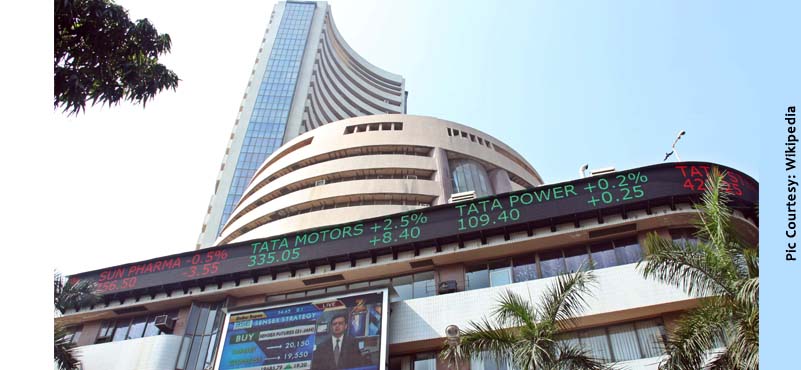
The sharp decline in Indian equities on October 8, 2026, erased approximately ₹10 lakh crore from the market capitalisation of BSE-listed companies. Such headlines understandably provoke anxiety, but require interpretation: they describe the repricing of outstanding shares, not an equivalent amount of cash disappearing from investors’ accounts. The Nifty fell 1.64%, illustrating how a modest percentage movement across a large market produces a spectacular rupee figure.
Gains and losses are intrinsic to equity ownership. Yet often rising prices are treated as evidence of economic strength (sometimes ignoring irrational exuberance, froth) and falling prices as a failure requiring official intervention. Calling a downturn a “correction” can be misleading: the expression suggests that prices are returning to some objectively correct level, although valuations depend on uncertain earnings, interest rates and expectations.
The asymmetry becomes sharper when speculative success is celebrated as individual brilliance, while subsequent losses prompt demands for collective protection. This is the temptation to “privatise profits, socialise losses”. However, not every appeal for regulatory action is justified. Protection against fraud, manipulation and misleading advice is fundamentally different from protection against an honestly disclosed investment risk.
India’s derivatives experience makes this distinction urgent. SEBI’s August 2026 study found that 87.7% of individual equity-derivatives traders incurred losses in FY2025–26; aggregate net losses reached ₹91,685 crore. These findings concern derivatives trading, not all equity investors, and should not be used to discredit long-term share ownership. They nevertheless challenge the romantic presentation of frequent trading as an accessible route to prosperity.
Responsibility must therefore transcend the inexperienced investor. SEBI recorded approximately ₹25,000 crore in annual transaction costs borne by individual derivatives traders. This raises a question: do intermediaries’ commercial incentives encourage trading activity even when customers’ outcomes remain persistently poor? Financial inclusion should not be measured simply by accounts opened or contracts traded.
The 2008 crisis exposed a more consequential version of this problem. Expectations that large institutions would be rescued weakened creditor scrutiny and encouraged excessive risk-taking—“moral hazard”. Yet allowing an interconnected institution to collapse can damage payments, credit and employment. The proper distinction is between preserving essential financial functions and shielding shareholders or managers from consequences.
I examined aspects of these tensions in my widely acclaimed two-volume book, Global Financial Meltdown, published by Atlantic Publishers in 2011. The enduring policy question is not whether markets should fall, but who bears the consequences when risks materialise.
Regulators should enforce disclosure, punish misconduct and contain systemic danger—not guarantee rising indices. Investors must accept uncertainty; intermediaries must answer for mis-selling; and rescue arrangements must preserve accountability. A credible market requires neither permanent optimism nor official price support, but rules that distribute responsibility fairly.
ABOUT THE AUTHOR
 Dr. Manoranjan Sharma has been the Chief Economist for 25 years with Canara Bank and Infomerics Ratings.
Globally recognised as an expert in global economy, Indian economy, banking, finance, MSMEs, sustainable development and financial inclusion, he has chaired sessions at national and international conferences and is recognised as one of the 30 global experts by the UN Virtual University (UNVU) for SDGs.
He has been on over a dozen Advisory Councils in seven states, viz. Member, Rajasthan Governor’s Advisory Council; Governor’s Senate Nominee on Rajasthan University; Governor’s Senate Nominee on SNDT University, Mumbai; and Expert on selection panels for IIMs, Vijay Patil School of Management, SAIL, IDBI Bank, Canara Bank, Bank of India, Union Bank of India.
He has been published widely and quoted extensively in major Indian and international media and publications.