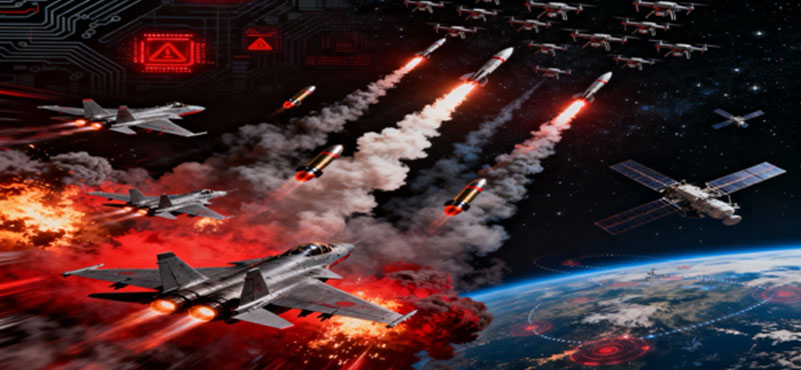
The next war may begin with a satellite going silent
On 14 September 2026, as I just stepped into the World Space Business Week at Paris, France , the U.S. Air Force Secretary Troy Meink publicly stated that the U.S. Space Force has “on-orbit space control weapons” capable of defending the Joint Force against hostile action. A day later, Space Force Chief Gen Douglas Schiess reinforced the disclosure. Neither official publicly identified the weapons or their technical characteristics. What has changed, therefore, is not that America suddenly acquired space weapons, but that Washington has now acknowledged that weapons capable of conducting space-control missions are already on orbit.
 On 15 September, while at a discussion at the Space Defence and Security Summit, Paris, I met Richard L. Palmer, Director, Capability & Resource Integration Directorate of US Space command. He admitted that US has weapons in Space and would deter any country that undermines US Space and National security.
For most of the Space Age, governments maintained a useful expression: satellites could be military, but space itself was not a battlefield. That distinction is now disappearing. This admission deserves attention far beyond Washington. It confirms what strategists have increasingly understood: space is becoming an operational warfighting domain rather than merely a supporting domain for war on Earth. The implications for India are profound.
The invisible battlefield above us
Modern armed forces depend on satellites for almost everything: communications, navigation, missile warning, intelligence, surveillance, reconnaissance, weather information, targeting, timing and precision weapons. Destroy or disrupt these capabilities and an adversary can lose military effectiveness without a conventional attack on its territory.
This creates a new form of warfare. A space attack may involve a missile destroying a satellite. But it may also involve a cyberattack on a satellite’s command system, jamming of a communications link, spoofing of navigation signals, dazzling of an optical sensor with a laser, or an approaching spacecraft interfering with another satellite. The most dangerous weapons may therefore be those that do not explode.
The five faces of counterspace warfare
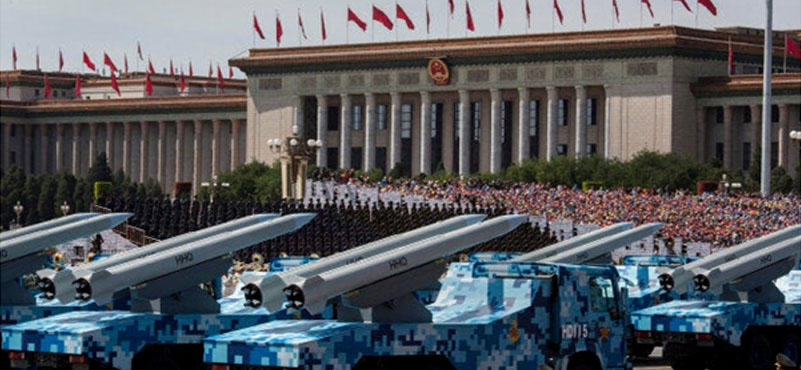
- Kinetic attack. Anti-satellite missiles can physically destroy satellites. China demonstrated this dramatically in 2007 by destroying the Fengyun-1C weather satellite. India demonstrated a direct-ascent ASAT capability through Mission Shakti in 2019. The Indian government described the test as successfully neutralising an Indian satellite in low Earth orbit. The disadvantage is debris that means that a destroyed satellite can produce thousands of fragments travelling at enormous velocity, potentially threatening spacecraft belonging to the attacker, the target and completely uninvolved countries.
- Electronic warfare. Jamming can prevent a receiver from hearing a legitimate signal. Spoofing can feed it a false signal. Navigation warfare is particularly significant. If positioning, navigation and timing become unreliable, aircraft, ships, missiles, drones, logistics networks and even financial systems can be affected.
- Cyber warfare. Satellites are computers in orbit. Their ground stations, software, command links and data-processing networks are therefore potential cyber targets. A cyberattack can potentially create effects without physically damaging a satellite.
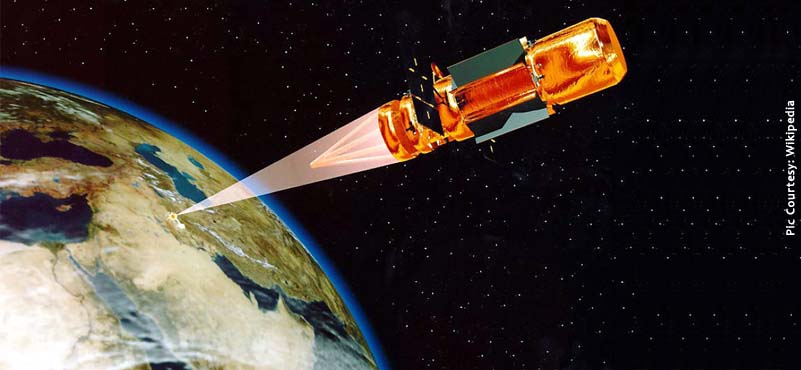
- Directed energy. Lasers and other directed-energy systems can interfere with or damage sensors. They offer the attraction of reversible effects in some circumstances and potentially permanent effects in others.
- Orbital warfare. Perhaps the most intriguing category involves spacecraft manoeuvring close to other spacecraft. A satellite that can approach, inspect, shadow or manipulate another satellite may have peaceful applications. The same technologies can potentially be used for counterspace missions. China, for example, has demonstrated rendezvous and proximity operations. Its Shijian-21 satellite demonstrated the ability to move a defunct satellite into a higher disposal orbit. Such technology has legitimate debris-management applications but also illustrates the dual-use nature of modern orbital systems. U.S. assessments describe China’s broader counterspace programme as including kinetic and non-kinetic systems and on-orbit capabilities.
This is what makes space warfare fundamentally different from conventional warfare: the same technology can be a tool of cooperation or a weapon.
America, China and Russia: the strategic triangle
The United States remains the world’s most extensive military space power, with a large constellation of communications, missile-warning, navigation, intelligence and surveillance satellites and a dedicated Space Force. Its latest disclosure suggests that Washington is moving from merely protecting space assets towards explicitly preparing to control the space domain. But the U.S. does not see itself operating in isolation.
China has rapidly expanded its military and dual-use space architecture. According to the U.S. Department of Defence, the People’s Liberation Army is developing kinetic and non-kinetic counterspace capabilities including ASAT missiles, electronic warfare, lasers and orbital systems. China also regards space superiority and the ability to deny an adversary’s space-enabled information systems as important to modern warfare.
Russia represents another major counterspace actor. U.S. Space Force assessments identify Russian kinetic and non-kinetic counterspace capabilities and note Russian activity affecting communications, navigation and command-and-control systems. Thus, the emerging contest is not simply an arms race in satellites. It is an arms race in space control.
Where does Pakistan fit?
Pakistan does not possess space capabilities comparable to the United States, China, Russia or India. Its space programme is centred principally on communications, remote sensing and related applications. But its strategic significance for India is greater than the size of its space programme might suggest. SUPARCO itself describes space as a strategic sector connected with national security.
Pakistan has increasingly developed remote-sensing capabilities through cooperation with China. Its PRSS-1 provides high-resolution Earth observation, while more recent satellites include electro-optical, hyperspectral and synthetic-aperture radar systems. Pakistan’s first SAR satellite, PRSC-S1/K-S1, was launched from China in July 2025.
For India, therefore, the issue is not whether Pakistan possesses an independent space-warfighting architecture equivalent to India’s. It is whether Pakistan can obtain space-enabled military effects through China, commercial providers and shared information architectures. That distinction will become increasingly important.
The great vulnerability: satellites are fragile
The traditional military instinct is to protect valuable assets by hardening them. Space requires a different philosophy. A satellite cannot easily hide. Its orbit is predictable. Its radio emissions can potentially be detected. Its communications links can be attacked. And a spacecraft destroyed in orbit cannot simply be replaced overnight.
The answer is therefore resilience. A military satellite architecture should increasingly resemble a distributed network rather than a handful of exquisite spacecraft. If one satellite is lost, another must immediately take over. If one communications link is jammed, another should be available. If GPS/GNSS becomes unavailable, alternative navigation and timing systems should exist.
This is why mega-constellations and proliferated low-Earth-orbit architectures are strategically important. They change the economics of attack. An adversary may be able to destroy one satellite. Destroying hundreds or thousands is another proposition.
The law: militarisation is not the same as weaponisation
Here lies one of the most misunderstood aspects of space security. The 1967 Outer Space Treaty does not prohibit every military activity in space. It prohibits placing nuclear weapons or other weapons of mass destruction in orbit and establishes restrictions concerning military activities on the Moon and other celestial bodies.
It does not constitute a comprehensive prohibition on conventional counterspace weapons. Consequently, the world has entered a grey legal zone. Military satellites , Intelligence satellites and Navigation satellites are all legal.
But what happens when a satellite designed to inspect another spacecraft can also disable it? What happens when a communications satellite has electronic-warfare capabilities? What happens when a spacecraft can manoeuvre around another country’s satellite?
Technology has moved faster than international law. The United Nations’ Long-Term Sustainability Guidelines, adopted by COPUOS in 2019, provide important principles for safe and sustainable space operations, including information sharing, conjunction assessment and responsible orbital behaviour. But they do not eliminate the strategic competition.
The challenge for diplomacy is therefore to establish stronger norms governing proximity operations, debris-generating attacks, cyber operations, jamming, notification and responsible behaviour.
What should India’s space doctrine be?
India has already crossed an important threshold. Mission Shakti demonstrated an indigenous direct-ascent ASAT capability in 2019. The next step should not simply be to accumulate weapons. India needs a coherent and comprehensive Space Security and Defence Doctrine.
The Indian Space Policy 2023 provides the overarching national framework for space activities and explicitly encourages development of space situational awareness capabilities, advanced R&D and private-sector participation. Five pillars should underpin India’s approach :-
- Observe first. India requires comprehensive Space Domain Awareness extending from low Earth orbit to geostationary and beyond. We cannot protect what we cannot see. India’s ISRO System for Safe and Sustainable Operations Management already monitors the space environment and conjunction risks. This capability should become a national-security priority.
- Build resilience, not just exquisite satellites. India should develop distributed communications, EO, SAR, SIGINT and navigation architectures. The objective should be simple: No single satellite attack should be capable of silencing or blinding Indian constellations.
- Develop a full spectrum of counterspace capabilities. India needs the ability to deter and, where legally justified, respond to hostile action across the spectrum—cyber, electronic, directed-energy and orbital domains. But kinetic destruction should not become the default option as debris does not recognise national boundaries.
- Integrate space with the other domains. The future battlefield is not divided into Army, Navy, Air Force, Cyber and Space compartments. It is a single network. A naval task force may require satellite imagery. An air campaign may require space-based targeting. A missile defence system requires space-based warning. A drone swarm requires navigation and communications. A cyber operation may depend upon satellite connectivity. Space therefore becomes the connective tissue of multi-domain warfare.
- Create a national space-security ecosystem. India needs close integration among the armed forces, ISRO, the Defence Space Agency, DRDO, intelligence agencies, academia and India’s rapidly expanding private space industry. The Indian Space Policy 2023 has already opened the sector to non-government entities across satellite, launch, communications, remote sensing and space-situational-awareness activities. This is strategically important. The future space force will not be built entirely inside government laboratories. It will emerge from the interaction of government, military, industry, start-ups, universities and international partners.
The future: from space support to space combat
The wars of the twenty-first century are revealing a new pattern. Ukraine has demonstrated the battlefield value of commercial satellite communications and Earth observation. The conflicts of the Middle East have demonstrated the importance of precision weapons, missile warning, drones and electronic warfare. The next stage is the integration of all these capabilities. Imagine a future conflict in which, within minutes, an adversary: –
- Jams satellite communications;
- Interferes with navigation;
- Attacks a ground station through cyberspace;
- Blinds an Earth-observation sensor;
- Manoeuvres a spacecraft towards a critical satellite;
- and simultaneously launches conventional attacks on land and sea.
There may be no spectacular explosion in space. Yet the consequences on Earth could be enormous. That is why the American acknowledgement of on-orbit space-control weapons matters.
It is a recognition that the strategic contest has moved beyond using space to conducting operations to control access to space-enabled effects. The U.S. Space Force itself now describes space as a contested operational domain, while U.S. Space Command has emphasised that effective counterspace operations require the ability to find, fix, track and target threats.
The paradox
As the author of the book Taramandal Sangram — Space Constellations at War, my central argument is not that humanity should fight a war in space as though it were inevitable. It is that we must understand the possibility of a space war and prepare to prevent it.
Space is unique – it is dual use and shall remain ubiquitous. A battlefield on earth can be abandoned, whereas the orbital assets cannot be hidden or temporarily put out of orbit. An orbital environment contaminated through an attack shall generate debris that may remain dangerous for generations, and to all space assets irrespective of their nationality. A missile that destroys an enemy satellite may also endanger an Indian satellite.
A cyberattack intended for a military spacecraft may spill into civilian infrastructure. And a conflict between two powers may impose costs on every nation that depends on space. The strategic objective should therefore be neither naive pacifism nor an uncontrolled arms race. It should be deterrence through resilience, technological preparedness, responsible behaviour and international rules.
India should prepare for the possibility of a space war while working to ensure that one does not occur. For the ordinary citizen, the lesson is surprisingly simple. The next war may not begin with soldiers crossing a border. It may begin when the satellite above us stops answering. And when that happens, the battle in the heavens would already have begun.
ABOUT THE AUTHOR
 Lt Gen P. J. S. Pannu, PVSM, AVSM, VSM, Ph.D. (Retd), is former Deputy Chief IDS who initiated the raising of Defence Space Agency. He is an author of a book titled Taramandal Sangram — Space Constellations at War. He is a founder of Space Club of India, is a senior advisor to SIA ( India) and is the Chief mentor and Dean of Department of Space Studies at MERI. He holds a Chair of excellence and is a distinguished fellow of CLAWS.