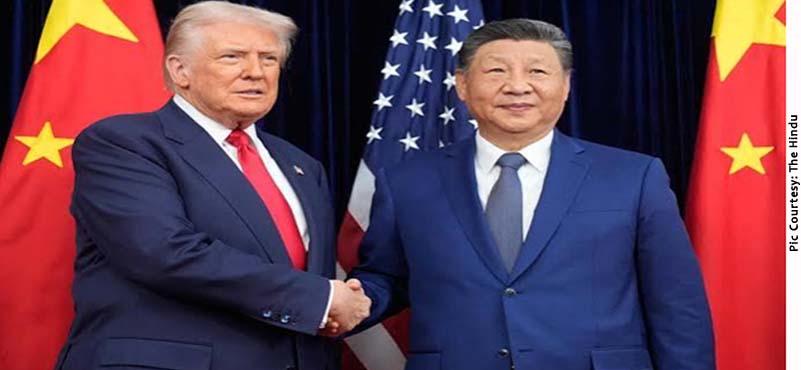
Xi Jinping landed in Washington on September 23 for a state visit that closes an extraordinary loop. Eleven months ago, in Busan, he and Donald Trump held their first face-to-face meeting during Trump’s second term. Five months later, Trump flew to Beijing and received the red-carpet treatment at the Great Hall of the People. Now Xi returns the visit, marking the third in-person meeting between the two leaders in under a year, with rare earths, AI, trade, tariffs and Taiwan all on the table.
It’s tempting to read this rhythm of summits as two men running different playbooks. Trump’s is loud and improvisational: tariffs first, threats next, deals struck quickly and often renegotiated. Xi’s is quieter and built for the long game, an approach better understood as patience and positioning than as any formal Chinese doctrine.
Still, the lens fits the behaviour. Where Trump manages the relationship through disruption, Xi manages it through positioning. You can see this in how the Busan truce was actually built: Beijing offered targeted concessions, resuming agricultural purchases and easing some export controls, in exchange for a pause in the tariff spiral, buying itself time rather than settling anything permanently. That’s a pattern, not a one-off. China keeps trading short-term, reversible gestures for a longer runway to build leverage at home.
The difference is more than style. For Beijing, time itself is a strategic resource. A temporary concession can ease immediate pressure while giving China room to strengthen its domestic capacity and prepare for the next round. It does not have to win every encounter. It has to keep improving its position over time.
On trade, Beijing isn’t trying to out-tariff Washington dollar for dollar. It’s trying to make the dollar-centred system matter less over time, through RCEP, deeper BRICS coordination, and gradual efforts to internationalise the yuan. Yet, the yuan’s share of global reserves and trade settlement remains small compared with the dollar’s, so “bypassing” the dollar system is more an ambition than a current reality. The diversification effort is real; how far it actually goes is genuinely uncertain.
Technology is where the self-reliance push is most concrete. US export bans on advanced chips pushed Beijing to pour subsidies into domestic chipmaking, AI, and quantum computing, aiming to insulate Chinese industry from future blockades while exporting its own tech stack to the Global South. Whether this closes the gap with US and allied chipmakers anytime soon is uncertain and should be checked against current industry data rather than taken at face value.
The difference is more than style. For Beijing, time itself is a strategic resource. A temporary concession can ease immediate pressure while giving China room to strengthen its domestic capacity and prepare for the next round. It does not have to win every encounter. It has to keep improving its position over time.
In the Indo-Pacific, China views the Quad and AUKUS as containment by another name and responds with what’s often called soft balancing: Belt and Road financing, trade dependence, and diplomacy aimed at making full alignment with Washington costly for Southeast Asian states. It’s slower and cheaper than naval confrontation and harder to counter because it rarely produces a single dramatic moment to react to.
Taiwan remains the one place where patience has a visible ceiling. Xi has repeatedly signalled that Taiwan is the most important issue in the relationship, and Chinese messaging continues to frame it as the line beyond which “stability” ends and “conflict” begins. The underlying message that Beijing sees Taiwan as non-negotiable is well established. The pattern of grey-zone pressure and near-daily military activity near the island fits a strategy of erosion rather than immediate confrontation, though whether that’s deliberate patience or simply the fact that neither side wants a war right now is a matter of interpretation.
New Delhi has watched the Trump-Xi sequence with real anxiety, and that anxiety is well-founded, even if the worst fears haven’t fully materialised. India’s post-2000 strategic value to Washington rested heavily on sustained US-China friction; every stabilisation between the two capitals raises the question of whether India becomes less central to American Indo-Pacific planning. That fear sharpened after Trump’s May 2026 Beijing trip and again when he publicly said India and Russia had been “lost” to China, a remark he partly walked back the same day. Meanwhile, US tariffs tied to India’s Russian oil purchases have strained the bilateral trade relationship at exactly the moment Washington and Beijing have been finding points of accommodation.
The counter-evidence matters too. The May summit produced little evidence of a G2 arrangement that would sideline India. By most accounts, it was heavy on stabilisation language and light on concrete deliverables. A full-blown US-China rupture would force India into uncomfortable choices, while a full-blown G2 would marginalise it. What’s emerging looks more like managed competition with occasional summitry, an environment India can navigate by hedging carefully, where its interests converge, and not overreading every Trump-Xi handshake as a setback.
The honest takeaway is that nobody, including Washington and Beijing, has settled what this relationship will become. Xi’s patience and Trump’s deal-making aren’t fixed doctrines so much as competing instincts within a relationship that keeps needing summits precisely because nothing gets permanently resolved. For India, the wiser posture is to prepare for both stabilisation and rupture, while ensuring that its own strategic choices are never dictated by either.
ABOUT THE AUTHOR
 Lieutenant General A B Shivane, is the former Strike Corps Commander and Director General of Mechanised Forces. As a scholar warrior, he has authored over 200 publications on national security and matters defence, besides four books and is an internationally renowned keynote speaker. The General was a Consultant to the Ministry of Defence (Ordnance Factory Board) post-superannuation. He was the Distinguished Fellow and held COAS Chair of Excellence at the Centre for Land Warfare Studies 2021 2022. He is also the Senior Advisor Board Member to several organisations and Think Tanks.