
The Irony of Peace Day
Every year, 21 September asks humanity to pause and think about peace. This year, the question feels particularly uncomfortable. The United Nations marks the International Day of Peace under the theme “Invest in Peace: For Everyone, Everywhere, Every Day”, reminding the world that peace is more than the absence of war; it is the lived experience of safety, dignity, opportunity and cooperation. Yet conflicts continue to consume lives, strategic rivalries deepen, military expenditures rise and the language of international engagement is increasingly shaped by suspicion, sanctions, coercion and fear.
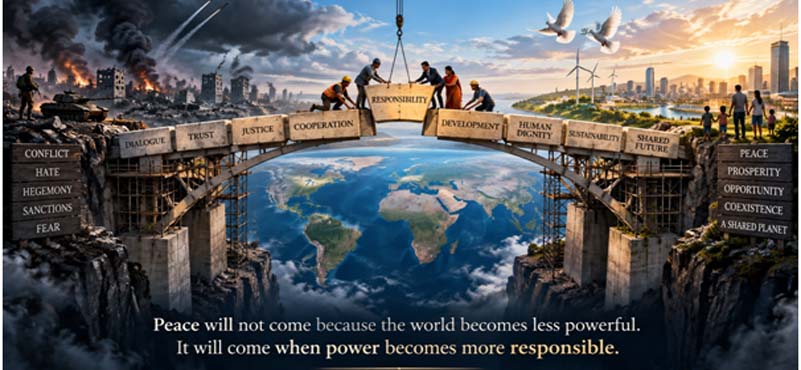
The answer cannot simply be another declaration, summit or ceasefire appeal. Peace fails repeatedly because the international system is still better equipped to respond to conflict after violence begins than to prevent the conditions that produce it. The world therefore needs to move beyond celebrating peace as an aspiration and begin designing it as an architecture. The world does not need another declaration of peace; it needs institutions, incentives and norms that make peace harder to break.
Why the Present Order Struggles
The contemporary security environment operates through a dangerous cycle. Mistrust produces military build-ups; military build-ups generate insecurity; insecurity encourages alliances and counter-alliances; these deepen strategic competition, which then spills into economic coercion, technology restrictions, information warfare and diplomatic confrontation. Even legitimate national-security concerns can therefore become components of a larger spiral.
The difficulty is compounded when international rules appear to be applied selectively. If sovereignty is defended in one circumstance and qualified in another, or sanctions are presented as principled in one crisis and political in another, faith in the system inevitably weakens. The objective, however, should not be to eliminate national interest, strategic competition or military capability. Those are enduring realities of international relations. The challenge is to ensure that competition does not become permanent confrontation, deterrence does not become perpetual insecurity, and national interest does not become an excuse for collective punishment.
Rebuild the United Nations for the World of Today
The United Nations remains the indispensable global platform, but its institutional architecture reflects the geopolitical circumstances of 1945 far more than the realities of 2026. Reform of the Security Council has been under intergovernmental negotiation for years, with representation, membership, regional balance, working methods and the veto among the central issues.
The Council therefore needs greater representation and legitimacy, particularly for regions whose political and economic weight has changed substantially since its creation. Expansion alone, however, will not be sufficient. Vetoes should carry greater transparency and responsibility, including mandatory explanations and stronger engagement with the General Assembly when the Council is unable to act. Special restraint should also be considered when a permanent member is directly involved in the conflict under discussion.
More importantly, the UN needs to become a stronger institution of prevention. A permanent international mediation and conflict-prevention mechanism, staffed by experienced diplomats, negotiators, regional specialists and peace practitioners, could intervene before disputes become military crises. The UN must become less a fire brigade arriving after the fire and more a system capable of detecting the spark.
From Conflict Management to Conflict Prevention
Peace architecture must begin before the first missile is fired. A Global Conflict Early-Warning and Response Network could integrate information on military mobilisation, border incidents, refugee flows, food and water insecurity, cyber-attacks, hate campaigns and other indicators of instability. Early warning, however, is meaningful only if it produces early action.
A graduated mechanism could therefore move from early warning to quiet diplomacy, mediation, confidence-building, emergency dialogue and monitored de-escalation. Regional organisations should form the first layer of this architecture because neighbouring states often understand the historical, cultural and political context better than distant institutions. The UN could provide legitimacy, coordination and additional diplomatic capacity.
Such a system would also redefine the meaning of preventive diplomacy. Instead of waiting until leaders are politically committed to confrontation, the international community would intervene when the cost of backing down is still manageable. The cheapest war to stop is the one that has not yet begun.
Geo-Morality: Putting Ethics Back into International Relations
Geopolitics is ultimately about power, interests, geography and strategic choice. But a world governed entirely by these calculations risks becoming technically sophisticated and morally directionless. This is where the idea of geo-morality deserves serious consideration.
Geo-morality should not mean imposing one civilisation’s values on another, nor should it become another instrument through which powerful states lecture weaker ones. It should mean something simpler and more universal: the exercise of international power must carry a minimum ethical responsibility towards human life, dignity and the possibility of reconciliation.
Before launching military action, imposing sweeping economic restrictions, supplying weapons, employing coercive diplomacy or adopting measures likely to affect civilian populations, states and international institutions should ask five questions. Does the action protect or endanger civilian life? Is it proportionate to the stated objective? Does it respect sovereignty and applicable international law? Does it leave a credible pathway towards negotiation and reconciliation? And, perhaps most importantly, will it reduce violence and hatred—or deepen them?
These questions would not eliminate disagreement. They would introduce accountability into disagreement.
Geo-morality is especially relevant to bilateral relationships. A powerful state may possess the economic or military ability to pressure another country, but capability alone cannot provide moral legitimacy. A smaller state may have fewer instruments of power, but its sovereignty and dignity cannot therefore become negotiable commodities. Equally, weaker states cannot claim moral exemption for actions that threaten their neighbours. Geo-morality must apply upward, downward and sideways; otherwise it becomes merely another vocabulary of power.
It should also influence multilateral institutions. Sanctions, peacekeeping mandates, development assistance, arms transfers and reconstruction programmes should be judged not merely by whether they advance a strategic objective, but by their consequences for ordinary people. The moral test should therefore accompany the strategic test.
This is not idealism detached from realism. It is an attempt to make realism sustainable. History repeatedly demonstrates that humiliation, exclusion, collective punishment and permanent insecurity eventually generate resentment, resistance and renewed conflict. A settlement that wins compliance but leaves hatred intact may end one war while preparing the ground for another.
Geopolitics tells us what states can do. Geo-morality asks what they should do. That distinction could become one of the foundations of a more mature international order.
Replace Collective Punishment with Accountable Restraint
Economic sanctions and other coercive instruments will remain part of international relations, particularly where serious violations require accountability. But the architecture of sanctions needs greater humanity and discipline. Measures should target responsible individuals and entities as precisely as possible rather than unnecessarily imposing suffering on entire populations. Food, medicines and essential humanitarian services must remain protected, while sanctions should face independent review, periodic reassessment, transparent criteria and clearly defined conditions for removal.
The principle should be straightforward: punish harmful conduct without punishing entire societies. Equally important, every coercive measure should contain an exit pathway. If the only available political message is “change your behaviour but expect permanent isolation”, diplomacy loses its incentive.
Fear itself must also be treated as a strategic variable. Governments have legitimate security responsibilities, but deliberate fear-mongering, dehumanising rhetoric and systematic misinformation can turn populations against one another long before armies meet. Responsible statecraft therefore requires restraint not only in weapons, but also in words.
India’s Civilisational Contribution to World Peace
India’s civilisational vocabulary offers another dimension to this debate. Vasudhaiva Kutumbakam—the world as one family—provides a powerful counterpoint to an international order based entirely on competing blocs. Sarve Bhavantu Sukhinah, the aspiration that all may be happy, places collective well-being alongside individual or national interest. Ahimsa introduces restraint as a principle of conduct, while the idea of shanti understands peace as a positive condition of harmony rather than merely the absence of violence.
These ideas should not be presented as ready-made solutions to contemporary geopolitics. Their value lies in the questions they pose. Can national interest coexist with a wider responsibility towards humanity? Can strength be exercised without humiliation? Can differences be preserved without becoming reasons for hatred?
The answer need not require uniformity. Indeed, India’s civilisational experience suggests something more practical: peace does not require everyone to think alike; it requires humanity to learn how to disagree without destroying one another. India’s contemporary engagement with the Global South has also been described by its own institutions through principles such as Vasudhaiva Kutumbakam, Bahujan hitaay, Bahujan sukhaay and Sarve Bhavantu Sukhina.
Create a Peace Dividend and a Culture of Strategic Restraint
Peace must also become materially rewarding. A Global Peace Dividend Framework could provide countries that peacefully resolve disputes with enhanced access to development finance, infrastructure partnerships, reconstruction assistance, technology cooperation and trade facilitation. The logic is simple: the international system should create tangible incentives for choosing negotiation over prolonged confrontation.
At the security level, strategic restraint should become a recognised norm. Military hotlines, advance notification of major exercises, border disengagement protocols, cyber-conflict understandings, space-security arrangements and responsible-use norms for autonomous weapons can reduce the possibility that miscalculation turns rivalry into war.
Deterrence will remain necessary in an uncertain world. But deterrence alone cannot create sustainable peace. Deterrence may prevent war; dialogue prevents deterrence from becoming miscalculation. The ultimate measure of strategic strength should therefore not be only the ability to win a war, but increasingly the ability to prevent one.
From Balance of Power to Balance of Humanity
The world cannot abolish national interests, strategic competition or geopolitical ambition. Nor should it imagine that military power can simply disappear. A durable peace must begin with the world as it actually exists, not as we would wish it to be.
But the rules governing power can change. International institutions can become more representative. Diplomacy can intervene earlier. Sanctions can become more targeted and humane. Regional organisations can become stronger peace intermediaries. Major powers can accept that strategic capability carries an equal obligation of restraint. And international engagement can acquire a geo-moral dimension in which the consequences for human beings matter alongside the calculations of states.
That is the real challenge of this International Day of Peace. The objective is not to create a world without disagreement, but a world in which disagreement does not automatically become confrontation; in which competition does not require humiliation; in which accountability does not become collective punishment; and in which strength is accompanied by responsibility.
Peace, therefore, must cease to be treated as the pause between wars. It must become the organising principle of international conduct.
Peace will not come because the world becomes less powerful. It will come when power becomes more responsible.
And perhaps that is the architecture humanity should now begin to build: not a world in which one power dominates all others, but a world in which no power needs to dominate in order to feel secure.
ABOUT THE AUTHOR

Lt Gen Rajeev Chaudhry (Retd) is a social observer and writes on contemporary national and international issues, strategic implications of infrastructure development towards national power, geo-moral dimension of international relations and leadership nuances in changing social construct.