Introduction
On 17 September the Wall Street Journal reported that Saudi Arabia had fired a Chinese-made Dongfeng 15 ballistic missile into Yemen. The launch marks the first-ever time that they have fired a ballistic missile in combat.
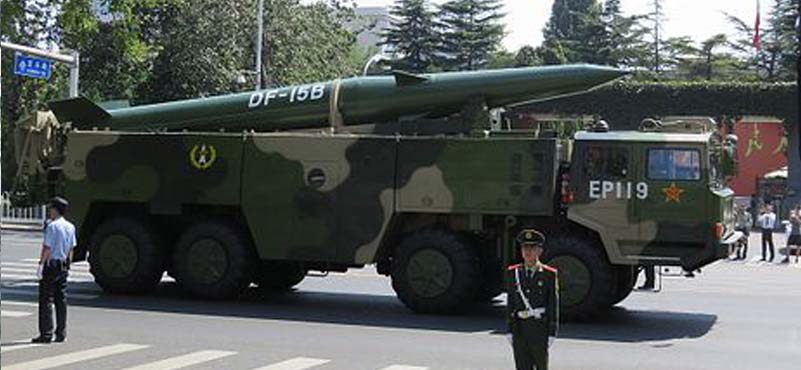
Cellphone videos from the Ragwan area of Marib Province, about 170 kilometers from Sanaa shared on social media show the fuselage and parts of a Chinese-made Dongfeng-15, including its intact “DF-15A” designation. The DF-15A warhead is designed to separate in flight, so it’s unclear how the missile failed, where it crashed, or what was the intended target. The Houthis are not known to have any weapons that could have intercepted it. It is also unclear as to how many missiles were fired, if at all, and how many reached their targets successfully.
Experts identified the weapon as a DF-15A because the shape of the fixed fins and the drive motor matched a missile shown in footage previously released by Chinese state broadcasters. Saudi Arabia has indeed been acquiring Chinese missiles, but are the DF-15 short-range ballistic missiles, part of their inventory?
Saudi’s Chinese Missile Arsenal
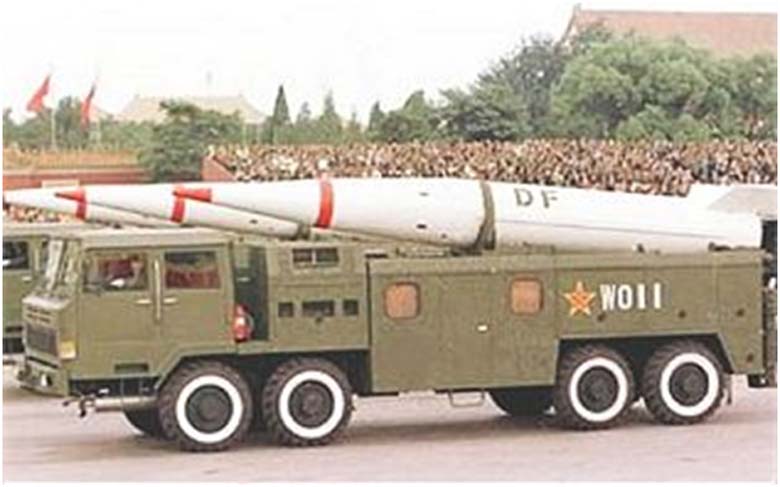
Saudi Arabia turned to China for ballistic missiles when it acquired the liquid-fueled DF-3A intermediate-range ballistic missile in 1988, establishing the foundations of what would become the Royal Saudi Strategic Missile Force. The acquisitions came in the latter stages of the Iran-Iraq War, when both sides were building up ballistic missile arsenals to hit each other’s cities. The liquid-fueled, single-stage intermediate-range ballistic missile was capable of reaching targets approximately 3,000 kilometers away, depending on payload and configuration.
This was followed by the procurement of the more accurate but shorter-range Chinese DF-21 in 2007, a considerably more capable and modern missile with solid-fuel propulsion. The DF-21 is a two-stage, solid-fueled, road-mobile medium-range ballistic missile, which can be transported and deployed using mobile launch equipment and does not require the lengthy fueling procedures associated with liquid-propellant missiles.
The system’s greater mobility and responsiveness therefore provide substantial advantages in survivability. The DF-21’s range is shorter than that of the DF-3, but its greater accuracy makes it considerably more useful as a conventional weapon. The system’s range is generally assessed at around 1,700 kilometers allowing targets throughout much of the region to be placed within reach from Saudi territory.
Saudi Arabia did not publicly display its ballistic missiles until 2014, when the DF-3 and DF-21 systems appeared in a military parade. The display highly unusual for Saudi Arabia was widely interpreted as a strategic message directed towards Iran.
The DF-15A SRBM is a solid-fuel, road-mobile, short-range ballistic missile. It is a substantially improved variant, and is assessed to have a range of approximately 600 kilometers. The missile can carry a conventional payload of 500–750 kilograms, providing greater destructive potential than most conventional rockets used by regional armed groups.
Unlike Iran, which has long prioritised its ballistic missile arsenal over other capabilities, Saudi Arabia has been discreet about its ballistic missile arsenal.
Why It Chose to Use the DF 15A
Why Saudi Arabia chose to use the DF 15A ballistic missile in Yemen, is a matter of speculation, although there are reasons. But it’s felt that Riyadh fired the missile to send a message to Houthis main supporter, Iran, as clashes with them have escalated.
Saudi Arabia boasts an advanced Western-equipped Air Force with sophisticated F-15SA and Eurofighter Typhoon combat aircraft. These Saudi jets are also armed with standoff missiles capable of hitting distant targets, including the Storm Shadow and AGM-84H SLAM-ER cruise missiles, with ranges of 270 kilometers.
The Saudi Air Force is believed to have used the latter against the runway of Yemen’s Houthi-controlled Sanaa International Airport in July to block an attempt by the Houthis to establish an air link with Iran. These weapons permit fighter jets to strike distant targets while staying safely out of range of enemy air defences.
However, Riyadh now chose to use one of its ground-based surface-to-surface missiles in Yemen. This is an indication that the recent escalation in Yemen has compelled it to signal its willingness to respond more forcefully and that it has credible missile capabilities.
Since the July airport standoff, the Houthis have ramped up missile and drone attacks against Saudi Arabia shipping in the Red Sea and have advanced down Yemen’s Western coast, against the Saudi-backed internationally recognized Yemeni government.
The use of a Chinese missile also points towards a possible shift in Saudi Arabia’s security strategy. For years, Saudi Arabia depended on the US for security support. But during the recent clashes with the Houthis, US air power assistance was apparently turned down.
This may be leading Saudi Arabia to reduce its security dependence on the US. Hence there is symbolism in the use of a Chinese missile. Another reason is that Saudi Arabia is signaling its close ties with China to Iran. Thereby indicating that Iran must think before taking any rash action against it.
This also sends an oblique message to Pakistan, with whom a bilateral and trilateral security pact has been recently signed, on the acceptance of usage of Chinese weapon systems, of which Pakistan is a pioneer. It could open a channel of exchange of common weapon systems including training, spares and maintenance.
Saudi Arabia now finds itself in a pincer with both the Strait of Hormuz and Ban Al Mandab being threatened. On top of that its East-West oil pipeline came under attack by drones launched from Iraq to its North on 11 September. The widening conflict is undoubtedly having an effect on the Saudi economy.
Conclusion
The discovery of suspected Chinese DF-15A missile debris in Yemen has provided another potentially important indication of the breadth of Saudi Arabia’s Chinese-derived missile arsenal, with the missile type representing a different class of capability from the strategic DF-3 and medium-range DF-21.
As per analysts this marks the first use of a ballistic missile by Riyadh in its long conflict with the Houthis and demonstrates to the Houthis and Iran, that Saudi Arabia holds weapons it has never previously disclosed and has the intent to use them.
Sacha Bruchmann of IISS stated that “Saudi Arabia is playing a card it has not shown before to balance the strategic equation.” The use of the DF-15A also demonstrates that Saudi Arabia’s ballistic missiles are not merely a strategic deterrent but can be used in extreme contingencies.
ABOUT THE AUTHOR
 Maj Gen VK Singh, VSM was commissioned into The Scinde Horse in Dec 1983. The officer has commanded an Independent Recce Sqn in the desert sector, and has the distinction of being the first Armoured Corps Officer to command an Assam Rifles Battalion in Counter Insurgency Operations in Manipur and Nagaland, as well as the first General Cadre Officer to command a Strategic Forces Brigade. He then commanded 12 Infantry Division (RAPID) in Western Sector. The General is a fourth generation army officer.
 Major General Jagatbir Singh was commissioned into 18 Cavalry in December 1981. During his 38 years of service in the Army he has held various command, staff and instructional appointments and served in varied terrains in the country. He has served in a United Nations Peace Keeping Mission as a Military Observer in Iraq and Kuwait. He has been an instructor to Indian Military Academy and the Defence Services Staff College, Wellington. He is a prolific writer in defence & national security and adept at public speaking.