
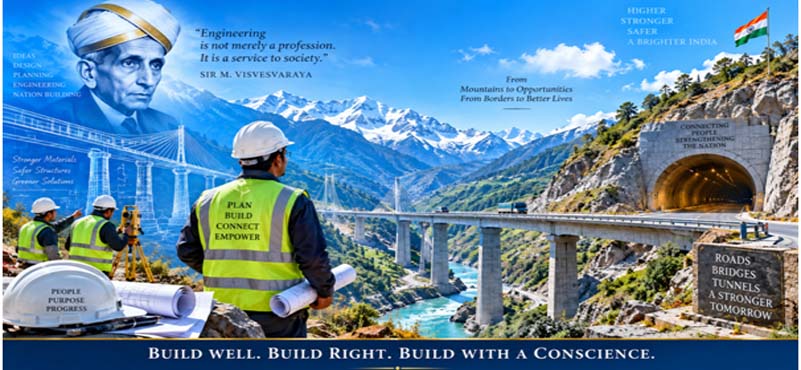
Engineering is where a nation’s dreams acquire weight, shape and permanence. Every bridge that connects two banks, every road that reaches a remote village, every tunnel that cuts through a mountain, every dam that holds back a river and every runway that opens a distant region to the world begins as an idea in an engineer’s mind. But engineering is far more than drawings, calculations and concrete. It is an act of public trust. On Engineers’ Day, as India remembers Sir Mokshagundam Visvesvaraya, one of its greatest engineering minds and nation-builders, it is worth asking not merely what engineers have built, but what kind of engineers the nation needs in the decades ahead.
The Engineer as a Nation Builder. Visvesvaraya belonged to an era when India was still discovering the power of infrastructure to transform society. His legacy was not simply that of a brilliant engineer; it was that of a professional who understood that engineering had to serve a larger national purpose. That principle remains as relevant today as it was a century ago. India’s transformation from an infrastructure-deficient economy into one of the world’s major growth engines will depend not only on policies, capital and technology, but on the ability of its engineers to translate ambition into assets that work, endure and serve people.
The modern engineer therefore occupies a much larger space than the traditional professional stereotype suggests. Engineers are shaping highways and high-speed rail, airports and ports, renewable-energy systems and digital infrastructure, smart cities and defence technologies. They are designing the physical and technological architecture of a new India. Their work may rarely make headlines when everything functions as it should, but the functioning of everyday India is itself a testimony to engineering.
Engineering the Difficult India. The real measure of an engineer is often revealed where nature refuses to cooperate. India’s most demanding infrastructure challenges lie in mountains, deserts, floodplains, islands, dense urban settlements and environmentally fragile regions. Building a road across the Himalayas is not simply a matter of laying pavement; it involves geology, weather, altitude, drainage, logistics, slope stability and the relentless forces of nature. A tunnel is not merely a hole through a mountain. It is a carefully calculated relationship between rock, water, pressure, ventilation, safety and human ingenuity.
Those who have worked in difficult terrain know that engineering drawings rarely capture the full drama of the ground. The mountain has its own opinion. The river changes course. The weather closes roads. Equipment fails. Materials arrive late. Yet the engineer perseveres, adapts and finds solutions. This is where engineering becomes more than a profession; it becomes an expression of national determination.
The true test of engineering is not where construction is easy, but where geography says it is impossible.
Engineering as an Instrument of National Security. In contemporary India, infrastructure has acquired another dimension: strategic power. A road in a border region can be an economic lifeline in peacetime and a strategic artery during a crisis. A bridge can connect communities while simultaneously enabling the movement of essential forces and supplies. An airfield can bring tourism and commerce to a remote region while also strengthening national security. A tunnel can shorten travel time, reduce vulnerability to weather and transform the strategic geometry of an entire area.
The old distinction between civilian and strategic infrastructure is therefore increasingly blurred. Connectivity creates economic opportunity, social integration and security simultaneously. Engineers working on such projects carry responsibilities that extend far beyond completing a contract. Their calculations can influence national resilience; their decisions can affect the safety of communities and, in sensitive areas, the security of the nation itself.
The Engineer We Must Never Become. Yet there is another side to Engineers’ Day that deserves to be spoken about with equal honesty. We celebrate engineers for what they build, but we must also confront what happens when professional responsibility is sacrificed at the altar of money, convenience or expediency. A collapsed bridge is not merely a structural failure. A road that deteriorates soon after construction is not always just a consequence of heavy traffic or harsh weather. A leaking tunnel, a failing retaining wall or a prematurely damaged structure can sometimes be the visible consequence of invisible compromises made much earlier.
There can be no engineering excellence where specifications are deliberately diluted, inferior material is accepted, measurements are manipulated, safety warnings are ignored or work is certified without adequate inspection. And when public officials, engineers and contractors collude to inflate bills, cut corners or siphon public money, the crime is larger than financial corruption. Public infrastructure is built with public money and entrusted to public servants and professionals. When that trust is betrayed, ordinary citizens pay the price.
The victims of such corruption are not abstract numbers in an audit report. They may be a family travelling across a bridge, workers entering a tunnel, children crossing a culvert or citizens using a road that should have been safe. An engineer who compromises quality for money does not merely steal from the exchequer; he mortgages the safety of strangers. That is why professional integrity cannot be treated as an optional virtue in engineering. It is part of the design.
The New Engineer. The engineer of tomorrow will work in a world very different from that of Visvesvaraya. Artificial intelligence, robotics, drones, digital twins, satellite imagery, advanced materials, automation and data analytics are rapidly changing how infrastructure is conceived, designed, constructed and maintained. Machines will increasingly perform calculations that once consumed hours. Software will identify patterns that the human eye could miss. Robots will enter hazardous environments. Digital models will allow engineers to test structures before the first foundation is laid.
But technology will not eliminate the engineer. It will raise the standard expected from one. A machine may calculate the most efficient design, but an engineer must still determine whether that design is appropriate, safe, sustainable and socially responsible. Artificial intelligence can optimise an answer; it cannot independently carry the moral burden of the decision. The engineer of the future must therefore combine technical competence with judgement, curiosity with humility and innovation with responsibility.
Competence is Not Enough. Engineering has always demanded precision, but the India of the future will demand something more: conscience. An engineer must be competent enough to understand the science, courageous enough to challenge a flawed decision and honest enough to refuse an unethical instruction. The professional oath cannot end where the tender document ends.
Every engineer should be prepared to ask three questions: Can we build it? Should we build it? And will we still be proud of it twenty years from now? The first is a question of competence. The second is a question of responsibility. The third is a question of character.
This becomes particularly important as India undertakes infrastructure on an unprecedented scale. Speed is essential, but speed without quality is false progress. Cost efficiency matters, but the cheapest structure is not necessarily the most economical if it requires repeated repairs. Innovation is necessary, but innovation without safety can become experimentation with human lives. The engineer must therefore understand that every number on a drawing ultimately becomes a physical reality in somebody’s life.
The Invisible Engineers. On Engineers’ Day, we should also remember those whose names never appear on plaques. There is the young engineer standing at a remote site in rain or snow, the surveyor walking difficult ground, the technician maintaining equipment late into the night, the supervisor checking reinforcement before concrete is poured and the countless workers who transform technical drawings into physical structures. Behind every successful engineering project stands an ecosystem of people whose contribution is rarely visible to the public.
Their work teaches us something important. Engineering is not about personal glory. It is about creating something that outlives the person who created it. The finest engineer may never see his name on a monument, but he will know that a bridge stands because he refused to compromise, that a road survives because he insisted on quality, or that a tunnel remains safe because somebody took one additional measurement when nobody was watching.
Engineering India’s Future. India today stands at an extraordinary moment. It wants to grow faster, connect better, become technologically self-reliant, transition towards cleaner energy and strengthen its strategic capabilities, all while ensuring that development reaches the remotest citizen. Each of these ambitions eventually becomes an engineering challenge. The India we imagine in policy documents will become real only when engineers turn those words into roads, railways, airports, bridges, power systems, water networks, digital platforms and resilient communities.
That makes Engineers’ Day more than a celebration of a profession. It is a reminder of a national responsibility. Visvesvaraya’s generation demonstrated that engineering could become an instrument of social transformation. The engineers of today must demonstrate that it can become an instrument of national resurgence. The engineers of tomorrow must take it further—to an India that is not merely bigger and faster, but safer, smarter, greener and more resilient.
A nation may dream through its leaders, defend itself through its soldiers and generate wealth through its entrepreneurs, but those dreams become tangible only when somebody designs them, calculates them, builds them and accepts responsibility for their performance.
The greatest engineering achievement is therefore not a bridge that stands for a hundred years; it is the trust that an engineer earns by refusing to let it fail.
ABOUT THE AUTHOR
Lt Gen Rajeev Chaudhry (Retd) is a social observer and writes on contemporary national and international issues, strategic implications of infrastructure development towards national power, geo-moral dimension of international relations and leadership nuances in changing social construct.