
Prelude: Operation Sindoor, A Strategic Inflection Point
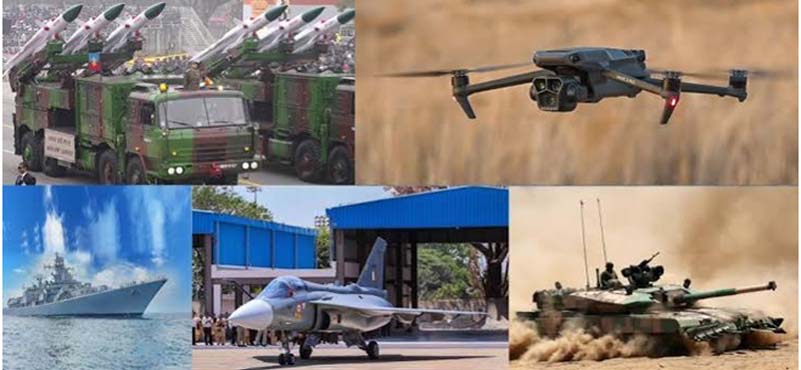
Operation Sindoor in May 2025 demonstrated India’s military prowess against a recalcitrant neighbour’s sustained threat of terrorism in the shadow of nuclear saber-rattling. Success flowed from clear political directive, meticulously chosen military objectives, tri-service integration and precision targeting of terror infrastructure and when Pakistan chose to escalate; its air defence and critical strategic airbases. Robust, synergised and multi-layered air defence architecture ensured protection of own critical civilian and military assets that constricted Pakistan’s retaliatory matrix. India maintained an unambiguous and calibrated escalation dominance through politico-military signaling forcing Pakistan to call for ceasefire. It also marked a doctrinal shift against a recurring, state-sponsored threat of terror that had for decades sheltered behind Pakistan’s nuclear overhang. The new normal calls for the punitive coercion on multiple axes simultaneously, including the declaration that blood and water will not flow together, with the Indus Waters Treaty held in abeyance as continuing leverage. This is a structural renaissance and not a one-off change.
Pakistan’s Convoluted Victory
Despite severe military losses, Pakistan converted defeat into a narrative victory. General Asim Munir’s elevation to Field Marshal further consolidated the Army’s primacy over a weak civilian government (cemented through the Constitutional Amendment No 27 including institution of post of Chief of Defence Forces and lifetime immunity for Field Marshal Munir), while Islamabad courted Washington through cryptocurrency and rare-earth investment overtures and a much-publicised nomination of President Trump for the Nobel Peace Prize. The result: strategic and diplomatic gains despite severe domestic economic distress (begging restrictions imposed by government during Haj) forcing continuing IMF dependence and combustible internal security challenges, an irony that conflict termination is now contested as much in the narrative space as on the battlefield.
The Altered Global Threat Environment
Since Operation Sindoor though, the global security environment has changed significantly. The Russia-Ukraine war has transited from contact battle to deep-strike war with drones, ballistic, cruise and hypersonic missiles hitting economic and strategic targets at varying depths from the frontlines. The escalation risks spilling toward NATO’s eastern flank (the Polish drone incursion) with greater overt support by NATO allies. Despite overwhelming conventional superiority, the US has retreated from escalation to conflict management (read economic D Day) in Iran, its missile stocks reportedly depleted, while Iran has emerged more belligerent with greater leverage over Hormuz, the Red Sea and its proxies. The Middle East alliance map has been redrawn.
- Pakistan’s mediatory role in the US-Israel-Iran war brought it recognition without tangible peace dividends. With trust in US security guarantees eroding after multiple military and civilian bases in gulf states subjected to Iran’s drone and missile attacks, the September 2025 Saudi-Pakistan Strategic Mutual Defence Agreement has widened into the Mecca Joint Defence Agreement (7 August 2026). Turkiye described the pact as “technically” Article 5-equivalent, though its text sets no binding commitments. The pact complements Turkish technology with Pakistani manpower and Saudi capital. Further expansion of the “Islamic NATO” with inclusion of Kuwait and Egypt is plausible. The biggest paradox however is backchannel talks for inclusion of Iran, the nation against whom the alliance was believed to have taken shape. This deepens India’s diplomatic dilemma while limiting targeting options even without altering the conventional balance.
- China-Pakistan collusion, evident during Operation Sindoor, has deepened institutionally. The first of eight Hangor-class submarines was commissioned in April 2026 and reached Karachi in June. Pakistan has signed an initial agreement for 40 Chinese J-35 stealth fighters (not proven in combat yet) alongside continuing J-10C acquisitions, with HQ-19 and KJ-500 systems also under discussion. Pakistan plans to sell the jointly produced JF-17 to Azerbaijan and Iraq. Heavier Chinese and Turkish military transport traffic into Nur Khan airbase in August points to a sustained resupply pipeline. Pakistan’s outreach now extends even to Somalia. While this outreach will is unlikely to transform Pakistan’s conventional capability in the near term, it is likely to progressively constrain India’s options.
- Elsewhere, reduced US participation in joint military exercises with South Korea, reports of thinning air-defence support to Japan for deployment in West Asia and redeployment of sole aircraft carrier from Pacific to the gulf, set against China’s outreach to Seoul, suggest Beijing sees greater immunity from coordinated response in a Taiwan contingency or indirectly a leverage along the LAC. China-Indonesia naval exercises raise the question of a wider regional detente with China compromising India’s SouthEast Asia embrace. Bangladesh’s tilt toward Pakistan, despite India’s outreach to mend relations, including speculation of joining the ‘Islamic quad’, adds fresh complication on India’s eastern flank.
Conclusive conflict termination in any future regional conflicts remains doubtful; the environment is open-ended. Economically, India’s energy and trade security has been affected by the West Asia war even as diversification continues. Across the board, alliances today rest on pragmatic economic-security combinations rather than ideology.
India’s Preparedness and Progress Since Sindoor
Indian Air Force
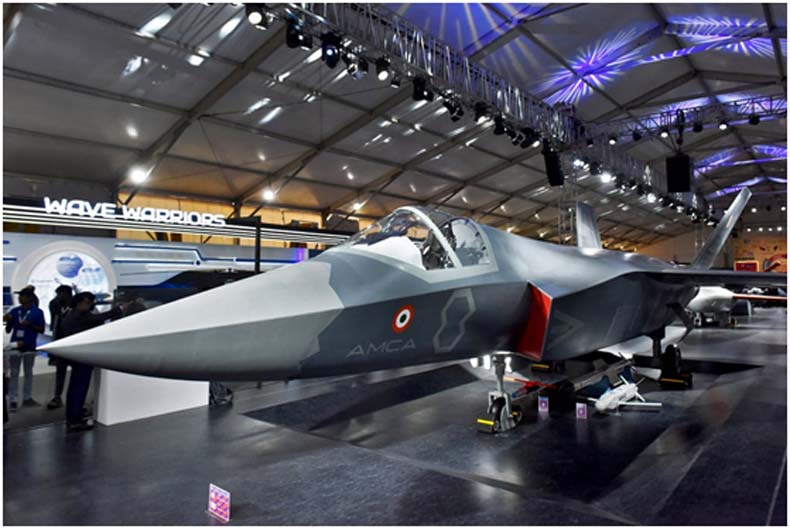
The IAF’s strike on eleven Pakistani airfields across a swathe of territory on 10 May 2025, against negligible resistance, was a spectacular precision-strike success. However, over time, squadron strength has depleted to roughly 29 against a sanctioned 42.5, with the last of MiG-21s retired in 2025 and the gap unlikely to close before 2030.
- Tejas Mk1A deliveries (83+97 aircraft) continue; the 114-aircraft MRFA requirement was cleared in February 2026, with 90 to be built in India (Rafale the front-runner), alongside 26 Rafale-M for the Navy. Delivery of Tejas Mk1A has been hit by GE F404 engine delays exceeding two years; Tejas Mk2 and AMCA face F414 cost escalation from Rs 80cr to roughly Rs 200 crore per engine. Parallel Reliance-Rolls-Royce and Safran-DRDO/GRTE engine deals are underway but carry their own gestation period inherent in such complex procurements.
- Mirage 2000 and Jaguar fleets are to be sustained by cannibalisation, critical-spares management and selective upgrades. Transport fleet renewal (An-32 replacement RFP issued for 60 Multi-Role Transport Aircraft on 12 August) including the C-295 indigenous line is progressing albeit gradually.
Beyond restoration of squadron numbers, the IAF must define how future envisaged threats can be addressed. A balanced mix of manned aircraft, UAVs/drones, long-range stand-off weapons (a direct Sindoor lesson), strategic missiles, AWACS/ISR, electronic warfare and integrated air defence — sequenced against production timelines and Atmanirbharta would be the key. Lessons from actual conflict zones and disaster-relief/humanitarian operations commitments need continuous evaluation to guide capacity building.
Navy
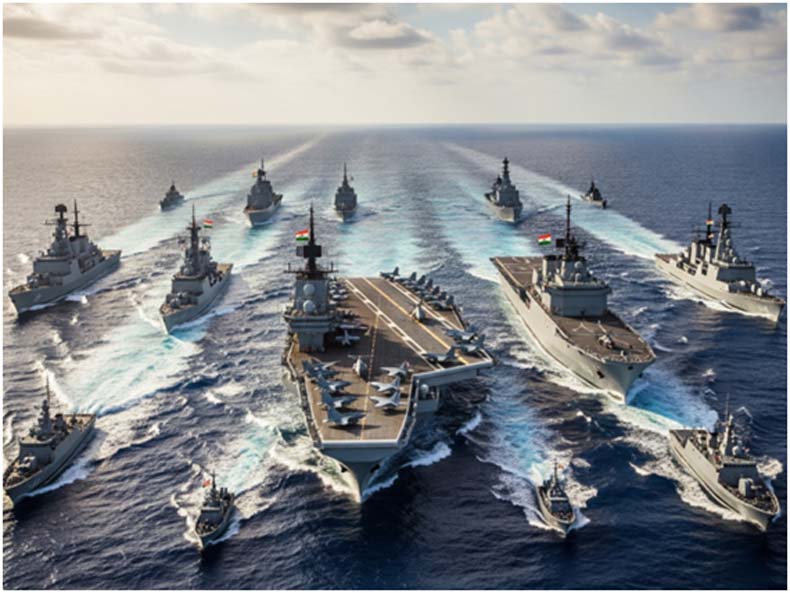
The Navy’s Sindoor role was silent but decisive: bottling up the Pakistan Navy at Karachi and restricting merchant shipping, imposing a credible threat of unacceptable damage while preserving India’s own escalation options. The evolving threat environment calls for it to play a more decisive role. The Navy has commissioned 12 ships/submarines in 2025. The momentum must continue.
- Hormuz-linked merchant-shipping escort duties (typically six to seven ships at a time) now add a standing operational burden, affecting deployment and rotation.
- Project 75(I) — six TKMS(Germany)-MDL AIP submarines, awaits final CCS clearance; first boat is contractually due seven years post-signature, full induction not before 2034-35. A further three boats and an indigenous Project 76 are already envisaged.
- To cater for expanding maritime ISR and anti-submarine warfare, P-8I surveillance numbers continue to expand. Six additional platforms are planned but their delivery timelines and cross-service platform dependency need operational deliberation. MH-60R helicopter induction continues to close a long-standing ASW gap. On the drone front, 31 contracted MQ-9B Sea Guardians (15 Navy, 8 each IAF and Army) are unlikely to fructify before January 2029. Only two are available and an additional two 30-month leased platforms signed on 17 August to cover the gap in the interim.
- Widening maritime-domain-awareness and evacuation duties across the IOR, Persian Gulf, Gulf of Aden, anti-piracy patrols, Malacca and the Andaman Sea compete for the same finite resources. The Navy’s net-security-provider role (convoy protection, tanker escort, SLOC protection) is now a standing commitment.
- A minimum of six SSBNs as part of nuclear triad are needed for continuous deterrent patrols, alongside a growing SSN force — requiring smaller naval nuclear propulsion plants. The 170-200 ship fleet goal and a third aircraft carrier (with Pacific and Mediterranean presence in view) remain multi-decade ambitions needing a credible interim plan.
What the Indian Navy needs is a coherent combination of persistent surveillance, submarines and unmanned systems, carrier aviation, long range missiles and maritime domain awareness in the wider sea-lanes that affect India’s security.
Army
The Army delivered Sindoor’s first strike on 7 May 2025, hitting seven of nine terror-infrastructure targets, and carries the continuing burden of two disputed and volatile land borders.
- On the LAC, the situation is stable but sensitive, requiring additional (60,000-70,000 troops) deployment, persistent ISR, rapid-reaction capability against grey-zone transgressions, infrastructure development, counter-drone systems, precision artillery, satellite coverage and high-altitude mobility.
- On the LoC, escalation options must be available at every level, including punitive precision strikes on camps and launch pads, validated during Operation Sindoor.
- Bhairav Light Commando Battalions (announced on 26 July 2025), roughly 250 personnel strong, bridge the gap between infantry and Special Forces with drone-enabled, agile, sector-specific employment. Some were operational by late 2025, with an eventual target of 25-30 battalions.
- Baaz (Hawk) drone battalions under Corps level formations and Ashni platoons at infantry battalion level (later expanded into armoured regiments and mechanised infantry battalions) provide organic drone capability for recce, target acquisition, surveillance and limited attack.
- Incremental upgradation of the T-72/T-90 tanks under the FRCV, BMP-2 under FICV programmes and induction of Zorawar light tanks for mountainous terrain are on the anvil.
- Artillery modernisation rests on ATAGS, K9 Vajra, Dhanush and BrahMos for mass and precision fires with sensor-shooter networked targeting and improved mobility, alongside Divyastra batteries and Shaktibaan regiments with long range reconnaissance, strike drones and loitering munitions.
Force Multipliers
Theaterisation has gathered urgency. Gen Anil Chauhan, erstwhile CDS submitted his final report before demitting office on 31 May 2026 (planning reportedly 90% complete). Gen NS Raja Subramani, the current CDS, now carries it into the governmental decision phase, with an emerging consensus on Northern (China-facing, likely Lucknow), Western (Pakistan-facing, likely Jaipur) and maritime commands, and Joint Logistics Nodes already functioning at Mumbai, Guwahati and Port Blair.
New Rudra all-arms brigades integrate infantry, mechanised forces, artillery, engineers and air defence within single formations. Layered air defence including VSHORADS, Akash, QRSAM and S-400 proved itself during Operation Sindoor and is being reinforced through fresh VSHORADS contracts (Rs 5,200 cr domestic mega deal in July 2026). The real force-multiplier is the integration itself: Akashteer, IACCS, naval systems, radars, AWACS and satellites fused into one real-time air picture, and deepening this fusion is now the priority. Mission Sudarshan Chakra, announced on 15 August 2025, envisages a national AI-enabled, multi-layered air defence system incorporating radars, satellites, fighters, EW, missiles, lasers and cyber in two phases. Medium-term to 2030 (building on IACCS, Akashteer and Project Kusha) and full maturity by 2035, protecting military, civilian and critical infrastructure nationwide. Missile diversification and scale of production across cruise, hypersonic and ballistic types deny adversaries a uniform defensive solution, echoing Ukraine’s deep-strike lessons. The recent initiative of approval by the defence ministry to transfer DRDO monopolised conventional military technologies to the private industry is laudatory as a march towards civil-military fusion. The cyber and space capabilities need constant enhancement.
On nuclear deterrence, the Strategic Forces Command’s tenth Agni-4 user trial in August 2026, reaffirmed operational readiness of the road-mobile, canisterised, 4,000-km system, with survivability through mobility and dispersal, complementing the air leg (Su-30MKI, Mirage 2000, Rafale) and the sea leg (Arihant-class SSBNs, K-series SLBMs).
DRDO’s DURGA-II 100-kilowatt directed-energy weapon has moved to active naval trials seeking to answer the drone-swarm threat witnessed during Sindoor and the October 2025 Jammu-Punjab incursions.
Summation
Operation Sindoor proved India’s political resolve, military doctrinal renaissance and jointness to impose costs on terror while controlling escalation. But battlefield success has not automatically produced a favourable strategic environment. Pakistan has converted defeat into diplomatic gain; the Saudi-Pakistan-Turkiye axis and deepening China-Pakistan military ties add fresh challenges. The wider global order offers a less reliable external counterweight than before. While across the forces the intent and approach to modernisation is in sync with emerging threats, delivery timelines, engine and platform dependencies, and the scale of the modernisation agenda mean genuine capability will take a decade or more to mature. IAF squadron strength is not closing before 2030, submarines not operational before the mid-2030s and Sudarshan Chakra itself a 2035 horizon. Covering this intervening decade demands a deliberate combination of accelerated imports where indigenous timelines cannot be compressed, sustained and well-funded Atmanirbharta where it can genuinely deliver, prioritisation among competing programmes, and above all the same focused politico-military urgency that made Sindoor succeed now applied to force modernisation, alliance management and shaping the narrative. Preparedness for future conflicts cannot be shrouded in Operation Sindoor success rhetoric or chest thumping on landing on the lunar south pole. It ought to be a pragmatic and focused approach towards military modernisation in consonance with the emerging threat dynamics. As they say, capability development takes time while intentions can change overnight.
ABOUT THE AUTHOR
 Major General SC Mohanty, AVSM (Retd), was commissioned in June 1983. The officer commanded a Mechanised Infantry Battalion, a Mechanised Brigade and an Infantry Division (RAPID Strike) in the Western Sector. As a Brigade Major, he took active part in the Kargil Operations while located at Drass. As part of Military Operations Directorate, he headed the Information Warfare, Cyber and Electronic Warfare branches. Post retirement, he was the Security Advisor to Government of Arunachal Pradesh from July 2020 to May 2023.