
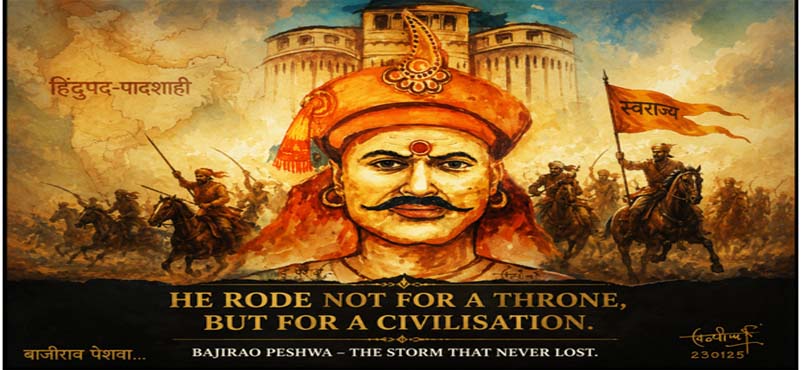
How a young Peshwa transformed mobility, manoeuvre and audacity into an art of war
The General Who Never Lost
On 18 August 1700, in the Deccan, a child was born who would grow into one of the most extraordinary military commanders in Indian history. His name was Bajirao Ballal Bhat. He became Peshwa at barely twenty, lived only thirty-nine years, and yet left behind a military record that continues to fascinate students of warfare. Bajirao’s achievement is often reduced to a single spectacular claim: he never lost a battle. More important than the claim itself, however, is the question why.
He did not command the largest armies. He did not possess the heaviest artillery. He did not build his reputation through prolonged sieges or bloody frontal assaults. His genius lay elsewhere. He understood that an enemy could be defeated without being annihilated; that an army could be paralysed without being destroyed; and that speed, properly employed, could become a weapon more powerful than numbers.
Bajirao did not merely win battles. He changed the way they could be fought. His campaigns against the Nizam, his lightning advance towards Delhi in 1737 and his victory at Bhopal demonstrated a distinctive philosophy of war: move faster than the enemy can think, appear where he does not expect you, attack his vulnerabilities rather than his strengths, and compel him to fight a war of your choosing.
That is why Bajirao deserves to be remembered not merely as a great Maratha Peshwa, but as a commander worthy of serious study in the history of manoeuvre warfare.
A Commander with Speed as His First Weapon
When Bajirao became Peshwa in 1720 at barely twenty, he inherited a Maratha state surrounded by powerful adversaries. Yet he possessed something more valuable than numbers or heavy artillery: an instinctive understanding of mobility as combat power.
Bajirao recognised that the Marathas could not always defeat larger armies by meeting them head-on. His answer was to change the very terms of battle. He moved faster than his opponents could respond, appeared where they least expected him, struck at their vulnerabilities and disappeared before their superior numbers could be brought to bear.
For Bajirao, speed was not simply the ability to march rapidly. It was a weapon that compressed his own decision cycle while expanding the enemy’s uncertainty. His cavalry travelled light, covered remarkable distances and could rapidly change direction. This allowed him to threaten several objectives simultaneously and force an adversary into a perpetual state of reaction.
He understood another timeless principle: an army’s strength is not merely the number of soldiers or guns it possesses, but its ability to move, communicate, replenish and fight at a time and place of its choosing. Thus, Bajirao sought not the enemy’s strongest point but his freedom of action. He did not fight wars on the enemy’s terms. He made the enemy fight the war he had already designed.
Bajirao understood that every mile travelled by the enemy under pressure was a mile of combat power consumed.
Palkhed — The Battle He Won Before the Battle
If military history had to preserve one campaign to explain Bajirao’s genius, Palkhed would be an obvious choice.
In 1727–28, Bajirao faced Nizam-ul-Mulk, whose army possessed the advantages of numbers and artillery. A conventional commander might have accepted battle on favourable ground and attempted to overcome the disparity through courage.
Bajirao chose intelligence over courage and manoeuvre over attrition.
He repeatedly changed direction, crossed rivers and threatened the Nizam’s territory. The Nizam was compelled to respond. Eventually, near Palkhed, Bajirao positioned his cavalry so that the Nizam’s army found itself increasingly isolated from water and supplies, while its artillery had become separated from the main body.
The decisive point is that Bajirao did not need to destroy the Nizam’s army. He made it incapable of fighting effectively. Surrounded and deprived of essential supplies, the Nizam was compelled to negotiate. The resulting settlement at Mungi-Shevgaon restored Maratha claims and recognised important political and fiscal rights.
Palkhed therefore belongs to the history of military manoeuvre because it demonstrates a timeless principle: The destruction of an army is only one way of defeating it. Breaking its mobility, cutting its logistics, denying it water, isolating its artillery and destroying its freedom of action can achieve the same strategic result.
Bajirao had effectively defeated the Nizam before the conventional battle that historians might have expected ever occurred.
Delhi 1737 — When Speed Became Strategic Shock
If Palkhed demonstrated Bajirao’s operational brilliance, the Delhi expedition demonstrated his strategic audacity.
In 1737, Bajirao led a rapid thrust towards the Mughal capital. Delhi was not merely another geographical objective. It represented the political heart of the empire that had dominated the subcontinent for generations. To appear at its gates with a highly mobile Maratha force was therefore a psychological event of enormous significance.
The expedition demonstrated a crucial aspect of Bajirao’s thinking: the strategic value of an objective may be greater than its military value. He did not need to occupy Delhi permanently to alter the balance of power. He needed to demonstrate that the Mughal centre could be penetrated, threatened and humiliated.
That was strategic shock.
The Mughal system was accustomed to thinking in terms of large armies, fortified centres and conventional lines of advance. Bajirao’s method introduced uncertainty. Where would he appear next? Which route would he take? Which city was safe? Which army could intercept him before he moved again?
His army’s speed became a psychological weapon. The expedition towards Delhi showed that an empire’s greatest vulnerability may not lie in its walls but in the assumption that distance itself provides security.
Bajirao turned distance into a corridor of attack.
Bhopal — Manoeuvre Over Mass
Bhopal in 1737–38 reinforced the lesson of Palkhed on an even larger strategic canvas.
Following Bajirao’s thrust towards Delhi, the Mughal emperor sought the support of the Nizam. A large opposing force gathered, and Bajirao again confronted a problem familiar from Palkhed: the enemy possessed considerable numbers and artillery.
Once again, Bajirao refused to allow numerical strength to dictate the terms of engagement. The Nizam’s force eventually found itself contained around Bhopal. Bajirao’s forces used mobility, positioning and control of access to place pressure on the larger army. The resulting settlement demonstrated once again that an enemy force could be compelled into submission through operational isolation rather than annihilation.
Bhopal therefore becomes the second major demonstration of Bajirao’s method. Palkhed had shown that mobility could defeat a superior force in the Deccan. Bhopal showed that the principle could operate at a much larger strategic scale. The recurring formula was remarkably consistent: Do not attack strength. Attack freedom of action.
The enemy may possess more guns, more soldiers and more resources. But if he cannot manoeuvre, replenish, communicate or choose the moment of battle, much of that superiority becomes theoretical.
The Five Principles of Bajirao’s Warfare
Bajirao’s campaigns reveal a remarkably coherent military philosophy.
- Speed over Mass. He understood that a smaller force that arrives first, moves faster and chooses the point of contact can possess disproportionate combat power.
- Manoeuvre over Attrition. He avoided wasting men in battles whose outcome could be achieved through movement, encirclement and pressure.
- Surprise over Predictability. His rapid changes of direction constantly disrupted enemy calculations. The enemy was compelled to respond to Bajirao’s initiative rather than impose his own.
- Logistics over Spectacle. Palkhed demonstrated that water, supplies, communications and mobility could be more decisive than artillery pieces or troop numbers. Bajirao attacked the system that sustained the army.
- Psychological dominance over Physical destruction. A commander who can convince an opponent that continued resistance is futile has achieved something more valuable than a battlefield victory.
And there was a sixth principle running beneath all five:
Political objective over Battlefield vanity. Bajirao did not fight simply to win battles. He fought to expand Maratha political influence. Military action remained subordinate to strategic purpose.
That is the mark of a great commander.
Bajirao Among the Great Generals
It would be tempting to rank Bajirao mechanically against Alexander, Genghis Khan or Napoleon. Such comparisons are ultimately artificial because each operated in a different technological, political and geographical environment.
Yet the comparison is valuable for another reason.
- Alexander understood aggressive operational movement and the importance of taking the initiative.
- Genghis Khan transformed mobility, intelligence and operational reach into instruments of imperial conquest.
- Napoleon demonstrated how speed, concentration and manoeuvre could defeat larger forces by repeatedly creating local superiority.
- Bajirao belongs in this conversation because he similarly understood a principle that transcends technology: war is fundamentally a contest of time, space, information, will and decision.
His army’s mobility allowed him to compress time for himself and expand it for his enemy. His manoeuvres created uncertainty. His intelligence enabled anticipation. His avoidance of unnecessary attrition preserved combat power.
He therefore deserves to be studied not as an Indian curiosity but as part of the wider history of military thought. The significance of Bajirao is not that he was an Indian Napoleon.
It is that Bajirao was Bajirao—an original commander shaped by the Deccan who developed methods suited to his own strategic environment and repeatedly defeated opponents who possessed conventional advantages.
Modern Lesson—Battlefields Change, Principles Not
The armies of today bear little resemblance to Bajirao’s cavalry.
Satellites have replaced scouts. Drones have transformed reconnaissance. Precision weapons can strike hundreds of kilometres away. Cyber and electronic warfare can disrupt an adversary without a single soldier crossing a border.
Yet one of Bajirao’s fundamental lessons has become more—not less—relevant. Speed remains combat power.
Today, speed means more than the speed of movement. It means speed of sensing, speed of decision, speed of targeting and speed of execution. The modern commander who can observe first, understand first, decide first and act first can create effects disproportionate to his physical strength.
Bajirao’s other lessons remain equally relevant: protect logistics; understand terrain; deceive the adversary; avoid predictable patterns; preserve freedom of manoeuvre; and never allow the enemy to dictate the battlefield.
Technology changes the instruments of war. It does not change the psychology of war. An opponent who is constantly reacting is already losing initiative. An opponent who cannot predict where the next blow will come from is already losing confidence. And an opponent whose logistics, communications and freedom of movement have been compromised may possess enormous military strength on paper and very little usable power on the ground.
That was Bajirao’s insight three centuries ago. It remains true today.
The Sword That Moved Faster Than History
Bajirao died on 28 April 1740, not yet forty. His life was extraordinarily short, but his military influence was not.
He left behind no great theoretical treatise on warfare. His doctrine was written instead across the map of India—in the routes he travelled, the armies he outmanoeuvred, the cities he threatened and the enemies he compelled to negotiate.
His greatness lay not simply in courage. It lay in judgement.
He knew when to fight and when not to fight. He understood that a river could be a weapon, that distance could be an ally, that hunger could defeat artillery and that uncertainty could defeat an army’s confidence.
Above all, he understood something every generation of commanders must rediscover: Victory does not always belong to the army that hits hardest. It often belongs to the army that makes the enemy react first—and react wrongly.
Bajirao’s sword was formidable. But his real weapon was the mind that directed it.
He did not conquer by fighting more. He conquered by moving faster, thinking farther and striking where the enemy could not respond.
Three centuries later, his greatest weapon remains undefeated: the speed of thought.
(The portrait of Bajirao placed in the centre of the opening image has been created by the author.)
ABOUT THE AUTHOR

Lt Gen Rajeev Chaudhry (Retd) is a social observer and writes on contemporary national and international issues, strategic implications of infrastructure development towards national power, geo-moral dimension of international relations and leadership nuances in changing social construct.