
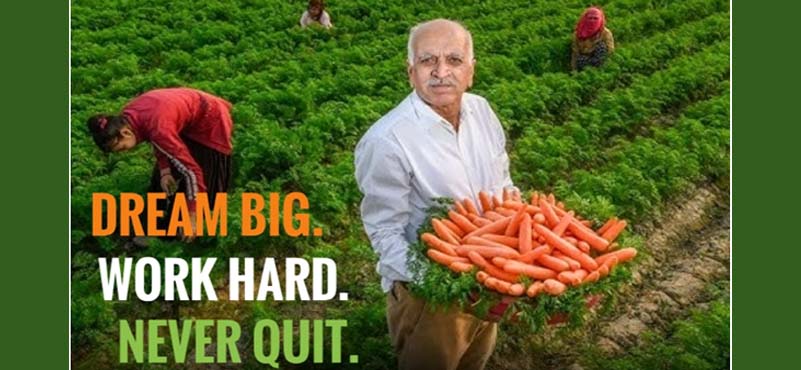
He Changed the Battlefield, Not the Soldier Within
I have known Colonel Subhash Deswal long before the world discovered the “Carrot King”. We were coursemates at the National Defence Academy, training together for three long years. Those were formative years when we were all young, broke, hungry, ambitious and largely unaware of what life would eventually make of us. Subhash was not the sort of cadet who announced himself. He was quiet, steady and completely unassuming. He did not seek the centre of the room, nor did he seem particularly interested in being noticed. He simply went about his business.
Looking back today, I realise that perhaps the most remarkable thing about Subhash’s success is that nothing about it is remarkable in the conventional sense. There was no overnight breakthrough, no dramatic stroke of luck, no inherited agricultural empire waiting for him. There was only a man who kept moving when circumstances told him to stop. Somewhere between the parade ground of NDA and the carrot fields of Sikandrabad, the same quiet determination that I had seen in a young cadet found a completely different battlefield.
After 21 years in uniform, Subhash decided to take the road less travelled. Agriculture was familiar to him through his family’s background, but farming as a serious enterprise was an entirely different proposition. In 1998, while still in service, he and Lal Krishan Yadav began cultivating leased land around Sikandrabad. Potatoes, onions and wheat were tried. For nearly four years, the results were disappointing. They lost money.
For most people, four years of losses would have been enough to declare farming a bad idea and move on. Subhash did something else. He began looking at the problem.
That, I believe, is the first secret of his success. He did not confuse a failed method with a failed mission. In the Army, we were trained to distinguish between the objective and the plan. If the plan did not work, you changed the plan. You did not abandon the objective. Subhash carried that instinct from the battlefield into the farm.
In 2002-03, he and Yadav experimented with carrots on just two acres. It was a small beginning, almost insignificant when viewed against what would eventually follow. But the results were encouraging. They expanded to 20 acres the following year. Better cultivation practices pushed yields from roughly 8-10 tonnes to more than 20 tonnes per acre, and by 2004-05 they finally made substantial money.
The two acres had quietly changed everything. But Subhash’s real breakthrough was not discovering that carrots could be profitable. It was discovering that farming was not simply about growing something in the soil. It was about understanding the entire chain between the soil and the customer.
This is where the soldier in him truly emerged. He began confronting every piece of friction that stood between production and profit—quality, seeds, sowing, harvesting, labour, mechanisation, grading, storage, transportation and, most importantly, the market. Hybrid Nantes carrots dramatically improved yields. Machines were developed and adapted because imported or available equipment did not always suit local conditions. When a machine did not exist for the problem he faced, he found someone who could make one.
That is what I find most inspiring about his journey. He never seemed to ask, “Why is this happening to me?”
He asked, “How do I solve it?”
There is a world of difference between the two. Indian agriculture has never suffered from a shortage of hard-working farmers. What it has often suffered from is the enormous friction surrounding the farmer—the middleman, perishability, inadequate storage, unpredictable prices, fragmented production and weak bargaining power. Subhash understood that producing more was only half the battle. Unless the farmer could control what happened after harvest, he would remain vulnerable.
His answer was scale. If a farmer produced too little, he would remain a price taker. If he could produce sufficient quantity and quality, the market would have to come to him. Subhash and Yadav gradually moved from their own cultivation to contract farming, providing growers with seeds, inputs, machinery and technical support while creating a reliable market for their produce. What began as a small experiment eventually grew into an enterprise covering about 1,500 acres, including hundreds of contract growers.
But even then, Subhash did not stop. The next problem was storage. A carrot is not a potato. It loses moisture quickly, and every hour between harvesting and proper storage can affect both quality and price. So the problem of farming became a problem of logistics. And the problem of logistics became a problem of infrastructure.
He built cold-storage capacity. He moved towards processing. He created an integrated value chain. Today, Sunshine Vegetables has expanded its cold-storage capacity to about 25,000 tonnes, with an integrated cold-chain project adding another dimension to the enterprise.
This is where the story stops being merely about carrots. It becomes a story about perseverance. Perseverance is often misunderstood as stubbornly doing the same thing again and again. Subhash’s journey teaches the opposite.
True perseverance is the ability to keep the destination fixed while continuously changing the route.
When the crop failed, he changed the crop. When conventional methods disappointed him, he changed the methods. When machinery did not suit the requirement, he helped create machinery. When the market dictated terms, he built scale. When storage became the bottleneck, he built cold storage. When individual farming limited the opportunity, he brought other farmers into the ecosystem. Every obstacle became another engineering problem.
That is perhaps the most enduring lesson of his journey. Life rarely gives us clean battlefields. There is always friction. There are regulations, markets, weather, people, money, systems and circumstances that refuse to cooperate. The successful person is not necessarily the one who encounters fewer obstacles. He is the one who develops the temperament to keep removing them, one at a time.
What makes Subhash’s story even more special for me, however, is the man himself. The numbers are impressive. Two acres becoming 1,500. A struggling experiment becoming a major carrot enterprise. Thousands of tonnes moving through an integrated production and marketing system. Sikandrabad itself emerging as a major carrot-growing hub. But numbers are not what I remember when I think of Subhash.
I remember the quiet cadet. The unassuming coursemate. The man who never needed to advertise himself. And perhaps that is why his success sits so comfortably on him. There is no visible arrogance in the crown the world has placed on his head. He has become the “Carrot King” without ever appearing to have set out to become a king. That is a rare quality.
Many people become successful and then spend the rest of their lives explaining their success. Subhash seems to have done something quite different. He simply kept working.
Perhaps that is also why his story resonates so strongly with me as a soldier. In the Army, we were taught that the mission mattered more than the individual. You did your job, solved the problem, helped the man beside you and moved forward. Subhash seems to have carried that ethos into civilian life.
And there is one more lesson in his journey that I find particularly beautiful. A carrot does most of its growing underground. There is no drama. No applause. No spectacle. For months, the real work remains invisible. Only when the crop is finally pulled out does the world discover what has been happening beneath the surface. Perhaps that is the perfect metaphor for Subhash Deswal.
The world sees the Carrot King today. I see the cadet I knew decades ago—the quiet, ordinary-looking ever smiling young man who never seemed to need the spotlight. He did not become extraordinary by trying to be extraordinary. He became extraordinary by refusing to stop.
And somewhere between those two acres and those 1,500 acres lies the real harvest—not of carrots, but of character. That is what makes me proud to call him my coursemate.
And perhaps the finest tribute to him is not that he became the Carrot King. It is that he remained Subhash Deswal after becoming one.
ABOUT THE AUTHOR

Lt Gen Rajeev Chaudhry (Retd) is a social observer and writes on contemporary national and international issues, strategic implications of infrastructure development towards national power, geo-moral dimension of international relations and leadership nuances in changing social construct.