Some heroes arrive with fanfare. They dominate headlines, command television screens, and bask in the glow of celebrity. Others walk quietly among us, speaking little, demanding nothing, and allowing their work to speak louder than their words. Saikhom Mirabai Chanu belongs to the second kind. In an age captivated by instant fame, she reminds us that true greatness is built in silence, strengthened by hardship, and sustained by humility.
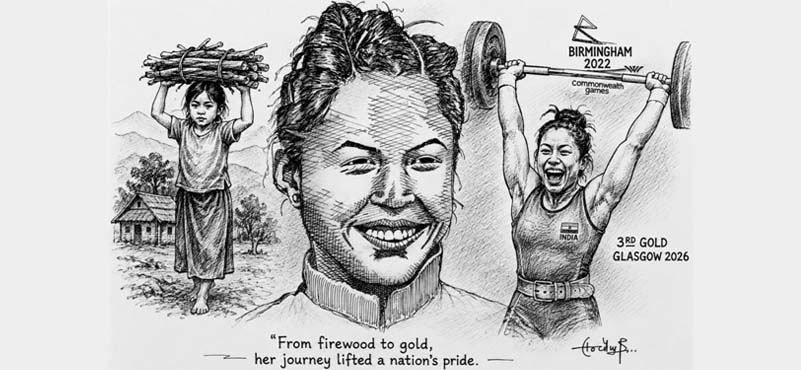
Long before the world watched her lift impossible weights on Olympic platforms, a little girl in the hills of Manipur was carrying bundles of firewood that were almost as heavy as she was. Her village, Nongpok Kakching, knew little of international medals or world records. Life was simple, resources were scarce, and every member of the family contributed to daily survival. It is often said that her elder brother struggled to lift the firewood she carried with ease. Nature, unknowingly, had become her first coach. The steep slopes, the rough paths, and the burdens of rural life were quietly preparing a future champion.
Yet, physical strength alone has never produced greatness. Character does.
What makes Mirabai Chanu extraordinary is not merely the weight she lifts but the life she has lived. She has remained among the world’s finest weightlifters for more than a decade, an achievement so rare that it deserves far greater admiration than it often receives. Sporting excellence is difficult to attain; sustaining it year after year is almost miraculous. Champions emerge every season. Legends endure.
Her journey was never a smooth ascent. There were moments when dreams appeared to crumble under unbearable pressure. At the Rio Olympics in 2016, she failed to register a successful lift. For an athlete who had carried the hopes of an entire nation, it was heart-breaking. Public disappointment was swift, criticism was harsh, and the weight on her shoulders became far heavier than any barbell she had attempted to lift.
Many athletes never recover from such a moment. Mirabai did.
She returned to training with the same quiet determination that had carried firewood through the hills of Manipur. There were no dramatic declarations, no excuses, and no bitterness. There was only discipline. Every failed lift became another reason to work harder. Every criticism became another reminder that success belongs not to those who never fall but to those who refuse to remain on the ground.
The years that followed transformed disappointment into one of Indian sport’s greatest redemption stories. She became World Champion. She rewrote records. She won multiple Commonwealth Games gold medals, becoming one of India’s most decorated weightlifters. At the Tokyo Olympics, she lifted not merely iron but the expectations of over a billion Indians to claim a historic silver medal. Even when she narrowly missed another Olympic medal in Paris, she fought until her very last attempt, displaying the same courage that has defined her entire career.
What is remarkable is not simply the collection of medals. It is the astonishing consistency behind them. For over twelve years, Mirabai Chanu has remained among the elite of world weightlifting despite injuries, changing competitors, evolving techniques, and the relentless demands of international sport. Such longevity is not achieved through talent alone. It is earned through thousands of unseen mornings, disciplined routines, careful nutrition, painful rehabilitation, and an unwavering commitment to excellence.
We celebrate the six seconds during which she lifts a barbell above her head. We rarely see the six thousand days that made those six seconds possible.
That is the invisible medal she wears every day.
Perhaps this is why Mirabai inspires even those who know little about weightlifting. She does not seek attention. She does not cultivate controversy. She has remained grounded despite standing on the highest sporting podiums in the world. Her smile carries no arrogance, only gratitude. Her victories belong not only to herself but to her family, her coaches, her state of Manipur, and to millions of ordinary Indians who recognise a part of their own struggles in hers.
She has also become a powerful symbol of a changing India. From the hills of the North-East has emerged a daughter who has shown the nation that excellence recognises neither geography nor privilege. Talent can blossom in the smallest village. Determination can overcome the greatest disadvantage. The path to greatness is not reserved for those born into comfort; it is open to anyone willing to embrace sacrifice.
There is another lesson that Mirabai Chanu teaches us, perhaps the most important one of all. Modern society celebrates extraordinary moments but often ignores ordinary discipline. We admire the medal but overlook the years of preparation. We applaud success while forgetting the loneliness, self-denial, injuries, and relentless repetition that create it. Mirabai reminds us that excellence is not an event; it is a habit. Greatness is not built on the day of victory but on countless ordinary days when no one is watching.
In a world that grows increasingly impatient, she embodies patience. In an age of noise, she represents quiet confidence. In a culture obsessed with shortcuts, she stands as living proof that there are none.
Every generation produces athletes who run faster, jump higher, or lift heavier. But only a handful become teachers without entering a classroom. Mirabai Chanu is one of them. She teaches us that humility can coexist with ambition, that failure can become the foundation of triumph, and that sincere effort is never wasted.
The weight she lifted was never just iron.
She lifted the dreams of a little girl from a forgotten village. She lifted the pride of a nation. Above all, she lifted our understanding of what true success really means—not fame, not applause, not even medals, but the quiet satisfaction of giving one’s very best every single day.
That is why generations will remember Saikhom Mirabai Chanu not merely as an Olympic medallist or a world champion, but as one of India’s finest examples of courage, character and the extraordinary strength of the human spirit.
(The opening pen sketch is a humble tribute by the author to the indomitable spirit of Mirabai Chanu.)
ABOUT THE AUTHOR

Lt Gen Rajeev Chaudhry (Retd) is a social observer and writes on contemporary national and international issues, strategic implications of infrastructure development towards national power, geo-moral dimension of international relations and leadership nuances in changing social construct.