The New Religion
Politics has always shaped nations. It has inspired revolutions, toppled empires, built constitutions and transformed societies. In a healthy democracy, politics is a means to achieve collective welfare. It is a tool for governance, not a template for life.
Something profound, however, has changed over the past decade. Politics has quietly escaped the confines of legislatures and election campaigns. It now occupies dining tables, WhatsApp groups, workplaces, friendships and even family gatherings. It has become more than a contest of ideas—it has become an identity.
Many people no longer simply hold political opinions; political opinions hold them. The line between citizenship and partisanship is becoming increasingly blurred.
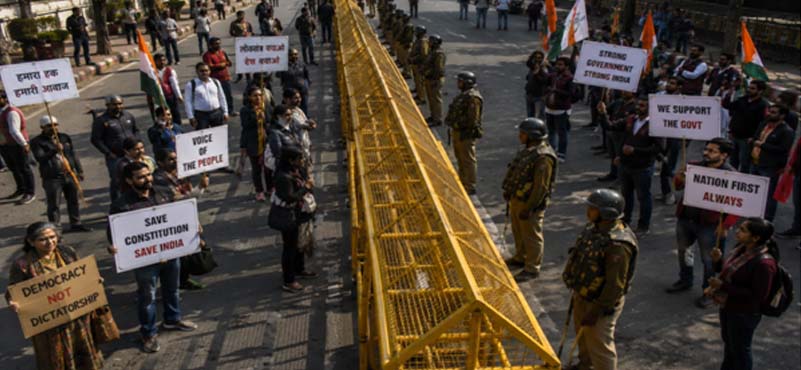
The recent protests across the country once again revealed how swiftly public discourse can harden into opposing camps. Overnight, families, friends, colleagues and communities seemed to align themselves into two competing narratives, each convinced of its own moral certainty. The issue itself is less important than the pattern it revealed. It prompts a larger question: Are we witnessing not merely political disagreement, but the gradual politicisation of society itself? When every public event becomes a test of political identity, politics ceases to be just a means of governing the nation—it begins to shape how the nation thinks, relates and even lives.
This transformation deserves attention because the health of a society depends not merely on the quality of its politics, but on the strength of everything that exists beyond politics.
The Great Alignment
Social media has accelerated this shift in unprecedented ways.
Digital platforms reward engagement, and nothing engages people more reliably than strong emotions. Every click, share and comment teaches algorithms what excites us. Gradually, these invisible systems begin feeding us more of the same until our worldview becomes carefully curated without our even noticing it.
People who once differed on countless issues slowly begin aligning into remarkably uniform political communities. Age groups, professions, castes, regions, religious communities and economic classes increasingly adopt common vocabularies, common heroes, common villains and common narratives. The result is an illusion that everyone around us thinks exactly as we do.
In reality, society remains diverse. Our digital windows simply become narrower.
From Citizens to Tribes
A democracy requires citizens. Social media often creates tribes.
A citizen asks, “Is this policy good for the country?”
A tribesman asks, “Whose side proposed it?”
The distinction is subtle but significant. Once loyalty begins outweighing reason, disagreement becomes betrayal rather than dialogue. Facts are accepted or rejected not on their merit but on their source. The capacity to admire a good idea from an opponent or criticise a poor decision by one’s own side slowly diminishes.
Truth becomes secondary. Tribal identity becomes primary.
The Shrinking Mind
The greatest casualty of perpetual politicisation is not democracy. It is the human mind.
Complex questions are compressed into simplistic binaries. Every issue demands immediate judgment. Every event becomes either victory or defeat. Nuance is mistaken for weakness, moderation for indecision and curiosity for disloyalty.
Over time, intellectual flexibility gives way to ideological rigidity.
Yet civilisation has always advanced because individuals were willing to revise their beliefs when confronted with better evidence. Scientific discovery, philosophical inquiry and spiritual wisdom all begin with humility—the willingness to admit that one may not possess the complete truth.
An ideologically captive mind gradually loses that precious quality.
The Spiritual Cost
Every great spiritual tradition encourages the expansion of consciousness.
Politics, by its very nature, emphasises distinctions—ours and theirs, supporters and opponents, victory and defeat. This is neither good nor bad; it is simply how political competition functions. Problems arise when political identity becomes the dominant identity.
A mind constantly occupied with political conflict finds little space for silence, gratitude or self-reflection. Compassion becomes conditional. Forgiveness becomes rare. Every conversation risks becoming another battlefield. The world’s enduring wisdom traditions remind us that inner freedom begins with detachment—not indifference to public affairs, but freedom from being emotionally imprisoned by them.
A politically aware citizen enriches democracy. A politically consumed individual often impoverishes himself.
The Social and Economic Cost
Polarisation rarely remains confined to elections.
Families avoid meaningful conversations for fear of conflict. Long-standing friendships dissolve over ideological differences. Communities become echo chambers where agreement is rewarded and dissent quietly excluded.
Trust—the invisible currency of every successful society—begins to erode.
The consequences extend beyond social harmony. Economies thrive on cooperation, institutions depend upon public confidence, and innovation flourishes where diverse viewpoints can collaborate freely. Excessive political polarisation weakens all three.
When every institution is viewed solely through a political lens, credibility declines. Suspicion replaces confidence. Cooperation becomes harder. Political friction eventually becomes economic friction.
Recovering the Centre
Politics deserves an important place in public life.
It should never occupy every place. Healthy societies cultivate identities larger than political affiliation. A person may simultaneously be a parent, teacher, soldier, artist, entrepreneur, volunteer, neighbour, believer, scientist and citizen. These overlapping identities create resilience because no single disagreement defines the entire relationship.
History’s strongest civilisations have always possessed institutions capable of uniting people beyond politics—families that nurtured values, schools that encouraged inquiry, cultural traditions that fostered belonging, places of worship that inspired humility, voluntary organisations that promoted service and national institutions that commanded trust across ideological lines.
When these foundations remain strong, politics performs its rightful role. When they weaken, politics rushes in to fill every vacuum.
Society Before Politics
Politics is indispensable to democracy. It shapes governments, laws and public policy. But society is larger than the state, and human beings are larger than their political preferences.
The challenge before modern civilisation is not to become less political but to become more complete.
We must preserve spaces where people can disagree without becoming enemies, debate without hatred and cooperate without demanding ideological uniformity. We must raise children who are intellectually curious rather than politically conditioned, and citizens who seek truth before victory.
Politics should shape governments, not personalities; influence public policy, not private wisdom; inspire citizenship, not imprison consciousness.
For a civilisation ultimately flourishes not when everyone thinks alike, but when free minds, generous hearts and confident institutions remain strong enough to hold diverse opinions together under a shared commitment to the common good.
ABOUT THE AUTHOR
Lt Gen Rajeev Chaudhry (Retd) is a social observer and writes on contemporary national and international issues, strategic implications of infrastructure development towards national power, geo-moral dimension of international relations and leadership nuances in changing social construct.