
Protest and the Mirror
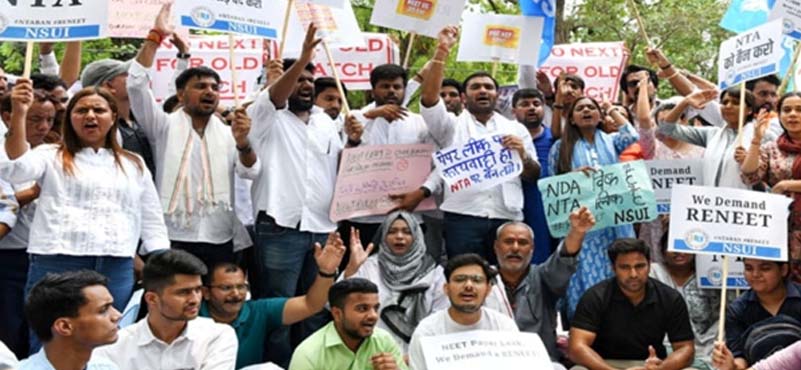
The scenes at Jantar Mantar are both familiar and understandable. Thousands of anxious students, supported by parents and civil society, have gathered to demand the resignation of the Education Minister following allegations of examination irregularities. Their anger is justified. In a country where millions compete fiercely for a handful of opportunities, every leaked question paper is more than an administrative lapse—it is a betrayal of trust. Accountability is the lifeblood of democracy, and those entrusted with public office cannot remain insulated from the consequences of systemic failures. Yet, once the slogans fade and the television cameras move on, a more fundamental question will remain. If the minister resigns tomorrow, will the examination system become honest the day after?
That question forces us to distinguish between accountability and integrity. Accountability identifies who must answer for a failure; integrity determines whether the failure could have occurred in the first place. Democracies rightly demand accountability, but prosperous nations invest in integrity. The former reacts to crises after they occur; the latter designs institutions that prevent crises from recurring. India has become remarkably efficient at changing ministers, transferring officials and constituting inquiry committees. Yet paper leaks recur, recruitment scams resurface and public confidence suffers repeated blows because the underlying architecture remains largely unchanged. We often mistake replacing individuals for reforming institutions.
The real challenge before India, therefore, is larger than the future of one minister or even one ministry. It is whether we are prepared to build institutions where honesty is not dependent upon the character of individuals but embedded in the design of the system itself. Strong nations are not built by assuming that every public servant will always do the right thing; they are built by creating processes that make it difficult to do the wrong thing. That is the difference between governance that survives headlines and governance that shapes history.
Changing individuals may satisfy the public’s demand for accountability; changing institutions alone secures a nation’s future.
Integrity Deficit
The education sector is merely the latest mirror reflecting a much deeper national problem. Examination leaks, recruitment scams, procurement irregularities, financial frauds, regulatory failures and endless judicial delays may appear unrelated, but they all spring from the same source—an erosion of institutional integrity. We often discuss these failures as isolated incidents, searching for individual culprits and immediate remedies. In reality, they are recurring symptoms of a systemic disorder that has quietly seeped into many layers of public life.
Integrity is often misunderstood as a personal virtue, confined to questions of honesty or ethics. In governance, however, integrity is something far more profound. It is the alignment of institutions, incentives and processes with the public interest. An institution possesses integrity when its outcomes remain fair regardless of who occupies the chair. Conversely, when systems depend entirely on the personal rectitude of individuals, they become vulnerable to manipulation, favouritism and corruption. The true test of a nation is not whether it occasionally produces honest leaders, but whether it consistently produces honest outcomes.
This is why India’s greatest governance challenge is not simply corruption; it is institutional fragility. Every scandal chips away at public trust, and trust, once lost, is painfully difficult to restore. Investors hesitate, citizens grow cynical, talented young people become disillusioned and institutions gradually lose their moral authority. The cost of an integrity deficit is therefore measured not only in money lost or examinations cancelled, but in the silent erosion of national confidence itself.
Most public scandals are not sudden failures; they are delayed manifestations of an integrity deficit that has been ignored for far too long.
Why Integrity Is India’s Next Strategic Asset
Integrity has traditionally been viewed as an ethical aspiration. In the twenty-first century, it has become a strategic necessity. Nations today compete not only through military strength or economic output but through their ability to inspire confidence among citizens, investors and the international community. Trust has become an economic multiplier. Capital flows more readily into predictable jurisdictions, innovation flourishes where rules are transparent and institutions command respect, and talent gravitates towards societies where merit prevails over manipulation.
The digital transformation of governance has made this reality even more pronounced. Artificial Intelligence, digital public infrastructure and data-driven administration promise unprecedented efficiency, but technology cannot compensate for weak institutions. It can only accelerate the strengths or weaknesses already embedded within them. Artificial Intelligence, for instance, does not create integrity; it merely scales it. If deployed within transparent institutions, it can detect fraud, improve service delivery and enhance accountability. If introduced into compromised systems, it simply automates inefficiency and magnifies existing distortions.
India’s aspiration to become a developed nation by 2047 will therefore depend as much on institutional credibility as on economic growth or technological innovation. Roads, ports and digital infrastructure remain indispensable, but the invisible infrastructure of trust is equally vital. Nations that master technology without integrity may become powerful; nations that combine technology with integrity become trusted. In an increasingly interconnected world, trust itself is emerging as a decisive instrument of national power.
The defining strategic resource of this century will not merely be technology or talent, but the integrity that makes both trustworthy.
What Singapore Understood
Few nations illustrate this principle better than Singapore. Lacking vast natural resources and constrained by geography, it transformed itself into one of the world’s most trusted economies by treating integrity not as a moral slogan but as a governing principle. Transparent institutions, merit-based appointments, swift accountability and predictable enforcement created an ecosystem where citizens trusted the state, businesses trusted the regulatory framework and investors trusted the future. Singapore did not eliminate human weakness; it designed institutions that made integrity the most rational choice.
Its success carries an important lesson for India. Sustainable national progress is rarely the product of extraordinary leaders alone. It is the result of ordinary institutions performing extraordinarily well over long periods. Leaders eventually change; institutions endure. The countries that command global respect are those where governance remains consistent despite political transitions because the system is stronger than the personalities who temporarily lead it.
Singapore’s greatest export is not capital or technology; it is trust—and trust is the highest dividend that institutional integrity can produce.
Kautilya Never Trusted Individuals
If Singapore offers a modern blueprint for institutional integrity, India need not look beyond its own civilisational heritage for its philosophical foundations. More than two thousand years ago, Kautilya understood that the strength of a state did not depend upon the goodness of its rulers but upon the robustness of its institutions. The Arthashastra was not a sermon on personal morality; it was a manual on institutional design. Kautilya assumed that human beings, regardless of rank or virtue, were susceptible to temptation. His famous analogy—that it is as difficult to know when an official steals from the treasury as it is to know when a fish drinks water—was not an expression of cynicism. It was a call to build systems where temptation was minimised, oversight was continuous and accountability was inescapable.
That philosophy remains remarkably contemporary. Kautilya advocated audits, inspections, rotation of officials, separation of responsibilities, incentives for honest conduct and swift punishment for abuse of office. He did not expect integrity to emerge spontaneously from individual character; he sought to cultivate it through institutional architecture. Modern governance literature has rediscovered these principles under different names—checks and balances, transparency, performance metrics and regulatory oversight. Long before these became fashionable, Kautilya had already recognised that the first duty of the state was not merely to govern efficiently but to govern credibly.
India’s journey towards becoming a developed nation cannot therefore rest solely on technological advancement or economic expansion. It must also rediscover the timeless wisdom that institutions outlast individuals. Our civilisational inheritance does not merely offer moral inspiration; it offers a practical framework for building trustworthy governance in an increasingly complex world.
The greatest tribute India can pay to Kautilya is not to quote him, but to build the institutions he envisioned.
India’s Integrity Revolution
If integrity is the foundation of national progress, then India requires more than periodic anti-corruption drives or administrative reforms. It needs an Integrity Revolution—a comprehensive transformation of the way public institutions are designed, rewarded and sustained. Such a revolution must proceed simultaneously along three complementary paths.
- Institutional Irreversibility. Good governance should never depend upon the integrity of a particular minister, civil servant or government. Systems must be designed so that transparency, accountability and fairness become irreversible features of public administration. Whether in examinations, public procurement, recruitment or service delivery, processes should be digital by default, auditable by design and insulated from arbitrary interference. Leadership should improve institutions, not determine whether they function honestly.
- Incentive Re-engineering. Institutions ultimately reflect the incentives they create. Honest officers should not merely receive praise; they should receive faster career progression, greater responsibility and institutional support. Conversely, corruption should cease to be a low-risk, high-reward enterprise. Detection must be timely, punishment certain and gains reversible. Nations do not become honest because they preach integrity; they become honest because integrity becomes the most rational choice for individuals operating within the system.
- Civilisational Entrenchment. Laws can enforce compliance, but only culture sustains integrity across generations. Schools must teach ethical citizenship as seriously as academic excellence. Universities should celebrate character alongside competence. Civil services, corporations, political parties and the media must consciously nurture a culture where public trust is treated as a sacred national asset rather than a convenient political slogan. India’s civilisational traditions—from Kautilya’s statecraft to Ashoka’s moral governance, from Mahatma Gandhi’s insistence on ethical public life to Dr. A.P.J. Abdul Kalam’s vision of leadership by example—provide abundant inspiration for such a transformation. Integrity must cease to be viewed as a compliance requirement and become part of the nation’s civic identity.

Institutions become strong when integrity is embedded in their design, but nations become great only when integrity is embedded in their culture.
Beyond Resignations
The young people protesting at Jantar Mantar deserve answers, and democracy demands that those responsible for institutional failures be held accountable. Resignations, inquiries and disciplinary action all have their place in a healthy republic. Yet history teaches us that they are only the beginning of reform, never its culmination. The true measure of a nation’s maturity lies not in how often it changes its leaders, but in how effectively it strengthens the institutions those leaders temporarily occupy.
As India stands at the threshold of becoming the world’s third-largest economy and aspires to become a developed nation by 2047, it must recognise that integrity is no longer merely an ethical ideal. It is a strategic resource, an economic multiplier and the foundation of national trust. It determines whether citizens believe in public institutions, whether investors commit long-term capital, whether innovation flourishes and whether technology becomes an instrument of progress or a vehicle for abuse. Every major national ambition—economic growth, technological leadership, social justice and global influence—ultimately rests upon the credibility of the institutions that pursue it.
The protesters at Jantar Mantar may eventually secure the resignation they seek. India, however, should demand something far more enduring.
History remembers those who resigned for their failures; history honours the nations that reformed their institutions. India’s next great national mission is not merely administrative reform—it is an Integrity Revolution.
ABOUT THE AUTHOR

Lt Gen Rajeev Chaudhry (Retd) is a social observer and writes on contemporary national and international issues, strategic implications of infrastructure development towards national power, geo-moral dimension of international relations and leadership nuances in changing social construct.